

On this page
- The short answer
- What you are actually buying when you buy supervision
- What the trials measured: the table nobody else on this page has
- The dose the research used — and what that costs
- You are not choosing between a trainer and nothing
- When a trainer is probably worth it for you
- When it probably is not worth it (and what to do instead)
- What you are not buying
- How to test-drive a trainer before you buy a package
- Frequently asked questions
- What to do next
The short answer
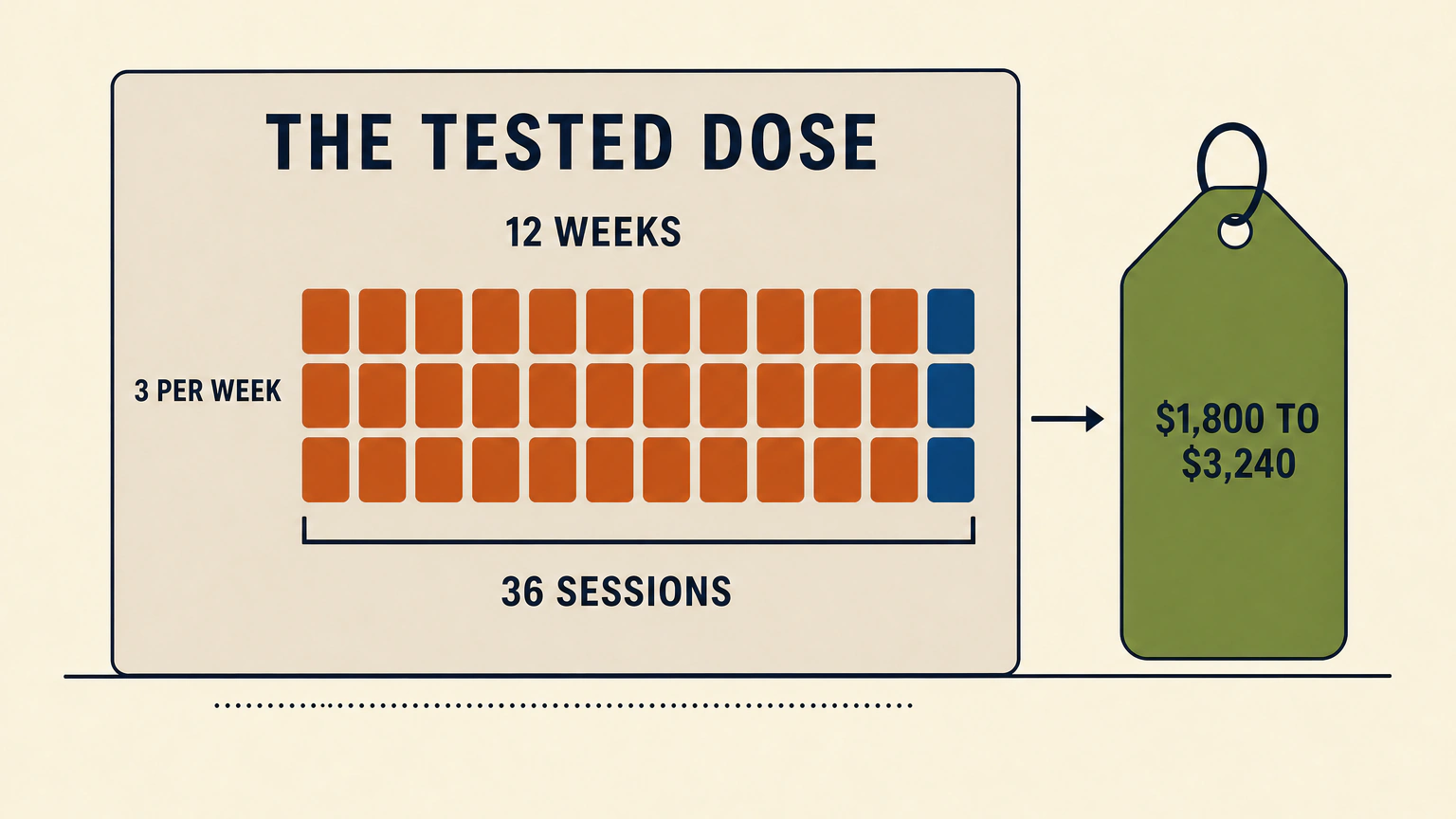
Yes, when what you're buying is supervision you wouldn't otherwise get. The clearest measured effects are on intensity and load, and the findings on attendance are mixed. In a randomized trial run inside a commercial fitness club on its members, twelve weeks of trainer-directed training beat self-directed training on lean mass, chest-press strength, leg power and aerobic capacity, but not on leg-press strength. The dose that produced it was 36 sessions, roughly $1,800 to $3,240 at current US prices.
We list personal trainers, and our guarantee says a business cannot pay to be included or featured on our lists. So we have no stake in whether a personal trainer is worth it for you, only in getting the answer right.
- Worth it if you're new to resistance training, coming back after a layoff or a medically cleared injury, or training regularly and stuck below the intensity that changes anything.
- Probably not worth it if you already train hard and consistently and what you really want is company.
- The honest middle: a small group with a real cap on numbers may buy most of the measured effect for a fraction of the money.
One thing before you read on. This is research about supervised exercise, not medical advice. If you have a medical condition, a current injury, or a long stretch of sitting behind you, talk to a physician before you start training.
What you are actually buying when you buy supervision
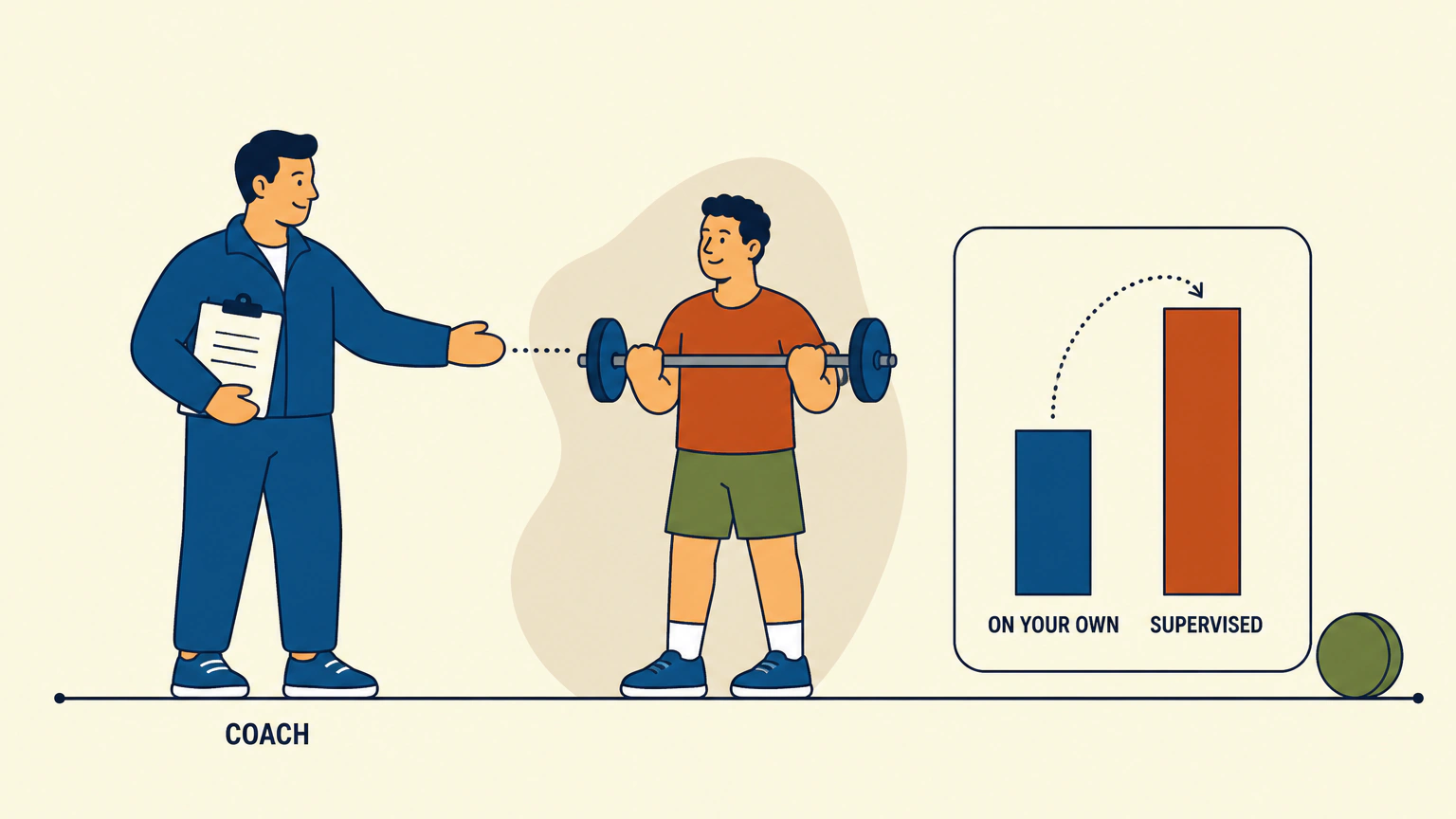
Ask whether personal trainers actually work and everyone selling one says yes. The answerable question is narrower: what changes when a qualified person stands next to you? Mostly two things. The weight goes up, and it goes up faster.
Load: the weight goes up faster
Mazzetti and colleagues randomized moderately trained men to twelve weeks of an identical periodized program, supervised or not. Through the back half of the program the supervised group used significantly heavier loads per set, added weight at a steeper rate, and finished with a greater maximal squat and bench press. Same program on paper. Different weight on the bar.
Intensity: you pick heavier weights than you would alone
Left to ourselves, most of us pick a weight we already know we can move. Ratamess and colleagues asked resistance-trained women to choose the load they'd normally use for ten repetitions on four machines, then measured their true one-repetition maximum. The women training with a trainer had picked about 51.4% of it. The women training alone had picked about 42.3%. It's a snapshot rather than a trial, so it shows an association rather than a cause.
Attendance: sometimes, and not always
This is the benefit every advertisement leads with, and the one the evidence supports least consistently. Coutts and colleagues found that supervised young athletes completed significantly more sessions, and session count tracked with their strength gains. Then set that beside the 2024 meta-analysis of adults over 60, where attendance was 81% in both arms. Showing up is not reliably what you're paying for.
What the trials measured: the table nobody else on this page has
Six sources, taken from the studies themselves rather than from anyone's summary of them. Five test supervision head-on. The sixth pools 34 randomized trials in older adults.
| Study | Who was studied | Design and length | What supervision changed | What it did not change |
|---|---|---|---|---|
| Storer 2014, J Strength Cond Res | 34 male club members aged 30 to 44, one Southern California club | Randomized, 12 weeks, 3 days a week | Lean mass +1.3 kg vs no change (p=0.029); chest press +42% vs +19% (p=0.003); peak leg power +6% vs +0.6% (p<0.0001); VO2max +7% vs -0.3% (p=0.01) | Leg-press strength +38% vs +25%, not significant (p=0.14) |
| Mazzetti 2000, Med Sci Sports Exerc | 20 moderately trained men, mean age 24.6, 18 analyzed | Randomized, 12 weeks, identical periodized program | Faster and larger load increases; greater maximal squat and bench press at week 12 | Both groups gained 1RM and power; endurance at 80% of 1RM was not compromised in either |
| Gentil and Bottaro 2010, J Strength Cond Res | 124 untrained young men | Randomized to a 1:5 or a 1:25 coach ratio, 11 weeks | Knee-extensor torque +11.8% in the 1:5 group only; bench 1RM +15.9% vs +10.22%; more people training at maximum intensity | Training volume and attendance did not differ |
| Coutts 2004, J Strength Cond Res | 42 young rugby league players, mean age 16.7 | Matched groups, 12 weeks | More sessions completed; greater 3RM squat at weeks 6 and 12 and 3RM bench at week 12; larger percentage gains in squat, bench and chin-ups | Both groups improved on every measure; an athlete population, not a general-adult one |
| Ratamess 2008, J Strength Cond Res | 46 resistance-trained women, mean age 26.6 | Cross-sectional comparison, not a trial | Self-selected intensity about 51.4% of 1RM with a trainer vs 42.3% without; higher 1RM values and perceived exertion | Nothing followed over time; the design shows association only |
| Gómez-Redondo 2024, Sports Medicine | 2,830 adults aged 60 and over, across 34 randomized controlled trials | Systematic review and meta-analysis | Greater benefit on knee-extension strength (SMD 0.18, p=0.002), sit-to-stand, timed-up-and-go, gait speed, lean mass (+1.05 kg) and quality of life | Only knee-extension strength stayed significant in sensitivity analyses; attendance 81% in both; no serious adverse events |
Now the limits, and they matter. The five direct-study samples are small, four enrolled only men, and none followed participants for a year.
The study run inside a commercial fitness club on its members
Storer's trial is the closest thing to your situation: men who already belonged to a commercial fitness club, randomized either to a trainer running a periodized program or to directing their own training, three days a week for twelve weeks. The trainer-directed group gained lean mass. The self-directed group gained none.
It's also 34 people at one club, and the leg-press result didn't reach significance. We trust it more for that, not less. A study that publishes the measure which refused to cooperate is telling the truth about the others.
Where the effect gets smaller than the sales pitch
Gómez-Redondo and colleagues pooled 34 randomized trials in adults over 60. Supervised training came out ahead on six outcomes, which sounds decisive right up to the sensitivity analyses, where only knee-extension strength held. Attendance was 81% in both arms.
If you're over 60 and weighing a trainer against a well-designed home program, that's the honest position. Both arms were safe, with no serious adverse events in either. Supervision probably helps. The dependable part is leg strength, and it isn't buying you attendance.
The 30% claim you will see everywhere, and why we are not repeating it
You'll meet this one everywhere: people who work with a personal trainer are 30% more likely to reach their fitness goals. It gets credited to IHRSA, the trade association now called the Health & Fitness Association. On the trainer-marketing and ranking pages we read, it never came with a report name, a year or a method.
So we searched the association's own website for it, and found no report carrying that figure. We're not saying the statistic is false. We're saying we couldn't find a primary source for it, and that is enough to keep it out of a decision this expensive. Do the same with any number a provider quotes at you: ask which study, and ask what year.
The dose the research used — and what that costs
Twelve weeks, three sessions a week, 36 sessions
Storer is plain about frequency: three days a week for twelve weeks, which is 36 supervised sessions. Mazzetti, Coutts and Gentil ran comparable blocks, and the training trials we read lasted eleven or twelve weeks. That is the yardstick. "A few sessions to learn the machines" sits below those doses, and a rolling multi-year commitment sits above them.
What 36 sessions costs in your market
| Market | Typical cost per session | 36 sessions (the tested 12-week dose) | Source |
|---|---|---|---|
| US national average | $50 to $90 | $1,800 to $3,240 | Bark, 2026 |
| Los Angeles, CA | $65 to $80 (average $75) | about $2,700 | Bark, 2026 |
| San Diego, CA | $76 to $85 (average $80) | about $2,880 | Bark, 2026 |
| New York City, NY | $100 to $135 (stated average $100) | about $3,600 | Bark, 2026 |
| Philadelphia, PA | $70 to $95 (average $80) | about $2,880 | Bark, 2026 |
| Palm Beach, FL | $90 to $100 (average $95) | about $3,420 | Bark, 2026 |
Prices come from Bark's US personal trainer price guide, last updated in January 2026. Bark is a marketplace with a commercial interest in these numbers, so treat them as marketplace-reported rather than independent. New York City appears exactly as Bark publishes it: the stated average of $100 sits at the bottom of its own $100 to $135 range, and we have not re-averaged it. We publish no cost panel for personal training and gyms, so the benchmark has to come from outside.
Thirty-six sessions at $50 is $1,800. At $90 it's $3,240. Spread across twelve weeks, that's roughly $150 to $270 a week, and the weekly figure is the one to hold against your budget. A package discount, a semi-private rate or a 30-minute session all bring the total down. So does buying fewer weeks, which buys less of what was tested.
Red flag: before you prepay for a package. A large prepaid block creates cancellation and refund risk, so we'd buy two singles first. If sessions expire, get the expiry date into the contract, not just into the conversation. Treat a "today only" discount on a multi-thousand-dollar commitment as a reason to slow down and read the written cancellation and refund terms. Get the cancellation method and the confirmation you'll receive in writing before you pay. If the money is going to an individual rather than the facility, ask for a receipt naming the entity that received it. California and New York regulate qualifying prepaid health-club contracts that include exercise instruction or training, and our guide to what prepaid lesson contracts look like covers how those protections work.
You are not choosing between a trainer and nothing
The most useful finding in the whole pile isn't about trainers at all. Gentil and Bottaro randomized untrained men to the same program under either a 1:5 or a 1:25 coach-to-athlete ratio for eleven weeks. Only the 1:5 group significantly increased knee-extensor torque, and bench-press strength rose 15.9% against 10.22%. Training volume and attendance didn't differ, and the authors said the greater strength gains were probably due to higher intensity. What the research tracks, then, is supervision density rather than the word "personal," and that turns your decision into a ladder with prices on it.
| Format | Supervision density | Cost per hour | What the research measured at this density | What to ask the provider |
|---|---|---|---|---|
| One-on-one personal training | 1:1 | $50 to $90 per session (Bark, 2026) | Supervised training; the abstracts do not state a coach-to-participant ratio | "Do I get a written copy of my program?" |
| Small-group or semi-private (studio Pilates as the priced proxy) | Commonly small; ask for the cap | $76 per hour average, 666 cost profiles | The 1:5 arm: a significant knee-extensor gain and a 15.9% bench-press gain on identical volume | "What is the maximum class size?" |
| Studio group class (yoga as the priced proxy) | Larger; ask for the cap | $40 per hour average, 909 cost profiles | No trial tested this exact density; the nearest measured point is the 1:25 arm | "How many spots are sold per class?" |
| Large group class (indoor cycling as the priced proxy) | Largest | $26 per hour average, 738 cost profiles | The 1:25 arm still gained 10.22% on bench 1RM but showed no significant knee-extensor gain | "Does an instructor correct individual form?" |
The three per-hour figures are our own published average per-hour rates for those categories, from our cost-profile data. They are a platform aggregate rather than an independently measured market rate, and the panel adapts to your location, so your own numbers may sit higher or lower. Each panel also prints a wider range beside the hourly figure ($182 to $253 Pilates, $145 to $268 yoga, $83 to $114 cycling) that reads as package pricing, so compare per-hour against per-hour. These class formats are priced proxies for supervision density, not substitutes for a resistance-training program.
One-on-one
Maximum supervision, maximum price. The Storer, Mazzetti and Coutts abstracts describe supervised training but do not state the coach-to-participant ratio, so nobody can credit those results to the one-on-one format. Buy it as a defined block rather than an open subscription, and expect the program to be written down.
Small-group and semi-private
The 1:5 arm is the one to want: identical program, same volume, same attendance and better strength outcomes, and the authors said this was probably because intensity was higher. A small-group session capped at five people matches the density where the research measured a real effect, and Pilates studios are the closest commonly priced version of it.
Large group classes
The 1:25 arm still added 10.22% to bench-press strength, which is not nothing. It simply didn't move knee-extensor torque. Hold on to that if your realistic alternative is a $26 class rather than a $0 one, which is the rung yoga studios and indoor cycling classes occupy.
The one question that places any local option on this ladder
Ask every provider the same thing: "What is the maximum number of people in this session?" The answer tells you which arm of the research you're buying. The price doesn't, and neither does the job title. A "small group" selling twenty spots is much closer to the 1:25 arm than the 1:5 arm.
Which supervision level should you pay for?
- Have you followed a structured resistance program before? - No: start at one-on-one, or a small group with a stated cap. - Yes: go to step 2.
- Are you progressing your load month over month? - No: buy one block of one-on-one, then reassess. - Yes: go to step 3.
- Is your barrier technique, or consistency? - Technique: a short one-on-one block, then back to your own program. - Consistency: the evidence on attendance is mixed, so buy a schedule you'll keep, and check the class-size cap before you compare prices.
When a trainer is probably worth it for you
- You're new to resistance training. The most technique to learn, the most load headroom, and load is what supervision moves.
- You're coming back after a long break or a medically cleared injury.
- You train consistently and you're not progressing. Ratamess suggests the likely reason: the weights you choose sit well below what you can actually lift.
- You have a specific dated goal. A twelve-week block maps onto a deadline cleanly.
- You have a diagnosed medical condition and the trainer has specific training to follow procedures prescribed and supervised by a licensed medical professional.
- You have a record of quitting alone inside a month. Book the block and treat the money as the commitment device it is.
Pro tip: buy the learning, not the dependency. Treat a first twelve-week block as a skills purchase. By the end of it you should own a written program, know how to add load week to week, and be able to run a session with nobody watching. Ask on day one what the exit looks like, and whether the written program comes home with you. A trainer who can't describe an endpoint is selling a subscription.
When it probably is not worth it (and what to do instead)
- You already train hard and consistently. Buy a single technique review or a program audit instead of an ongoing block.
- Your budget stretches to four or five sessions. That is below the doses in these studies. Buy small-group sessions for twelve weeks instead, or save until you can buy the block.
- The real problem is diet, sleep or an untreated medical issue. A trainer is not the appropriate professional to diagnose or treat a medical issue or prescribe an individualized meal plan. Start with a physician or a registered dietitian.
- You want company. A class, a training partner or a running club buys that for a fraction of the price.
- The only local option is a very large class at a one-on-one price. Ask the class-size question, then walk.
If you've already bought a package and want out, our guide to how to cancel a program cleanly covers the cancellation steps and the notice rules.
What you are not buying
You are not buying a licensed professional. Personal training is not a state-licensed occupation, so a certification is a voluntary credential rather than a government license. What matters is which body issued it and whether that body is accredited. NASM states that its certified personal trainer program is accredited by the National Commission for Certifying Agencies, a division of the Institute for Credentialing Excellence. Don't take a logo at face value: verify a trainer's certification yourself.
You are also not buying a physician, a physical therapist or a dietitian, and the certifying bodies say so in their own documents. NASM's Code of Professional Conduct requires that a certified professional not diagnose or treat illness or injury beyond basic first aid unless separately licensed, and refer the client to a healthcare professional when nutritional or supplement advice is requested unless the trainer is specifically trained and credentialed to provide it. Its handbook is blunter: personal trainers do not diagnose or treat areas of pain or disease. ACE's published position statement puts individualized meal planning, nutritional assessment, specific calorie or nutrient targets, specialty diets, and recommending, prescribing or selling supplements outside a fitness professional's scope. An offer to do any of that is your cue to walk.
How to test-drive a trainer before you buy a package
- Book two paid single sessions before you consider any package, even when the package rate looks better per session.
- Ask which certification the trainer holds and which body accredits it, then check it yourself in that body's public registry.
- Ask the maximum group size for any semi-private or small-group rate, and get a number, not an adjective.
- Say your goal in one sentence, and see whether the first session includes an assessment before the training starts.
- Ask for the written program after session two. If none exists, you're buying company rather than instruction.
- Watch whether the trainer counts your repetitions and adjusts your load, or watches from across the room.
- Ask what happens to unused sessions: expiry date, refund policy, transferability, and whether the money sits with the trainer or the facility.
- Ask how cancellation works in writing: notice period, method, and the confirmation you receive.
- Check that nothing on offer strays outside instruction: no diagnosis, no injury treatment, no prescribed meal plan, no supplement sales.
- After session two, ask the only question that matters: could you run one of those sessions on your own now?
Frequently asked questions
How much does a personal trainer cost?
Expect $50 to $90 a session in the US, going by Bark's 2026 price guide. City averages run from about $75 in Los Angeles to a stated $100 in New York City. Session length, package size, online versus in-person and gym versus home all move the number.
How many sessions with a personal trainer do you need to see results?
The strongest gym-based trial ran 36 sessions: three a week for twelve weeks. That is the amount of supervision that produced measurable gains in lean mass, chest-press strength, leg power and aerobic capacity. Four or five introductory sessions are below the dose used in that trial.
Is a personal trainer worth it for beginners?
Usually yes, for one block. In the trial comparing 1:5 with 1:25 supervision in untrained men, only the closely supervised group gained knee-extensor strength, while both groups gained bench-press strength. Buy it as a block with an endpoint, and ask for the program in writing.
Is a personal trainer worth it for weight loss?
Not on its own. None of these studies tested fat loss as a primary outcome. Nothing we read establishes that supervision itself produces weight loss, and a standard personal-trainer credential does not include prescribing an individualized meal plan. Food is a dietitian's work.
How often should you see a personal trainer?
The strongest gym-based trial used three supervised sessions a week for twelve weeks. The budget version, one supervised session plus two you run yourself, is not what the studies we read tested, so nobody can promise it works the same.
Why are personal trainers so expensive?
You are buying one professional's undivided hour, and that hour carries floor space, insurance, certification, continuing education and the unpaid time spent writing your program. A $75 session is not a $75 wage. Small-group formats split the same hour between several people.
Can a personal trainer give you nutrition advice?
Only general information. ACE's published position statement puts individualized meal planning, nutritional assessment, specific calorie or nutrient targets, specialty diets, and selling or prescribing supplements outside a fitness professional's scope. NASM's code requires referral to a healthcare professional when nutritional or supplement advice is requested unless the trainer is specifically trained and credentialed to provide it.
How long should you work with a personal trainer?
Think in blocks, not subscriptions. Twelve weeks is the tested unit. At the end of one you should hold a written program, know how to add load, and be able to train with nobody watching. Buy another block when you have a new goal, not by default.
What to do next
Decide your ratio before you shop. The class-size cap, not the job title, is what the research measured. Set your budget against the 36-session benchmark rather than a per-session price, so you know whether you are buying the tested dose or a sample of it. Then compare rated personal trainers near you, and ask each one the maximum-group-size question before you ask about price. If your answer came out "not one-on-one," start from the group-format categories and ask exactly the same question.