

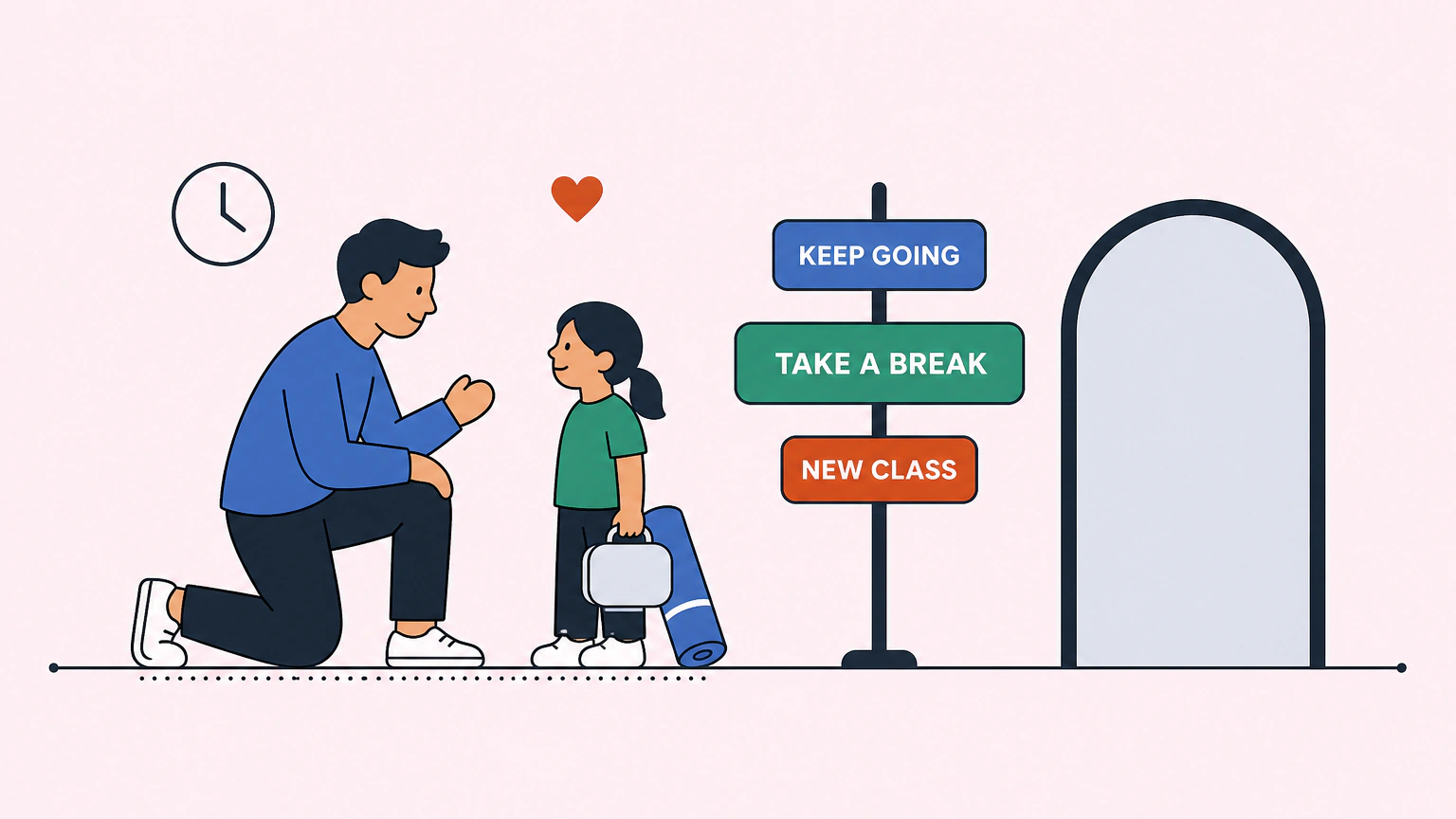
Before you cancel anything, work out which of three things your child is actually quitting. The teacher and the room. The schedule. Or the activity itself. In the Aspen Institute's survey of US parents whose children played sports, most children who left weren't trying another sport: only 15% of the time was a child leaving a sport to try a different one, while 36% of the time they had simply stopped enjoying the one they had. Unless pain, fear or another red flag is involved, finish the session you already paid for, use those weeks to test whether a different instructor, level or class time fixes it, and treat quitting as the answer only when it doesn't.
On this page
The short answer
That's the shape of it. The rest settles three things: whether this is normal for your activity, which of the three problems you have, and what walking away costs. Music, dance, martial arts, gymnastics, swim and tennis, not travel soccer.
Is this normal? What the dropout data actually shows
Almost every parent privately believes her child is the unusual one. She isn't. The honest answer differs by activity, so the numbers stay split.
Organized sports: most of the leaving happens before 13
The American Academy of Pediatrics puts it bluntly: nearly 70% of US kids drop their favorite sport before age 13. The Aspen Institute, with Utah State University's Families in Sport Lab, surveyed 1,032 US parents whose children played sports and found an average start near age 8 and an average run of 2.86 years, which puts the two averages near 11. Parents whose children hadn't played or had been forced to quit weren't sampled. Aspen defined regular participation as at least 35 practice, training or competition days in the previous 12 months. If yours started very young, check whether they started too early for this one.
Music lessons: one study puts most leaving in the teen years
One study puts the heaviest drop-off in adolescence. A survival analysis published in PLOS One in 2021 found about half of students in its sample stopped musical activity by 17, most of them between 15 and 17. The sample was 3,303 students aged 10 to 17 in the UK and Germany, so it isn't American data. Only some students participated more than once, and the authors say the work is better described as a study across ages than a longitudinal study. A nine-year-old sits below the study's age range, so these numbers can't tell you whether their problem is fixable. A different teacher is one thing you can test, and there are piano teachers in your area who teach a completely different kind of student.
Dance, martial arts, gymnastics and swim: nobody is counting
Here's the honest gap. We couldn't find a national US dataset tracking how long children stay in private dance, martial arts, gymnastics, swim or tennis lessons, or a checkable source for the confident "80% quit within two years" figure. The better question is yours to ask: how many kids from last year's class came back this fall? It works at gymnastics programs near you and at the studio you're already paying.
| Activity | What the best available data shows | When most of the leaving happens | Source and scope |
|---|---|---|---|
| Organized youth sports (US) | Nearly 70% of US kids drop their favorite sport before age 13 | Before age 13 | American Academy of Pediatrics, HealthyChildren.org. AAP credits "studies" without naming one, so read it as AAP's own reported figure |
| Organized youth sports (US) | Kids start at around age 8 and stop after 2.86 years on average | Around age 11 | Aspen Institute Project Play with Utah State University's Families in Sport Lab, National Youth Sport Survey, published 2019; 1,032 US parents of young athletes across all 50 states |
| Music lessons and musical activity | About 50% of students stop musical activity by age 17 | Ages 15 to 17 | Ruth and Müllensiefen, PLOS One, 2021; 3,303 students aged 10 to 17 in four UK and eight German secondary schools. Not US data; only some students took part more than once, and the authors call it a study across ages rather than a longitudinal study |
| Dance, martial arts, gymnastics, swim, tennis (private lessons) | We couldn't find a national US dataset tracking how long children stay | Not measured | We couldn't find a national number. Ask your own studio what share of last year's class re-enrolled |
Why the reassurance matters more than the number
Look again at what those parents reported. Only 15% of departures were a child moving to a different sport. In 36%, the child had just stopped enjoying it. Losing interest is the ordinary outcome, not a flaw in your kid, and a run of under three years is the American average.
The three things a child can be quitting
"I want to quit" is one sentence doing three different jobs, and most advice treats it as one. Work out which job it's doing and the decision largely makes itself. Nobody is better placed to do that than you.
The teacher, the group or the room
The most fixable version, and the least discussed. Being the only beginner in the room, or the youngest by two years, or taught by someone whose style suits a different kind of kid, produces exactly the same dragging feet as real disinterest. The AAP's burnout report points at the surrounding adults rather than the sport: "some youth may feel pressure from parents, coaches and others to measure success only by performance," said co-author Dr. Joel Brenner. A child who has decided they're bad at something may simply say it's boring.
The schedule
Sometimes the activity is fine and the week is not. The tells: the complaint is about the day or the time rather than the class, your child is cheerful once they're there, and the resistance started when something else got added. Check the week before you blame the activity. Three days down to one keeps the part they like.
The activity itself
The real version looks different. Your child is calm, even relieved, once the decision is on the table, can name in specifics what they'd rather do, and has felt this way for months rather than since one bad class. All three together isn't a problem to solve. It's an ending to run well.
Working out which one you're looking at
Most of what you have to work with is one sentence your child said in the car. It usually points somewhere more specific than it sounds.
| What your child says or does | What it usually points to | Does changing the class fix it? | First thing to try |
|---|---|---|---|
| "It's boring now" or "I don't like it anymore" | Lost interest, the reason parents reported most often to Aspen (36%) | Sometimes: level, repertoire or format | Ask the instructor what your child has been working on for the last month |
| "Everyone's better than me" | Possible level mismatch or a plateau | Sometimes | Ask for a level reassessment, or four weeks of semi-private lessons |
| "The teacher doesn't like me" or "she yells" | Possible class-climate or instructor-fit problem | Sometimes | Watch a full class, then ask about a different instructor or a different studio |
| "I'm too tired" or "I have too much on" | Possible schedule load | Sometimes: cutting frequency tests it | Try one day a week before dropping the activity |
| Stomachaches on class day, sleep or mood changes | Possible burnout, or something wrong at the class | Not by switching alone | Talk with your child privately; if it keeps up, call your pediatrician |
| "I want to try another sport instead" | Moving to another sport, which parents reported in 15% of cases | Not applicable | Let the switch happen at the end of the session, not mid-week |
| Refuses, gives no reason at all | Information you don't have yet | Unknown until you look | Watch a class before you decide anything |
Watch one full class before you decide
You'll learn more in one full session than in a month of bedtime questions. Count how much of the hour your child is actually moving, playing or holding the instrument. Notice whether the instructor uses their name, and watch what happens the first time somebody makes a mistake. See where your child sits in the group's range of ability. Some studios have a viewing window or an observation week, and asking is reasonable.
Ask the question that gets a real answer
"Do you want to quit?" is a leading question and can produce a quick yes. Ask smaller ones. What's the worst part of class? Who do you stand next to? What would have to change for you to want to go? Then ask the instructor what they've noticed.
When it is not a preference: signals worth taking seriously
Some of what you're seeing may not be about the activity at all. Symptoms that track the class calendar, sleep or mood changes, a sudden refusal with no reason, reluctance to be alone with one adult, pain that doesn't settle. None of it is a reason to argue about attendance.
Red flag: These five change the order of operations. Sudden refusal with no reason after months of going happily: ask open questions somewhere relaxed, not in the car outside class. Unwillingness to be alone with one specific adult: don't require it, and ask the studio about its policy on one-on-one instruction and observation. Stomachaches, headaches or sleep changes that show up on class days and clear on others: note the pattern, and call your pediatrician if it keeps happening. Pain that doesn't settle between sessions: stop training and get it looked at first. Your child asking you not to tell the instructor something: follow the thread gently rather than promising secrecy. The next conversation is with your child, and the call after that is to your pediatrician, not the front desk.
This is general information for parents managing paid lessons and classes, not medical or legal advice. If your child's mood, sleep, appetite or physical symptoms keep changing, or you have any worry about their safety in a program, call your pediatrician.
What to check before you withdraw
Parenting articles skip the money question. It's the one that costs you. The answers sit in an enrollment agreement you signed in August and almost certainly didn't read. They matter most where the calendar carries fees of its own, like martial arts schools in your city with testing cycles and uniform orders.
- Find your session end date, and whether tuition bills per session, per month or per lesson. That decides whether stopping now saves you anything.
- Read the notice clause. Your agreement may require notice by a set date, and it may need to be in writing.
- Check what actually stops the auto-charge. Canceling with the studio and canceling the card charge are sometimes two separate jobs.
- Ask about prepaid packages and unused private lessons: transferable to a sibling, refundable, or expiring on a date.
- Add up what's committed, not just what's paid: recital costumes, competition entries, testing fees, uniform orders.
- Ask what it costs to come back. Next year's re-enrollment fee is part of the price of leaving now.
- Round up rented equipment and get the return deadline in writing. A rental may keep billing until the item is back.
- Ask whether a hold, freeze or reduced schedule exists before you say the word withdraw, even if you haven't seen one advertised.
There is no federal "click to cancel" rule right now
If your studio bills a card every month, you may have heard about a federal rule forcing companies to make canceling as easy as joining. It isn't in force. The US Court of Appeals for the Eighth Circuit vacated the FTC's Negative Option Rule in its entirety on July 8, 2025, on procedural grounds rather than on the merits. The FTC has since conformed its rules to that decision and reopened the question, publishing an advance notice of proposed rulemaking in March 2026. Nothing new is in force yet, and the Health & Fitness Association, the trade group for fitness businesses, filed in support of the challengers. The vacated click-to-cancel rule isn't the whole federal landscape: other federal consumer laws still cover parts of negative-option marketing, and a number of states run their own auto-renewal statutes. Check your agreement and your state attorney general's consumer pages.
Ask about a hold before you ask about a refund
A hold is worth asking about. Some studios offer freezes, reduced schedules, make-up credits or transfers to another class. A hold may keep your spot or rate while you decide. If you're 60% sure you want out, lead with that.
If the answer is a different class, not no class
For a lot of families, the honest outcome isn't quit or don't quit. It's change one variable and decide again in four weeks. That's not dodging the conversation. It's how you find out which of the three problems you had.
Change one thing, not three
Instructor. Level. Format, meaning group to semi-private or the reverse. Or day of the week. Pick one. Change all four and you've bought a new class with no information about what was wrong with the old one. A child who wants to quit "dance" may want to quit one studio's competition track, and a recreational class at one of the dance studios near you is a different listing, not a different life.
What to look for in the next instructor
Ask for a trial class before committing to a semester. Get the make-up policy in writing. Ask what class size looks like on a normal week, then go see it. Watch whether the instructor talks to your child or about your child while your child is standing there. And find the group where yours sits in the middle of the ability range, because the top and the bottom of a class are both lonely.
How to leave the current one well
Give notice in writing, say thank you, and name what your child got out of the time. Then let your child say goodbye instead of just not showing up again. The local teaching community is small. You may want this studio again in two years, and your child is watching how adults handle an ending.
Pro tip: The four-week test. Change exactly one variable, put a date four weeks out on the calendar, and tell your child you'll both decide again then. Write down first what "better" would look like: going without an argument, talking about class afterward, practicing once unasked. Deciding that in advance stops four weeks becoming four months of the same argument.
If the answer is yes, let them stop
Sometimes the answer really is yes, and you can say it without hedging. You're not raising a quitter. You're the parent who paid attention and worked it out.
Make the ending a decision, not a disappearance
Finish the session, the recital or the belt test if it's within reach, then mark the end deliberately. Say what your child got out of it, in specifics, and let them tell the instructor themselves. The AAP frames the goal as keeping kids active and interested in something rather than finishing any particular thing.
What to do with the hours you get back
Leave some of them genuinely empty, on purpose. The urge to fill a freed-up Tuesday with a better-chosen activity is strong and usually wrong: an unstructured afternoon is where kids find out what they like. If your child names a replacement, start it at a natural break rather than next week.
Leaving the door open
Ask three things before the paperwork is done: what the re-enrollment fee is, whether the same level will exist next fall, and how long a spot stays available. If you're stopping mid-rank, find out how close they actually are to the next rank first.
Frequently asked questions
Why do kids quit sports?
Mostly because it stopped being fun. In the Aspen Institute's national parent survey, 36% of departures came down to the child losing interest, and only 15% were kids leaving to try another sport. The AAP adds two contributors: performance pressure from the adults around a child, and year-round specialization.
Should I let my kid quit a sport mid-season?
Usually finish the season or session, for practical reasons rather than moral ones. The money is generally spent, and a team or class has planned around your child's spot. One exception: if the reason is pain, fear or any of the red-flag signals, mid-season is exactly when to stop.
Should I let my child quit piano?
Try one change before you decide. The PLOS study found most musical drop-out in its 10-to-17-year-old sample between 15 and 17, but it didn't study nine-year-olds or test whether their reasons were fixable. Change what they play or who teaches them before you decide whether they stop, unless pain, fear or another red flag means they should stop now.
What do I say to the teacher or coach when we quit?
Keep it short and put it in writing. Say when the last class will be, say what your child got out of the lessons, and name the reason plainly if it's scheduling or money. Then ask whether the spot can be held.
My child wants to quit everything: is that different?
Yes, and treat it differently. A pattern running across every activity may point to load, mood or something that changed at school rather than any one activity. That's a conversation with your child, and possibly with your pediatrician, rather than separate enrollment decisions made one studio at a time.
What do kids learn from quitting?
That depends almost entirely on how it's handled. Walking away from something that isn't working is a real skill, and plenty of adults never learn it. A decided ending, marked and talked about, teaches a child to evaluate and choose. An ending nobody mentions again teaches avoidance.
How do I tell "hard" from "harm"?
Hard can sit inside the learning: nerves before a test, frustration with a piece that won't come together. Warning signs can show up during or outside the activity, including persistent pain, sleep or mood changes, or fear around a particular adult. If something feels wrong, stop and ask your child what is happening before you send them back.
It's 9pm on a Tuesday and you're still deciding. For most families the next step isn't canceling anything. It's watching one full class this week, asking the instructor one direct question, then changing a single variable and giving it four weeks.