

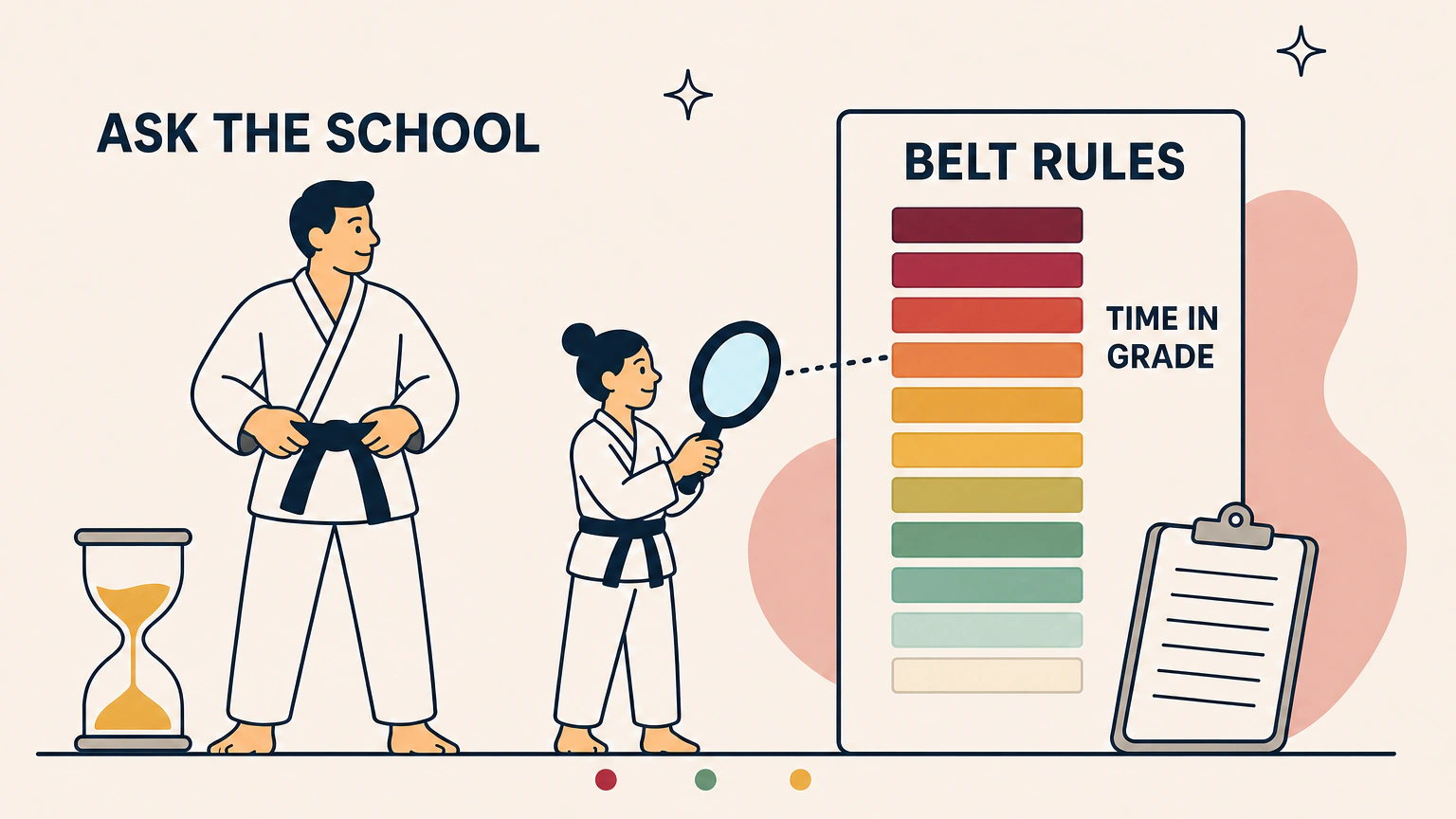
Four organizations have, and we read them. The IBJJF's standard adult path comes to four years and six months after your blue belt is registered, and its rules carry exceptions. The USJF's recommended judo ladder for non-competitors runs four years and five months before Shodan. USA Karate sets a minimum age for a first Dan and no minimum time. Kukkiwon's English regulations index posts an old table with no minimum to a first poom or Dan, and nothing on the page says whether it still applies.
So the useful question is broader than how long does it take to get a black belt: it's who decides, and what they'll put in writing.
On this page
The short answer, and why "it depends" isn't a dodge
Two answers can both be true when they answer different questions. Some pages quote an organization's rule. Others describe what one school happens to do, a different claim in the same words.
Among the four we read, the IBJJF's minimums are mandatory on its standard adult path. The USJF's ladder is a recommendation, and member Yudanshakai may modify it. USA Karate's current policy sets no minimum time to a first Dan. Kukkiwon's English site carries an older table, and its status today is unclear.
What a black belt actually certifies
A black belt records one promotion, made under one instructor's or one organization's standard. Two of them can stand for very different amounts of mat time, because different organizations require different amounts. The rank doesn't travel automatically either.
The two questions that decide your timeline
First: does this school belong to an organization that publishes a minimum time in grade? Second: how many times a week will you actually train? Talent, age and athletic background can also affect the number, but those two set the frame. Start with the first, because some arts have a published answer and some have none.
The arts that publish a minimum, and what the rule says
The IBJJF and USJF documents call the wait between ranks time in grade. It runs from the date your current rank was registered with the organization, not your first class and not the night your instructor tied it on. The IBJJF counts "from the day the athlete completes registration of each belt rank," and the USJF "from the time the candidate's present rank was registered with the National Office."
Brazilian jiu-jitsu: the IBJJF minimums, belt by belt
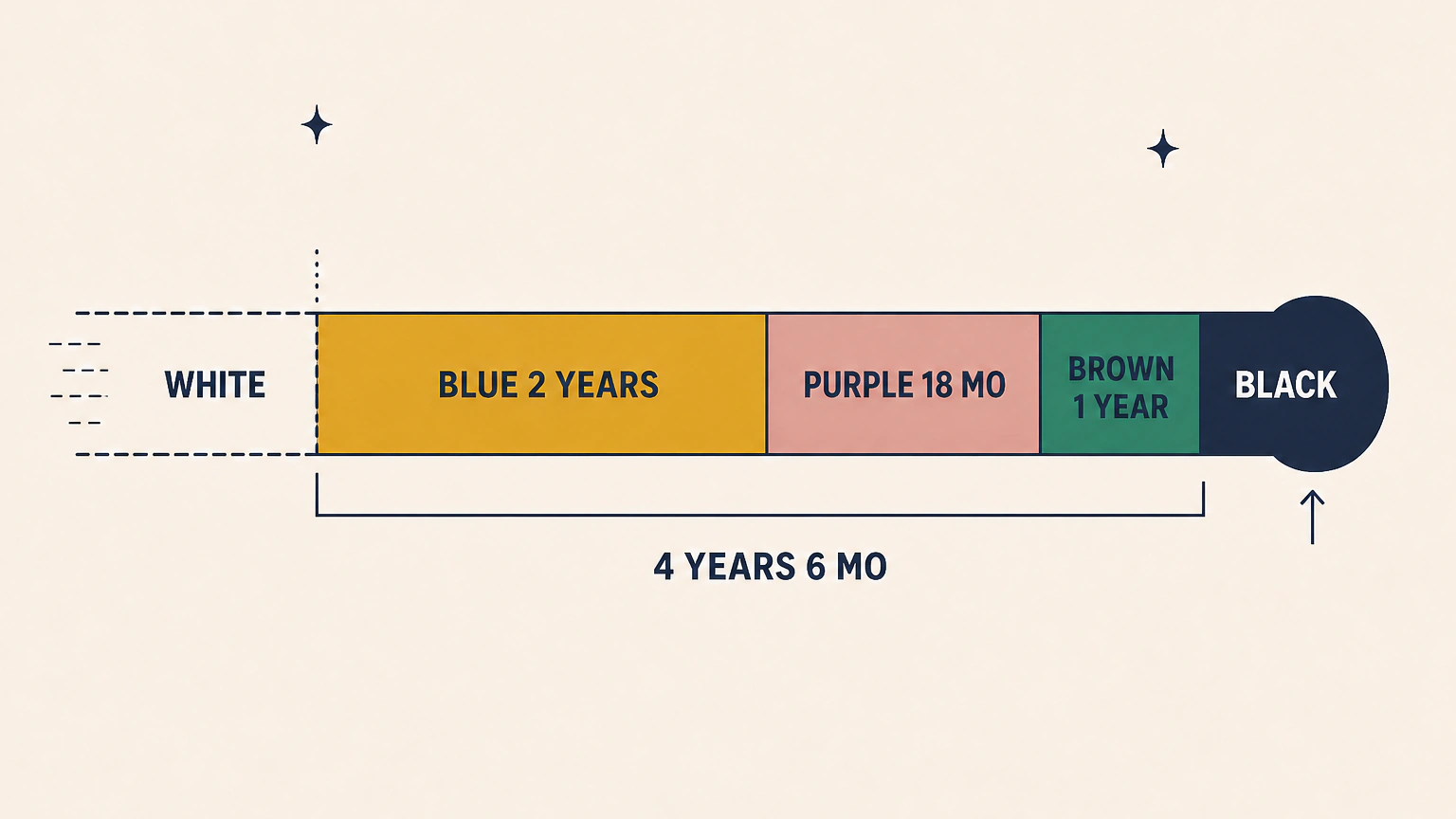
| Step | Brazilian jiu-jitsu, IBJJF minimum (standard adult path, 18+) | Judo, USJF recommended minimum (non-competitor track) |
|---|---|---|
| First colored belt | No minimum at white belt | 12 classes or 1 month (Gokyu) |
| Second step | No equivalent step | 24 classes or 2 months (Yonkyu) |
| Third step | No equivalent step | 5 months at Yonkyu (Sankyu) |
| Fourth step | 2 years at blue belt | 9 months at Sankyu (Nikyu) |
| Fifth step | 1 year 6 months at purple belt | 1 year at Nikyu (Ikkyu) |
| Final step | 1 year at brown belt | 2 years at Ikkyu (Shodan) |
| Total minimum | 4 years 6 months (from blue belt registration; white belt uncounted) | 4 years 5 months |
| Minimum age at black belt | 19, or 18 for an Adult World Champion at brown belt | 14 for Shodan |
The IBJJF figures are mandatory minimums for its standard adult path, and the rules publish exceptions. The USJF figures are guidelines, and member Yudanshakai may modify them. Neither is a promised schedule.
Those figures come from the IBJJF's General System of Graduation. Look at what the sum leaves out: white belt. That time is uncounted and open ended on the standard adult path, so whatever you spend there lands on top of the four-year-six-month total. Published exceptions can shorten the later belts.
Ages are in there too. Blue and purple require 16, brown requires 18. Black is listed at 18 only for an athlete who won the Adult World Champion title at brown, so for everybody else the floor is 19. In the kids' system, ages 4 to 15, there is no minimum period at any belt.
Judo: the USJF time-in-grade ladder
The United States Judo Federation prints its ladder in the Rank Requirement Recommendations Handbook: 12 classes or one month to Gokyu, 24 classes or two months to Yonkyu, five months to Sankyu, nine to Nikyu, one year to Ikkyu and two years to Shodan. Read that title again: these are recommendations, and member Yudanshakai may adopt or modify the guidelines within their promotional authority. Competitor columns reduce several of the time requirements, and a separate batsu-gun route can produce a Shodan promotion at the Summer Nationals.
Time is not the only gate. A club Shodan promotion needs a Form 20, SafeSport and CDC Heads Up certifications, and a background check; SafeSport and the background check are waived for minors. Then comes the exam: three USJF Sandan-or-higher examiners, plus a written essay from the candidate.
What a published minimum does and does not promise
A floor is not a schedule. Under the IBJJF, meeting the minimum earns you the right to be considered, not the belt. The document says the time from white to black "is at the professor's discretion" and that the federation "will only recognize the graduation if it meets the mandatory minimum times." The USJF table is a recommendation that member Yudanshakai may modify, not a federation-wide guarantee. A school quoting four and a half years as typical is quoting a benchmark out of context.
Pro tip: Your clock may have started later than you think. Both published systems count from the date the organization registered your rank, not the day you were handed the belt. A school slow to file has pushed your start date back. Ask to see that registration date.
The arts where your school sets the clock
| Art | Is there a published minimum? | Who publishes it | What is still left to your school |
|---|---|---|---|
| Brazilian jiu-jitsu | Yes, with exceptions | IBJJF General System of Graduation | Whether and when you are promoted, plus white belt time |
| Judo | Recommended ladder, locally modifiable | USJF Rank Requirement Recommendations, Section VI | The Yudanshakai's adopted requirements, examination standards, kata and the promotion vote |
| Karate | No time minimum to first Dan, but a minimum age of 16 | USA Karate (USA-NKF) Dan Certification policy; time in rank starts at 2nd Dan | The timeline before the first Dan test or homologation |
| Taekwondo | Dated English table: no minimum to first poom or Dan; current status unclear | Kukkiwon, which issues poom (1-4) and dan (1-9) certificates | Confirm the current colored-belt timeline and first-test rules |
| Muay Thai, kickboxing, boxing, MMA | No shared ladder reviewed here | No universal rank body cited here | Any local levels depend on the gym or organization |
| Krav maga and most self-defense programs | Not assessed here | No organization reviewed | Any requirements depend on the specific curriculum |
USA Karate's current policy sets no minimum time to a first Dan. Kukkiwon's posted English table sets none to a first poom or Dan either, and it's dated 2010.
Karate: a national dan certificate that recognizes your school's diploma
USA Karate (USA-NKF) is the national governing body, and it does issue dan certificates. Its eligibility chart lays out a 1st, 2nd and 3rd Dan "Cross Rank Recognition" path that runs on your current rank diploma from a recognized member school: a signed application, a fee, Technical Committee approval, and no performance evaluation.
Its Dan Certification policy fills in the rest. Shodan needs a minimum age of 16, or 12 to 15 for a Junior Dan, and no minimum time in rank. The waiting only starts at Nidan, which needs two years at Shodan.
Two doors, then: homologation can follow a recognized school's decision, while a separate testing path lets the national body evaluate candidates directly. Compare karate schools in your area on what they will put in writing.
Taekwondo: poom, dan, and what Kukkiwon's certificate actually is
Kukkiwon is the global certifying body for taekwondo rank, and its English promotion-test page gives you the structure: poom 1st through 4th, dan 1st through 9th, more than 12 million certificates issued, and World Taekwondo events open only to Kukkiwon-certified holders.
Timing is murkier. Kukkiwon's English regulations index links a time-and-age table dated November 23, 2010. That table sets no minimum period for first poom or first Dan, gives periods for later promotions, and places the first-poom/first-Dan boundary at age 15. Nothing on the page says whether it has been superseded, so ask your school for the current Kukkiwon rules rather than planning around a table older than most of the kids on the mat.
Muay Thai, kickboxing, boxing and MMA: no belt to time
These sports don't share one universal colored-belt ladder. Progress tends to be tracked in rounds, in sparring and, for competitors, in a fight record.
Some gyms run their own level or shirt systems, which belong to the gym. We didn't review any Muay Thai, kickboxing or krav maga organization's rules here. At kickboxing gyms near you, ask what a student can do after six months and after a year.
What actually moves your timeline
A published floor tells you the earliest the door can open. Four things decide how far past it you land.
How often you train
The USJF writes its two lowest grades as 12 classes or one month and 24 classes or two months, so the guideline can be met by class count or by calendar time. Be honest about how many nights a week you'll really be on the mat.
Whether you compete
In the two systems we read, competing is a documented accelerator. The USJF's batsu-gun route can carry a brown belt straight to Shodan: enter the USJF/USJA Summer National Championships as a registered member, hold a current brown belt, be at least 14 on the competition date, and in one division beat three or more opponents at brown belt or higher with at least one win by ippon, or five of any rank by ippon. The IBJJF is blunter: it removes the minimum period at blue, purple or brown for an Adult World Champion at that belt.
Kids' belts, junior black belts and the age floors
The IBJJF sets no minimum period at any belt in its system for ages 4 to 15, then requires 16 for blue. The USJF's minimum age for Shodan is 14, and USA Karate's Junior Dan spans ages 12 to 15. Kukkiwon's posted 2010 table starts first Dan at 15 and first poom below 15; confirm that one with the school.
A junior or poom rank is a real rank in its own age band, not a lesser belt. Black belt age requirements tell you when a belt is possible, which is a different question from what age kids are actually ready to start.
Switching schools: what transfers and what doesn't
Registration status can affect whether a rank transfers.
Under the IBJJF, an athlete who registers a brown or black belt without prior registration at the previous rank is "provisional" for two years. You stay under the same professor or academy for that window, and the federation "reserves the right to revoke an athlete's graduation at its discretion." Under the USJF, time in grade counts only from the date your rank was registered with the National Office. USA Karate can cross-recognize a member school's diploma.
So ask about the registration, not just the belt.
When a fast timeline is a warning sign
Red flag: Three claims worth a follow-up question.
"Black belt in two years, guaranteed." Ask which organization's standard backs the guarantee, then go read it. Neither the IBJJF nor the USJF document makes a promise like that, so it's a sales pitch, not a curriculum.
"Testing is required every eight weeks." Ask what happens to the student who isn't ready. A promotion calendar that never slips is a calendar, not an evaluation.
"Our rank is recognized everywhere." Ask which registry the rank is entered in. Recognition means a named organization holds a record, and you can ask for the registration number.
A promise with a date attached
A school that guarantees a black belt within a fixed number of years is promising more than either document we read does. The IBJJF leaves promotion to the professor. USJF promotion is governed by the adopting Yudanshakai's procedures.
That doesn't mean walk out. We'd ask which standard the school follows, and read it before signing.
Testing fees that grow with the promise
Belt tests can carry fees. What's worth a question is a schedule that climbs steeply as black belt gets closer, or mandatory testing on a fixed calendar regardless of readiness.
So ask for the whole schedule through black belt in writing, next to monthly tuition. Our guide to what martial arts classes actually cost covers the money side, and the martial arts category page carries a cost panel built from 668 cost profiles.
What to ask before you enroll
- Which organization is this school affiliated with, and is my rank registered with it?
- Does that organization publish a minimum time in grade, and can I see it?
- What is your own promotion standard, in writing?
- How often do students test, and who decides that a student is ready?
- What does each belt test cost, including the black belt test?
- If we move or switch schools, what happens to the rank we earned here?
Ask all six in one visit, and write the answers down. A school that says "we set our own standard, and here it is" has told you what you need to know.
How to check a school's standard yourself
Find the affiliation, then read the affiliation's rule
Affiliations hide in plain sight: the website footer, the wall, the certificate behind the desk. Get the name, then check whether that organization publishes a promotion document, the way the IBJJF, USJF, USA Karate and Kukkiwon do.
For anything else, search the organization's name plus "promotion requirements" and look for a dated document on its own site. The same habit covers how to verify an instructor's credentials.
When there is no published standard
Plenty of schools answer to no outside organization, and that isn't a strike against them: excellent instructors run their own curriculum.
The questions just change shape. What does your standard look like in writing? How often do students test? And what happens if my child isn't ready on test day? A school that answers those clearly gives you what a federation document would.
Frequently asked questions
Can you get a black belt in two years?
Not under the published ladders. The standard IBJJF adult path totals four years and six months after blue-belt registration, although published exceptions can shorten it. The USJF's recommended non-competitor ladder totals four years and five months, member Yudanshakai may modify those guidelines, and competitors can move faster. USA Karate's current policy sets no minimum time to a first Dan, and Kukkiwon's posted table, dated 2010, says the same for a first poom or Dan.
What is the minimum age for a black belt?
It depends on the organization. The IBJJF puts black belt at 19, or 18 for an athlete who won the Adult World Champion title at brown belt, with brown at 18 and blue and purple at 16. The USJF puts Shodan at 14. USA Karate sets 16 for Shodan and 12 to 15 for a Junior Dan.
Kukkiwon's posted English table, dated 2010, starts first poom below age 15 and first Dan at 15. Confirm that one with the school.
Do competitions get you promoted faster?
In the two systems we read, yes. The USJF's competitor columns reduce several time-in-grade requirements according to points won in sanctioned events, and batsu-gun can take a brown belt to Shodan in one tournament. The IBJJF removes the minimum period at blue, purple and brown for an Adult World Champion at that belt.
Is a kids' black belt the same as an adult black belt?
Not necessarily. The IBJJF runs a separate belt system for ages 4 to 15 with no minimum period at any belt, and requires 16 before a student can hold a blue belt. USA Karate issues a Junior Dan from ages 12 to 15. Kukkiwon's posted 2010 table starts first poom below age 15 and first Dan at 15, so confirm the current rule with the school.
How much does a black belt test cost?
That's set by the school or the certifying organization. Ask whether the test fee is separate from tuition, and get the full schedule through black belt before you enroll, association fees included.
USA Karate separately lists $250 for a 1st, 2nd or 3rd Dan certificate and $150 for a Junior Dan.
How often should a school test students for belts?
There's no single national answer across the systems we read. The USJF publishes recommended class-count or calendar-time minimums at its lowest grades: 12 classes or one month, then 24 classes or two months.
A fixed testing calendar with no readiness gate is worth a question, and so is a school that never tests at all.
Does my belt transfer if I switch schools?
Sometimes. In the examples we read, the paperwork matters more than the belt. The IBJJF treats a brown or black belt registered without prior registration at the previous rank as provisional for two years, and may revoke it. The USJF counts time in grade only from the date your rank was registered nationally.
USA Karate can recognize a member school's diploma, provided you meet its age and time-in-rank requirements.
So take the affiliation question to two or three real schools. Start with martial arts schools near you, bring the six questions to the front desk, and compare answers rather than marketing.
A published standard isn't a promise about what any one school will do, and the promotion call belongs to your instructor or their organization. These rules get revised, so the document on the organization's own site is the one that governs.