

On this page
The short answer, activity by activity
Two things run at once here, and mixing them up is what makes the internet contradict itself. One is developmental: what a child's body and attention span can handle. The other is eligibility: what a program will let you sign up for. National guidance and competition rules are written down. A studio's enrollment policy may live only on its registration page.
| Activity | National minimum age? | Who sets it, and what it governs | What it means when you enroll |
|---|---|---|---|
| Women's gymnastics (competitive, Development Program) | Yes | USA Gymnastics, 2026-2027 Women's Rules & Policies | Level 1 needs the 4th birthday, Level 10 the 9th |
| Women's gymnastics (competitive, Xcel) | Yes | Same rulebook, Xcel chart | Bronze needs the 5th birthday, Sapphire the 12th |
| Gymnastics (recreational or preschool) | No | Nothing above the gym | The gym bound by that chart can still take a 3-year-old in rec class |
| Tumbling classes | Program policy | The studio sets its recreational-class policy | Ask what that class accepts |
| Swim lessons | No, a health recommendation instead | American Academy of Pediatrics | Lessons can begin for many children starting at age 1, as a layer of protection against drowning |
| Organized sports, in general | No | AAP guidance, not a rule | Age 6 proposed as appropriate for most children |
| Dance and ballet | Program policy | The studio sets the starting age for its classes | "Ages 3 and up" is that studio's judgment |
| Martial arts and karate | Program policy for an independent school | National bodies publish competition rules, but the school sets its class policy | Ask whose rule the minimum is |
| Tennis lessons | Program policy | USTA's 2026 rules require age 5 for sanctioned Red Ball events and govern youth competition, not private lesson enrollment | Court and ball size scale by competition stage |
| Piano and music lessons | Teacher or school policy | The teacher or school sets its own starting age | Readiness signs, not a national rule |
| Driver training | Yes, and it is state law | Your state's licensing statute sets the learner-permit age | The only age here that binds legally; check your state DMV |
How to read the "who sets it" column
Three kinds of number sit in that middle column. A governing body minimum is a published rule a club follows to run sanctioned competition, and you can go read it. A health recommendation comes from a medical body and carries no enforcement. A studio policy is a business decision, which is why it changes from one street to the next. Use the first for eligibility, the second to think with, and treat the third as the opening line of a conversation.
Where the age 6 guidance comes from
Many pages answering this question paraphrase one source without naming it. It's the AAP. The thinking underneath that number is worth more to you than the number itself, because it travels to activities nobody wrote a guideline for.
Ages 2 to 5: free play is the program
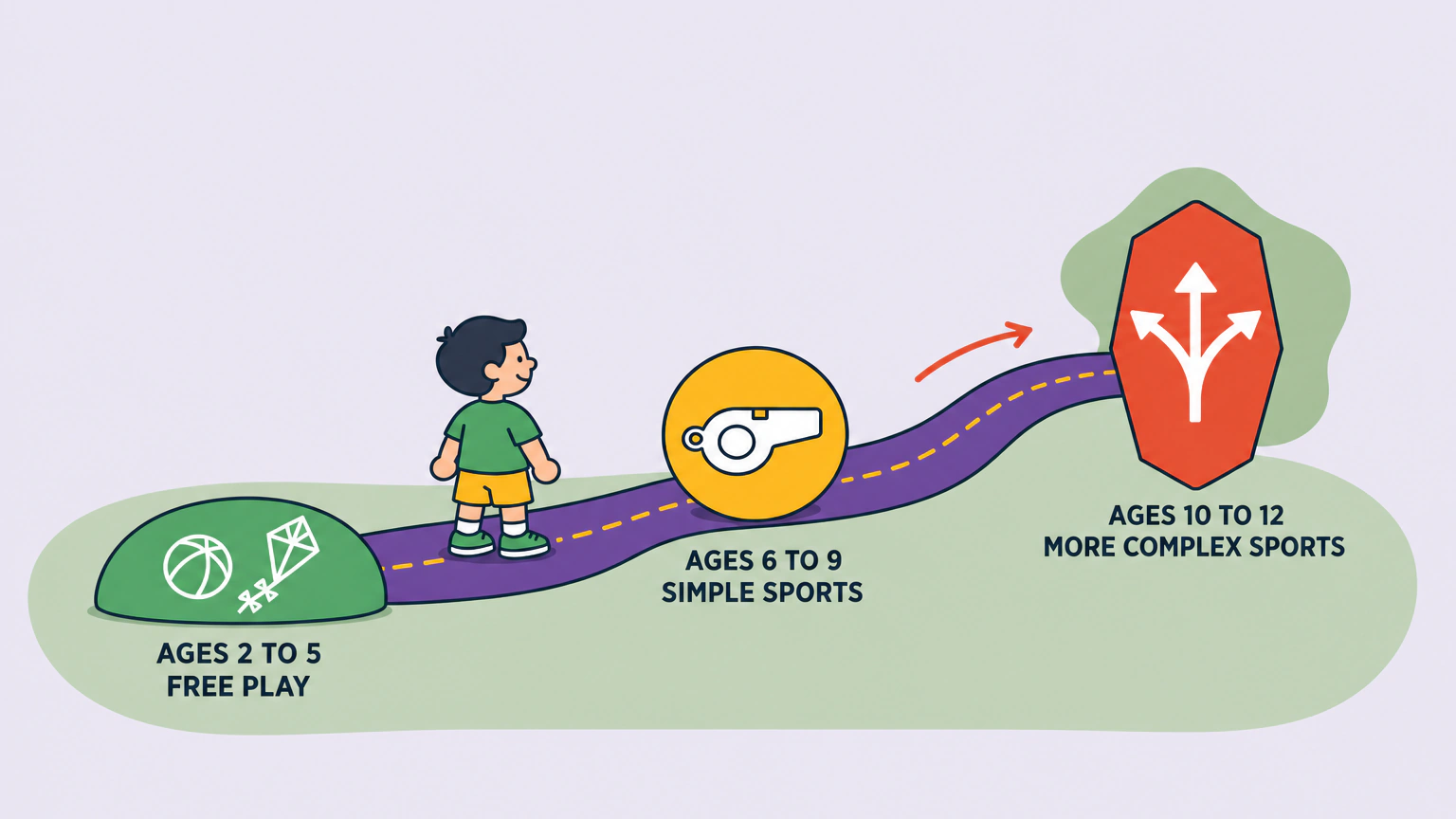
The AAP's position on preschoolers isn't "wait." Its handout for parents says most children under 6 don't yet have the basic motor skills for organized sports, that balance and attention span are limited, and that vision and the ability to track a moving object aren't fully mature. Then comes the part almost everyone skips: look for activities built on running, swimming, tumbling, throwing and catching, skills improved through active play rather than through organized sport. Keep instruction brief, include playtime, avoid competition. Read that way, the 4-year-old rolling sideways down a wedge mat is following the plan. So is the one in your backyard with a kite.
What changes at 6
By 6, most children have the basic motor skills for simple organized sports. The AAP names running, swimming, soccer, baseball, tennis, gymnastics, martial arts and skiing among the activities that adapt well to that level. What stays hard is anything resting on quick decisions and detailed strategy: football, basketball, hockey, volleyball, unless someone modifies them for small players. That list is where the famous 6 comes from. It was never a gate.
What changes at 10
Between 10 and 12 the harder stuff arrives: complex motor skills, teamwork, strategy. Puberty starts for some children in this band and scatters same-age kids across very different bodies, and the AAP is unsentimental about it. An early maturer's temporary size advantage isn't talent. Its guidance for these years still puts skill, fun and participation ahead of winning, because "most children would rather play more on a losing team than less on a winning team."
The readiness bands at a glance
What a child can generally do, and what a class built for that child looks like from the parking lot.
| Age band | What most children can do | What to look for in a class |
|---|---|---|
| 2 to 5 | Limited balance and attention span; object tracking still maturing | Show-and-tell instruction, real playtime, no competition |
| 6 to 9 | Basic motor skills for simple organized sports; teamwork and strategy still hard | Flexible rules, scaled equipment, skills over the score |
| 10 to 12 | Complex motor skills, teamwork and strategy; puberty splitting same-age bodies | Skill development, fun and participation ahead of winning |
Source: American Academy of Pediatrics, "Is Your Child Ready for Sports?"
Who actually sets a minimum age, and who doesn't
Here is the finding, stated plainly. USA Gymnastics publishes a level-by-level minimum for its Women's Development and Xcel programs. USTA and USA Karate also publish competition age rules, while the AAP gives medical guidance for swim lessons and organized sports. For ordinary lesson enrollment, the program usually sets the starting age.
Women's gymnastics publishes level-by-level minimums
USA Gymnastics writes its age rules down in the 2026-2027 Women's Rules & Policies. What matters as much as the ages is what they govern: entry into the Women's Development and Xcel programs, not enrollment in every recreational class. The rulebook describes Levels 1 to 3 as usable inside a gym's pre-team program, and a gym can also run preschool classes outside that competition ladder. If competition is the direction you're heading, compare gymnastics classes near you on whether they run a team at all.
Development Program
| Level | Minimum age |
|---|---|
| 1 | 4th birthday |
| 2 | 5th birthday |
| 3 | 6th birthday |
| 4, 5, 6 and 7 | 7th birthday |
| 8 and 9 | 8th birthday |
| 10 | 9th birthday |
Xcel
| Division | Minimum age |
|---|---|
| Bronze | 5th birthday |
| Silver | 6th birthday |
| Gold | 7th birthday |
| Platinum | 8th birthday |
| Diamond | 9th birthday |
| Sapphire | 12th birthday |
Source: USA Gymnastics, 2026-2027 Women's Rules & Policies, Development Program and Xcel age and entry charts. The gymnast must have reached the birthday shown. These ages govern entry into sanctioned competition, not enrollment in a recreational class.
Swim: a recommendation, not a minimum
Swim is the one category where starting early is a safety argument rather than a head start. The AAP recommends swim lessons "as a layer of protection against drowning that can begin for many children starting at age 1," and it points parents of toddlers and preschoolers toward parent-child classes. That's a recommendation rather than a minimum, and it's hedged on purpose. Children develop at different rates, and your child's doctor can tell you where she is. The AAP is just as firm about what lessons don't do. They don't make a child drown proof, and constant close supervision plus blocked access to the water stay your job. Check swim lessons in your area and ask what the youngest class accepts.
One note, then we'll leave it alone: this is general information rather than medical advice, and your pediatrician knows your child in a way no article can.
Dance, martial arts and music leave the age to the program
We couldn't find a national lesson minimum for ordinary dance, ballet, karate, tumbling or piano programs. National sport bodies may publish competition rules, but an independent local program sets its own enrollment age. The minimum age for a dance class is one owner's read on attention span, room size, and how many 3-year-olds she wants on a Wednesday at four. That isn't a scandal, but it does mean the number tells you about the studio rather than about your child. Two studios a mile apart can print 3 and 5 for the same kind of creative-movement class because each is describing its own room, teacher and routine. So compare the programs: sit in on local dance studios rather than sorting them by the flyer, and judge piano teachers in your city on how they teach a five-year-old.
Where federal safe-sport rules reach
Federal law designates the U.S. Center for SafeSport and tells it to "exercise jurisdiction over the corporation and each national governing body with regard to safeguarding amateur athletes against abuse." The corporation is the U.S. Olympic and Paralympic Committee, so USA Gymnastics and clubs inside its system follow a national safety framework. A separate section of the same law also covers some amateur sports organizations outside that system when they take part in interstate or international competition and have adults in regular contact with minors. An independent local studio may sit outside both groups, but that depends on how it is organized and what competitions it enters. None of these federal safe-sport provisions sets a starting age for ordinary lessons.
Readiness signs that matter more than the birthday
You can watch for most of this over one weekend, without an appointment. None of it is a test, and a child who misses several isn't behind. It's a way of asking whether this class, this fall, fits her.
- She can follow a simple instruction from an adult who isn't you.
- She can stay with an activity long enough to take part without constant redirection.
- She can separate from you for the length of the class without distress.
- She can take a turn and wait for it, without the waiting ending the session.
- She does the activity when nobody is watching, not only when she's praised for it.
- She can manage the basics the class assumes: a bathroom trip, her own shoes, a water bottle.
- She can be corrected without shutting down.
- She has asked about the activity more than once, unprompted.
Watch one class before you decide
Sit through a session in the age group your child would actually join, not the showcase group, and watch the children rather than the instructor. Are they moving most of the time, or waiting in line most of the time? Does the coach get down to their height? The AAP's own test is refreshingly unclinical: a sign of a good program is children having fun.
The signals that mean wait a season
If she melts down at drop-off week after week, or the class ends in a conversation about her behavior every time, a season off is a real option. Children develop at different rates, as the AAP keeps saying. Starting in January instead of September is not a lost year.
How to check a program's real minimum before you pay
Registration weeks reward the parent who asks four blunt questions before the deposit rather than after. None of them is confrontational, and a good program answers them directly.
Four questions to ask at registration
- What's the age of the youngest child currently in this class? The published minimum is a floor; the roster is the room she walks into. A good answer is specific and arrives without hesitation.
- What happens if she isn't ready? Listen for a mechanism: a move to a younger group, a paused month, an extended trial. "We'll work with you" is not a policy.
- Is that minimum yours, or a governing body's? For an ordinary lesson, the answer is often "ours." If the program cites a governing body, ask to see the rule.
- What's the refund or transfer policy in the first month? Ask for it in writing, and read the part about stopping mid-session.
Red flags at sign-up
None of these means a program is bad. Each one means you ask one more question before you pay.
Red flag: The minimum age is quoted as a rule and nobody can say whose rule it is. Ask whether it's the program's own policy or a governing body's requirement.
Red flag: The trial class is a different age group than the one your child would join. Ask to observe the actual class.
Red flag: A long commitment comes before any trial. Ask for the first-month transfer or refund policy in writing.
Red flag: The class you're shown is visibly older or more advanced. Ask what the current age range in that group is.
Red flag: Registration gets pushed before you've seen a class run. Say you'll decide after watching one. A program comfortable with that is telling you something.
If your child is under the minimum
An under-age answer isn't a wasted fall. A competitive minimum does not always bar a recreational class, and a studio may offer a younger group than the one on the first flyer you saw.
Parent-and-me and preschool tracks
These programs give younger children a place to move before a competitive track fits. In gymnastics that means the pre-team levels the rulebook describes for in-gym use. In swim it's the parent-child toddler and preschool classes the AAP points families toward. In dance, creative movement. A good one is short, loud and mostly play, with a coach who expects a four-year-old to wander off and brings her back without making it a thing. Trouble sitting still is age-appropriate behavior, as the U.S. Center for SafeSport tells parents.
What to do for the year in between
Take the AAP's own list as the curriculum: running, swimming, tumbling, throwing and catching. All five improve through active play, which means a park, a pool and a ball can build the skills the AAP names. If you want structure anyway, sample a few activities in short seasons instead of committing to one. The AAP cautions against early specialization and year-round training for the same reasons SafeSport does: overuse injury, mental stress and burnout. A term of martial arts schools near you and then a term of swimming is exactly the pattern both of them recommend.
Finding programs that take your child's age locally
Start from the category rather than the studio, since the enrollment answer lives in the roster and not in the marketing. Our gymnastics category is built from 591 local provider cost profiles and swim from 861, our own count of the providers we've profiled rather than a market survey. Filter for what a program accepts, call two, go watch one. Once she's old enough the next question is money, and what a year of martial arts classes actually costs covers what the flyer leaves out.
Frequently asked questions
What age can a child start gymnastics?
Recreational and preschool classes can open below school age, and the gym sets that enrollment policy. For sanctioned women's competition the rule is published: USA Gymnastics requires the 4th birthday for Development Program Level 1 and the 5th for Xcel Bronze. One gym can run both tracks, so ask which one the class belongs to.
What age can kids start dance class?
No national body sets a minimum. Some studios open creative-movement classes to preschoolers, and the age on the flyer is that studio's judgment about attention span and independence rather than a national lesson rule. Two studios in one town can print different numbers for the same class.
What age can you start swim lessons?
The AAP recommends swim lessons as a layer of protection against drowning that can begin for many children starting at age 1, with parent-child classes for toddlers and preschoolers. It also says children develop at different rates, and suggests deciding with your pediatrician. Lessons are one layer, never a substitute for supervision and barriers.
What age can a child start martial arts?
National karate bodies publish competition rules, but an independent martial arts school sets its own lesson minimum, so the advertised age tells you about that school. Judge the program instead: ask the age of the youngest child in that class now, and watch it run before you enroll.
What is the best age to start piano lessons?
There's no single national lesson minimum, so the teacher decides what readiness looks like. Ask for a short trial lesson and watch whether your child can reach the keys comfortably, follow the teacher and stay engaged.
What age should kids start competitive sports?
The AAP's guidance is that children shouldn't play competitive win-or-lose sports until they understand their self-worth isn't tied to the outcome of the game. Even at 10 to 12, when most children can handle more complex motor skills and strategy, it says the emphasis should stay on skill development, fun and participation.
Is my child behind if she hasn't started anything yet?
No. The AAP's framing is that children develop at different rates, and before 6 the recommended activity is free play building the same running, swimming, tumbling, throwing and catching skills a class would teach. A child who spent this year at the park has been training for the thing you're about to sign her up for.