

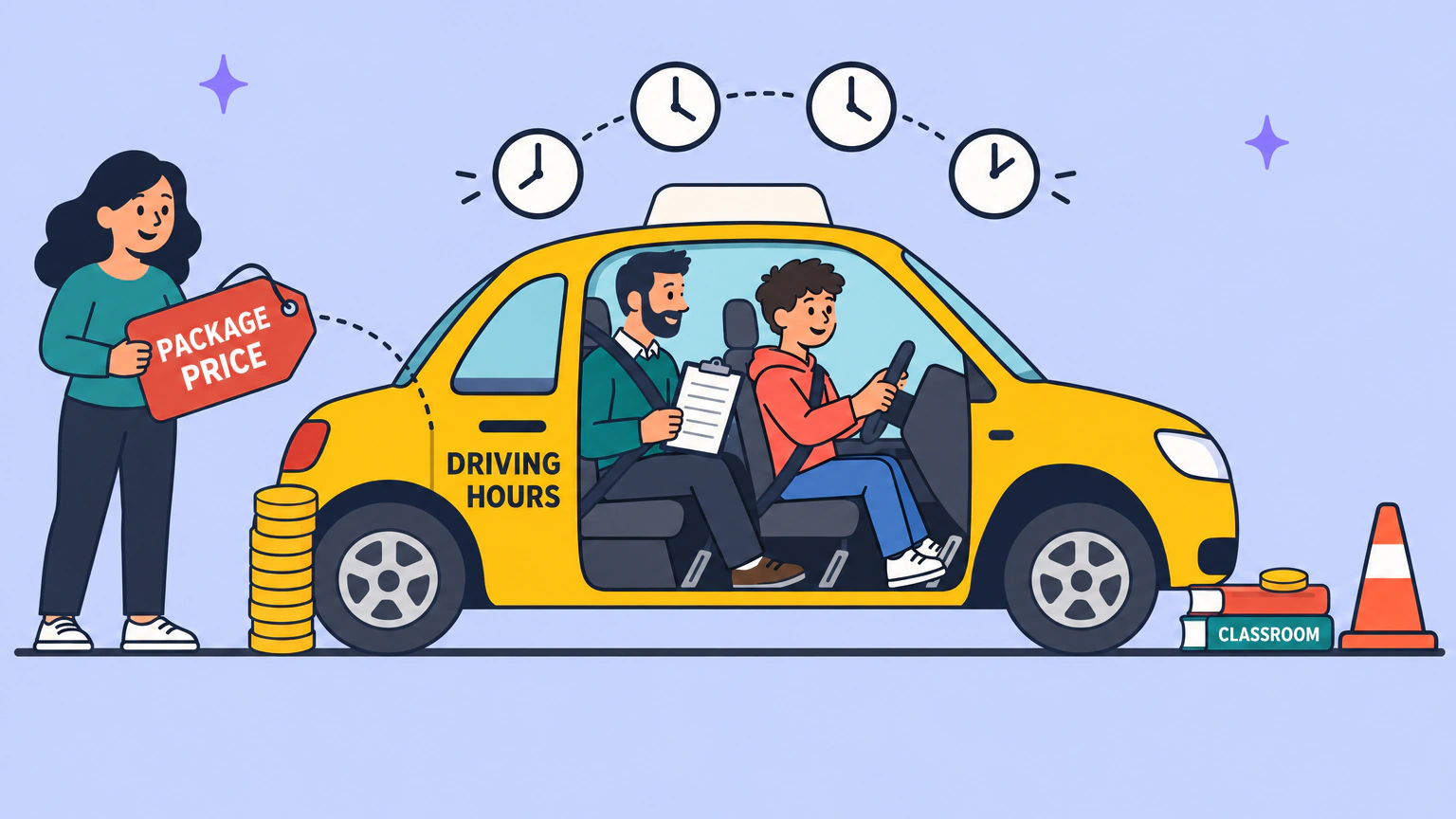
At the driving schools whose price lists we read in Texas, California, Washington and Ohio, a full teen package costs $479 to $599. In Massachusetts, where the law asks for 12 hours of driving instead of six to eight, it's $1,199. Most of that money buys time in the car: $62.50 to $83.17 for each hour your teen actually drives. Through a North Carolina public school the course costs $65 at most, and Delaware students get one course free.
On this page
The short answer: you're paying for hours in the car
Strip away the logos and a teen package is two things. There's a classroom course, often online, and there's a set number of hours behind the wheel, which means your teen drives while a licensed instructor sits beside them. Your state sets the minimum hours, and that minimum moves the driving school cost more than anything a school does.
Ohio's Drive to Succeed program puts typical teen training there at $400 to $900.
A class for a traffic ticket is a different product at a different price.
What six driving schools actually charge
Here's what six schools in five states publish for a full teen package, and what the driving costs once you pull the classroom out.
| School | What the package includes | Package price | Price per hour of driving |
|---|---|---|---|
| Driving School of North Texas, Allen, Texas | 24 hours of classroom, 7 two-hour lessons (1 hour driving and 1 hour watching in each), permit test | $479 | $64.29, from the $450 driving-only price |
| SOC Driving School, Orange County, California | 6 hours behind the wheel, online driver's ed included | $499 | $83.17 |
| Vision Driving School, Edmonds, Washington | 30 hours of online class, 6 hours behind the wheel, 1 hour watching | $545 | No driving-only price listed |
| Youth Driving Schools, Ohio | 24-hour online class, 8 hours behind the wheel | $575 | $62.50, from the $500 driving-only price |
| Professional Driving School, Cleveland area, Ohio | 24 hours of classroom, 8 hours behind the wheel | $599 | $74.88, from the $599 driving-only price |
| CMSC Driving School, West Boylston, Massachusetts | 30 hours of classroom, 12 hours driving, 6 hours watching, parent class | $1,199 | $66.67, after taking out the $399 classroom price |
Prices as each school published them. Price per hour of driving is our arithmetic: the school's driving-only price, or the package minus its classroom price, divided by the hours the student drives.
Divide out the driving and the gap nearly closes. At five schools in four states, an hour at the wheel costs between $62.50 and $83.17, even though the packages run from $479 to $1,199. Six price lists are examples, not a survey, but the pattern is hard to miss.
Why the Massachusetts price is so much higher
The state sets the hours, so the state sets most of the price. Massachusetts law requires 30 hours of classroom, 12 hours of driving and 6 hours of watching another student drive. A parent has to sit through two hours of class too.
The other states ask for less time at the wheel. California wants 30 hours of driver education and 6 behind the wheel. Washington wants 30 hours of class, 6 behind the wheel and at least one hour of watching. Ohio sets 24 and 8. Texas asks for 24 hours of class, 7 driving and 7 observing.
A little multiplication proves the point. Twelve driving hours at about $67 each is the Massachusetts bill, and six at $83 is the California one. For the rules elsewhere, check how many hours your state requires, and find out whether your state requires the course at all before you pay for one.
The classroom half is the cheap half
Online, the classroom part costs very little. SOC Driving School in California sells its online course for $30, and Youth Driving Schools in Ohio charges $75. Two Texas online courses, DriversEd.com and Aceable, list $69 and $74, both marked down from a $115 regular price. A real classroom costs more: CMSC in Massachusetts sells classroom-only for $399.
The telling case is Professional Driving School in the Cleveland area. It charges $599 for 24 classroom hours plus 8 hours of driving. Students who did their classroom online pay the same $599 for the 8 hours of driving alone. The classroom is thrown in.
At these schools, when two quotes differ, the difference is usually in the car.
How to compare two quotes
The math takes three steps. Start from the package price, take off what the classroom or online course costs on its own, and divide what's left by the hours your teen is actually driving.
That last part trips people up. Some states require hours in the back seat, watching another student drive, and those hours count toward the course. They just aren't driving. Driving School of North Texas lists its package as "14 hours driving lessons," and each two-hour lesson is one hour driving and one hour watching.
That same school sells seven two-hour lessons on their own for $450. That's $32.14 for each hour in the car and $64.29 for each hour at the wheel. The second number is the one to compare.
The one-line math: Take the package price. Subtract what the classroom or online course costs on its own. Divide by the hours your teen is actually driving, not watching. At the five schools where we could run that math, the answer landed between $62.50 and $83.17.
Timing changes what extra hours cost, too. At Professional Driving School, stepping up from the 8-hour package to the 10-hour one adds $60, while a single two-hour appointment bought later costs $150. SOC Driving School's 8-hour and 10-hour packages both work out to $80 an hour. Driving School of North Texas sells two extra lessons for $180, and Stanwood High School in Washington charges $45 for an extra hour.
The paid hours are the scarce ones, though. Most of a new driver's practice happens between lessons, with you in the passenger seat.
What the package price leaves out
Three charges sat outside at least one package we checked, and each one has a question that drags it into the open.
Test day is the big one. Professional Driving School charges $150 to use its car for the driving test. SOC Driving School sells a $249 test-day service: the school drives your teen to the DMV, and your teen tests in the school's car. Vision Driving School in Washington charges $625 instead of $545 for the package that adds the state knowledge exam and the driving exam in its car, an $80 difference. Stanwood High School, a state testing center, lists $25 for the knowledge test, $35 for the skills test and $20 for a retest. Ask about the test car early.
Missed lessons come next. Stanwood lists a $45 no-show fee, and Walla Walla Public Schools charges $50 for a missed drive without 24 hours' notice. Find out how much notice a school needs before you book a lesson on the afternoon of a game.
Then there's paperwork. Both Ohio schools we priced charge $15 for a replacement certificate, which feels like a small fee until the original goes through the wash.
The state's own fees are a separate bill, paid to the licensing agency rather than the school. Delaware's Class D license fee is $40, for example, and Texas charges $20 just to authorize a parent as the instructor. Budget for those on top of whatever the school quotes.
The cheaper routes: school courses, state programs and teaching it yourself
Before you pay a commercial school's full price, make one call to the high school and one search for your state's program. Eight of the nine states we read have a current rule or program that brings the drivers ed cost down, sometimes to zero. Washington expects its voucher in January 2027.
| State | What it does | Who it covers | Where it's written |
|---|---|---|---|
| Delaware | One free driver education course | Residents enrolled in a Delaware public, private or home school | 14 Del. Admin. Code 540, section 1.1 |
| North Carolina | Caps the school district fee at $65 and requires a way to reduce or waive it for hardship | Students taking the course through their local school board | N.C. Gen. Stat. 115C-216(g) |
| Illinois | Caps the school district fee at $50, or $250 after a public hearing, and waives it for students who can't pay | Students taking the course at their high school | 105 ILCS 5/27-815 |
| Minnesota | Bars school districts from charging more than the course costs them | District-run courses, which must be open to 15-to-18-year-olds who live or go to school in the district | Minn. Stat. 123B.36, subd. 1(b)(6) |
| Oregon | Pays approved providers up to $210 a student, plus a scholarship of up to $75 | Students in ODOT-approved courses; the $75 is for teens 15 to 18 whose families qualify for meal assistance | ODOT Transportation Safety Office |
| Texas | Lets a parent teach the course for a $20 state fee plus the price of an approved curriculum | Teens whose parent passes the state's instructor checks | Texas Department of Licensing and Regulation |
| Ohio | Drive to Succeed scholarships, paid straight to an approved school | Ohio residents 15 and a half to 20 with a permit and proof of SNAP, Medicaid, WIC or Summer EBT | Ohio's Drive to Succeed program site |
| Georgia | Grant scholarships for the 30 classroom hours and 6 driving hours | Residents 15 through 17 with a Georgia permit or license; two priority groups go first | Georgia Driver's Education Commission |
| Washington | A voucher for some low-income drivers, expected to start in January 2027 | Not published yet | Washington State Department of Licensing |
These are the nine states where we read the rule or the program page ourselves. Other states may run programs too, so call your high school and your state's highway safety office before you pay full price.
Your high school may run the course, and some states cap the fee
North Carolina is the clearest case. Its local school boards must offer driver education, and the law lets them charge "a fee of up to sixty-five dollars." A board that charges has to offer a way to reduce or waive the fee for families facing hardship. Wake County and Guilford County both charge $65, and Guilford publishes a fee waiver form.
| Program | What you get | Price |
|---|---|---|
| Wake County Public School System, North Carolina | 30 hours of class, 6 hours driving, 6 hours watching | $65 |
| Guilford County Schools, North Carolina | The district's course, taught by its contracted driving school | $65, with a fee waiver form |
| Walla Walla Public Schools, Washington | Traffic safety course at the high school | Free for district students and residents; $450 from outside the district |
| Stanwood High School, Washington | 34 hours of class, 6 hours driving, 6 hours watching | $500 |
| Polytech Adult Education, Delaware | 30 hours of class, 14 hours of driving and watching | $710 plus a $40 registration fee |
Illinois lets a district charge "a reasonable fee, not to exceed $50," or up to $250 after a board resolution and a public hearing. Either way, the district has to waive it for a student who can't pay. In Minnesota, a district can't charge more than the course costs it to run.
Delaware goes furthest. Every resident student, in public, private or home school, gets one free course. A student who doesn't pass it can take an adult program for a fee, and Polytech Adult Education lists $710 plus a $40 registration fee.
Washington's two examples show how far apart school-run prices can sit. Walla Walla's course is free to its own students, while Stanwood High School charges $500, about what a commercial school does. So ask. Don't assume.
Scholarships and subsidies in Ohio, Georgia and Oregon, with Washington expected in 2027
Ohio's Drive to Succeed scholarship is for Ohio residents aged 15 and a half to 20 who hold a temporary permit and can show SNAP, Medicaid, WIC or Summer EBT eligibility from the past 12 months. If your teen is under 18, you'll also need to finish the state's online Parent Orientation Course. The money goes straight to a school on the state's approved list, and it "can not be used to reimburse students." Awards are first come, first served, so apply early.
Georgia's Driver's Education Grant Scholarship covers the 30 classroom hours and 6 driving hours that the state's Joshua's Law requires. It's open to residents aged 15 through 17 with a Georgia permit or license. First priority goes to children of first responders disabled or killed in the line of duty, children of service members killed in action, and teens in state custody. Financial need comes second. Within a level, winners are drawn at random and spread evenly across the state's congressional districts. Awards go out on the first of each month. A student can apply only once, though a rejected application is reconsidered automatically for the next two months. The scholarship has to be awarded before the first class, and the commission doesn't require schools to refund a family that paid while it waited.
Oregon pays approved providers up to $210 a student "for the purpose of keeping student cost as low as possible." Public programs can't make a profit, and commercial schools can keep up to 12 percent. Teens from families who qualify for meal assistance can get up to $75 more. ODOT's own policy words that test differently, so ask the provider whether your family qualifies. Finishing an approved course also cuts the required practice from 100 hours to 50, and it can waive the drive test for teens under 18.
Washington's Department of Licensing says it's "developing a voucher program to help reduce the cost of driver education courses for some low-income individuals" and expects it to start in January 2027. It hasn't published amounts or eligibility rules yet.
Apply before you pay in Ohio and Georgia. Ask about Oregon's scholarship first. Washington's rules are not published yet.
Teaching it yourself in Texas
Texas lets a parent teach the whole course. The state charges $20, nonrefundable, to authorize one parent to teach one student. You then buy the curriculum from a licensed provider. DriversEd.com listed its course at $69 and Aceable at $74, both as sale prices. That puts the state fee and the course together under $100, against $479 for the full package at a North Texas school.
The real cost is your time. The parent-taught course runs 24 hours of classroom, 7 hours of observation, 7 hours behind the wheel and 30 more hours of supervised driving, 10 of them at night. The parent also has to pass the state's instructor checks, which look for an excellent driving history and no convictions for certain criminal offenses.
It suits a patient parent with evenings and weekends to spare. If you work late or your teen tenses up with you in the passenger seat, paid lessons are money well spent. Start with driving schools in Texas.
Seven questions to ask before you pay
Take these to every school you call, and write the answers next to the price.
- How many hours will my teen actually drive, and how many are spent watching another student?
- Is the classroom or online course in this price, and what does it cost on its own?
- What do you charge to use your car for the road test?
- What's the fee for a missed or late-canceled lesson, and how much notice do you need?
- Are there registration, fuel or certificate fees on top?
- What's the refund if we stop partway through?
- What's your state license number, and where can I look it up?
California's DMV gives families the short version of the same advice. "Check the school's license status," it says, and the school "must be licensed and bonded by the DMV." It also tells parents to "Compare tuition costs between driving schools and ask about any additional fees or charges," and to "Retain copies of all receipts, contracts, and other school documents."
Schools change their prices and states change their programs, so confirm the number with the school or the agency before you budget around it.
Here's the order we'd go in. Call the high school first, then check your state's program. After that, get two quotes from driving schools near you and run the one-line math on each. Ohio families can start with driving schools in Ohio. And if you want to know what a listing with us means, here's how we screen the schools we list.
Frequently asked questions
How much is driving school for adults?
Often about what a teen pays for the driving alone. Professional Driving School in the Cleveland area charges adults 21 and older $600 for eight hours behind the wheel, a dollar more than its teen package with classroom. SOC Driving School charges $170 for a first two-hour session, then $80 an hour. In Illinois, Top Driver sells a six-hour online course for first-time drivers aged 18 to 20 for $49.
How much is one driving lesson?
Bought one at a time, an hour at the wheel ran $75 to $95 at the commercial schools we checked, and lessons often come in two-hour blocks. Youth Driving Schools in Ohio lists $95 an hour, against $62.50 inside its eight-hour package. Professional Driving School charges $150 for a two-hour appointment. Extra hours are cheapest bought up front: Professional's ten-hour package costs just $60 more than its eight-hour one.
Why is driving school so expensive?
Because the costly part can't be shared. Each hour of driving ties up a licensed instructor and a training car with a second brake pedal for one student at the wheel. Your state then decides how many of those hours a teen has to buy: six in California, eight in Ohio, twelve in Massachusetts. The classroom half is cheap by comparison, as little as $30 online.
Is driving school ever free?
Sometimes. Delaware gives every resident student one free driver education course, and Walla Walla Public Schools in Washington charges its own students nothing. North Carolina districts can charge $65 at most and must offer a way to reduce or waive it for hardship. Ohio and Georgia both run scholarships. Apply before you enroll, though. Ohio's money can't reimburse a family, and Georgia's has to be awarded before the first class.
Does driving school lower your car insurance?
It might, but GEICO, the insurer whose discount page we read, doesn't put a number on it. Its table lists the driver training course discount as "Varies," and describes it for drivers over 55. The one student discount with a figure is for good grades, up to 15% on certain coverages. Ask your own insurer, in writing, what a finished course is worth before you pay extra for one.
Does the price include the road test?
Not in the standard packages we checked. Vision Driving School in Washington charges $625 instead of $545 for the package that adds the state knowledge and driving exams in its car. Professional Driving School in Ohio charges $150 to use its car for the test, and SOC Driving School sells a $249 test-day service. Permit and license fees go to your state's licensing agency, not the school.