

On this page
- The short answer, by age
- The three things a state can actually require (and only one of them is a class)
- Where driver's ed changes what the law demands
- Adults: the states that still make you take a course
- Online or in person: what your state will accept
- What driver's ed costs, and how to check a school is approved
- Check your own state
- Frequently asked questions
- What to do next
The short answer, by age
You want one thing: to know whether you have to sit through a course, or whether you can just book the test. Two facts decide it, your state and your age. Under 18, almost every state wants some mix of three things: a course, logged practice hours with an adult in the passenger seat, and a minimum stretch of time holding the permit. A few states, Texas and Florida among them, keep a course requirement in force past 18. Over 18 the answer swings state by state. But "not required" and "not worth it" are two different sentences. The Insurance Institute for Highway Safety tracks these rules jurisdiction by jurisdiction, and its table records where finishing the course changes what the law demands: Alabama, Arizona, Nebraska and West Virginia waive up to 50 hours of practice driving, Oregon halves its 100-hour requirement, and Connecticut cuts the permit wait from six months to four.
Under 18, your rules come out of the graduated driver licensing system, the staged path from permit to restricted license to the full thing. Adults are on a separate track. Three questions settle either one: does a course apply at your age, how many supervised hours do you owe, and how long must you hold the permit before you can test?
If you are under 18
Nearly every state puts conditions on a first license before 18, and the spread is enormous. Permit ages start at 14 in Alaska, Arkansas, Iowa, Kansas, North Dakota and South Dakota, and 16 in Connecticut, Delaware, the District of Columbia, Massachusetts, New Jersey, New York, Pennsylvania and Rhode Island. Practice hours run from 20 in Iowa to 70 in Maine. The permit wait runs from 10 days in Wyoming to 12 months in seven states. A national average tells you nothing. Your own state's line is the answer.
If you are 18 or older
Adults don't get an automatic pass. Texas is blunt about it: "all persons under 25 years old must take a driver education course to get a Texas driver's license." Florida requires most first-time applicants aged 18 or over to take its Traffic Law and Substance Abuse Education course. Younger learner applicants need an approved driver education course instead. Connecticut asks adult first-timers for an eight-hour Safe Driving Practices Course. Elsewhere the rule swings state by state, so assume yours has one you haven't read yet.
Why the "how many states require it" numbers you see never agree
You'll see confident counts elsewhere: 32 states, 37, 41. They disagree because "driver's ed" means something different in each of those sentences. A 30-hour classroom program, a six-hour adult class and a four-hour substance-awareness module all get called driver's ed, and they are not the same product, the same price, or the same legal requirement. We're not going to pick a number. One verified sentence about your own state beats a count you can't act on.
The three things a state can actually require (and only one of them is a class)
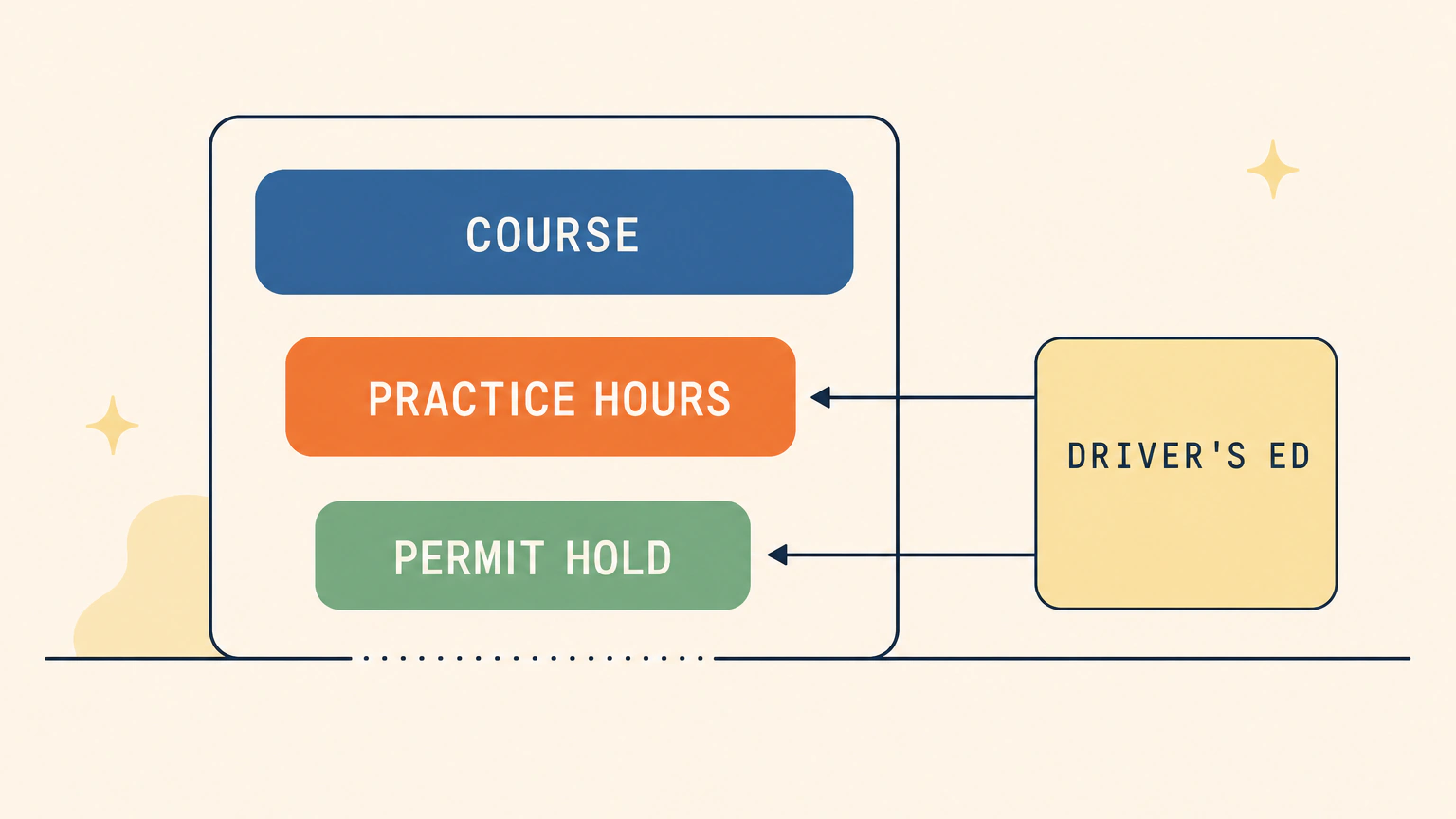
Three separate demands hide inside the phrase "driver's ed requirement," and confusing them is how a family loses a summer. A state can require a course. It can require logged practice hours. It can require a minimum stretch of calendar time on the permit. They're independent, so you can be excused from one and still owe the other two.
| Requirement | What it looks like in practice | Can driver's ed change it? |
|---|---|---|
| A course | Classroom or online hours plus behind-the-wheel hours with a licensed instructor | This is the requirement itself |
| Supervised practice hours | Logged hours driving with a qualifying adult, often with a night sub-minimum | Yes, in some jurisdictions |
| Permit holding period | A minimum calendar time holding the permit before you can test | Yes, in some jurisdictions |
Requirement one: the course
A course can combine classroom or online instruction, instructor-led driving and supervised practice. The required split depends on your state. Utah's Driver License Division wants 27 classroom hours through a high school, 18 through a commercial or private school, or 30 online, then six hours behind the wheel whichever door you came in. Texas sits at the far end for its under-18 applicants: 24 classroom hours and 44 hours in the car.
Requirement two: logged supervised practice hours
These are hours you drive with a qualifying adult and write down. The common pattern is 50 hours with 10 after dark, which is what driving schools in California prepare learners for. The range around it is wide: Iowa asks 20 hours, Maine 70, Pennsylvania 65 with five in bad weather. Arkansas and Mississippi ask for none.
The qualifying adult is defined by the state, not by you. New Jersey wants a supervising driver at least 21, with a valid New Jersey license and three years of experience. Connecticut wants a trainer 20 or older, licensed for four consecutive years, with no suspensions. Check the person before you count hours.
Requirement three: the permit holding period
Nobody warns you about this one, and it's usually the real bottleneck. It's a minimum calendar wait between the day the permit is issued and the day you can test, and driving more doesn't shave an hour off it. Most states land between six and 12 months. Colorado, Florida, Georgia, Iowa, Kansas, Mississippi and Vermont all sit at 12. Wyoming asks 10 days. New Hampshire asks for nothing.
Pro tip: you can't work harder to shorten a holding period, so put it on the calendar first and count backward from the day you want to be driving. Where driver's ed cuts that wait, enrolling early beats any discount you'll find later.
Where driver's ed changes what the law demands
Every line here comes from one place, the Insurance Institute for Highway Safety's graduated licensing laws table dated August 2026. These are effects written into state law and recorded by a safety research body, not promises from a driving school's sales page.
| State | Without driver's ed | With driver's ed | What it changes |
|---|---|---|---|
| Alabama | 50 hours supervised driving | None | Practice hours |
| Arizona | 30 hours, 10 at night | None | Practice hours |
| Nebraska | 50 hours, 10 at night | None | Practice hours |
| West Virginia | 50 hours, 10 at night | None | Practice hours |
| Oregon | 100 hours | 50 hours | Practice hours |
| Connecticut | 6-month permit holding period | 4 months | Permit wait |
| South Dakota | 9-month permit holding period | 6 months | Permit wait |
| New York | Night and passenger limits lift at 18 | Lift at 17 | Restrictions |
| Pennsylvania | Restrictions lift at 18 | Lift at 17 (with 12 months licensed) | Restrictions |
| Oklahoma | After 12 months licensed or at 18 (minimum 16 yrs 6 mos) | After 6 months licensed or at 18 (minimum 16 yrs 6 mos) | Restrictions |
| Indiana | Earliest lift at 17 yrs 3 mos, after 6 months licensed | Earliest lift at 16 yrs 6 mos, after 6 months licensed | Restrictions |
Nevada almost belongs here. It waives its 50-hour requirement for a defensive driving course, not for driver education.
States where the course waives or halves your practice hours
Alabama, Arizona, Nebraska and West Virginia drop the practice requirement to nothing once the course is finished. Oregon halves it, 100 hours down to 50. Put 50 hours into weeks: seven of them, an hour behind the wheel every day. Oregon's course hands back a second block of the same size.
States where the course shortens the permit wait
Connecticut cuts a six-month permit holding period to four, and South Dakota cuts nine months to six. That can matter more than the hours do, because it moves a date rather than a workload. Two months of driving yourself to a job or a campus is time no amount of extra practice buys back.
States where the course lifts night and passenger limits sooner
A new driver in the intermediate stage usually can't be out late or carry more than one young passenger. Families feel those two rules hardest, because the new driver can't run a sibling to practice or drive home from an evening shift.
New York lifts both limits at 17 with driver education and 18 without. Pennsylvania lifts them at 17 with driver education and 12 months licensed, otherwise at 18. Oklahoma lifts them after six months licensed instead of 12, or at age 18 either way. Indiana's passenger limit can lift after six months licensed, as early as 16 years 6 months with driver education instead of 17 years 3 months without. In a one-car household, that is a year of not being everybody's driver.
Nevada's near-miss, and why the wording matters
Nevada's own wording is "none with defensive driving course," not "none with driver education." A defensive driving course is a different product. A family that buys a full driver education program expecting the practice hours to disappear has bought the wrong thing. One noun settled the answer for a whole state. Read your own state's exact words rather than a summary of them.
Adults: the states that still make you take a course
New Jersey is the clearest verified case. For permits issued on or after February 1, 2025, its Motor Vehicle Commission requires every permit holder under 21 to log 50 hours of practice, 10 of them after dark, before it will issue a probationary license. That is one state's rule, not a national one. We checked the rest on each agency's own page. One wouldn't open.
| State | Who must take a course | What the course is | Verified on the agency's page? |
|---|---|---|---|
| Texas | Everyone under 25 | 6-hour adult course at 18 to 24; 24 classroom plus 44 in-car hours under 18 | Yes, tdlr.texas.gov |
| Florida | Learner applicants under 18; most first-time applicants aged 18 or over | Under 18: approved driver education. At 18 or over: Traffic Law and Substance Abuse Education, unless exempt | No — checked against Florida Statutes §§ 322.1615 and 322.095 instead |
| Illinois | 18, 19 and 20 with no prior driver education | 6-hour adult course | Yes, ilsos.gov |
| Ohio | Applicants under 21 | 24 classroom or online hours plus 8 behind-the-wheel hours | Yes, codes.ohio.gov |
| New Jersey | 16-year-olds on the special learner's permit track, not adults | 6 in-car hours in a dual-controlled car | Yes, nj.gov/mvc |
| Maryland | Reported: all first-time applicants | Reported: 30 classroom plus 6 in-car hours | No, page blocked |
| Connecticut | First-time applicants 18 and older | 8-hour Safe Driving Practices Course | Yes, portal.ct.gov |
| Utah | Nobody at 19 and older, the course is optional | The counter-case | Yes, dld.utah.gov |
Texas: everyone under 25
The Texas Department of Licensing and Regulation answers this without hedging: "All persons under 25 years old must take a driver education course to get a Texas driver's license."
Which course depends on your age. Under 18 it's the full program, 24 classroom hours and 44 in the car. Between 18 and 24 you can take a six-hour adult course instead, or the 24-hour minor course, or a parent-taught course. A new resident with a valid, unexpired out-of-state license needs no course at all, though an applicant under 18 still takes the driving test. If a course is in your future, start with driving schools in Texas.
Florida: which course your age requires
Florida law now takes two paths. A learner applicant under 18 must complete a department-approved driver education course that meets the state's classroom course standard. An applicant aged 18 or over must usually complete the Traffic Law and Substance Abuse Education (TLSAE) course, unless they were licensed elsewhere or completed a qualifying Department of Education driver education course.
Utah: not required at 19, but it waives your 90-day wait
Utah is the cleanest illustration of the trade. Its Driver License Division calls driver education "optional for applicants 19+ years of age." Skip it and you must "apply for a learner permit and hold it for 90 days before being eligible to apply for your driver license." Take it and the same page says the "90-day holding period not required." Either way you complete 40 hours of practice driving, 10 of them after sunset.
Watch the scope, because Utah runs two holding periods for two populations. The six months in the IIHS table belongs to the under-18 track. The 90 days belongs to the 19-and-over track. Neither reaches the other group. If the arithmetic favors the course, compare driving schools in Utah.
The state we could not verify from the agency's own page
Maryland's rule gets repeated everywhere: a course for every first-time applicant. We couldn't confirm it. The agency's page returned a security block every time we knocked, so we're not printing Maryland's course hours as fact.
If you live there, open mva.maryland.gov yourself and search for driver education. A page you loaded with your own hands beats any summary of it, ours included.
Online or in person: what your state will accept
Some states will take an approved online provider for the classroom portion. Nothing online replaces the in-car hours with a licensed instructor. What decides it is approval: a course that isn't on your state's list buys you nothing, however good the website looks.
Utah shows both halves. It accepts an online school at 30 classroom hours, and it states that out-of-state online or home-study certificates will not be accepted. Approval and reciprocity are separate questions, and a provider's website rarely volunteers either answer.
Every state that regulates these courses publishes a list of who may teach them. Texas keeps a searchable directory of licensed providers, parent-taught programs included, on tdlr.texas.gov. Florida publishes its approved DELAP providers on flhsmv.gov, and Illinois publishes a certified adult provider list. Find the list before you find the school, the same habit as how to verify any instructor's credentials.
What driver's ed costs, and how to check a school is approved
On our own compare driver training schools near you category page, the quote data puts the national average at $437 and a fair price range of $364 to $520. The cheapest quote in it is $188 and the priciest $936.
Two things are worth knowing before you lean on those figures. They are our network's own aggregate of quotes rather than a market survey, and the panel reads the visitor's location, so your number may differ from the national one. How the site's category cost panels work explains the mechanics, and how Distinguished Teaching evaluates providers covers the evaluation behind the listings. Price is the easy part of this decision. What protects you is your state agency's approved-provider list.
Before you pay: the seven-item check
- Confirm on your state agency's own page whether a course is required at your age, not for teenagers generally.
- Check whether your state's table records a driver's-ed adjustment to hours, the permit wait or restriction ages, then price the course against what it saves.
- Find the school on your state's approved-provider list, by its licensed name, before you pay anything.
- Ask which parts are online and which must be in a car, and how far out the in-car hours are booking.
- Get the total in writing: course fee, in-car hours, retests, and any certificate or processing fee.
- Ask how and when the completion certificate reaches the licensing agency, electronically or on paper.
- Ask what happens to your money if you move states or miss a session.
Red flags at a driving school
Four things that should stop you signing:
- The school can't give you its state approval or license number, or the number it gives you isn't on the state's list.
- The price you hear out loud doesn't match the price in writing, or the in-car hours are billed separately once you've enrolled.
- You're told the course "counts everywhere." Requirements are state-specific, and an out-of-state certificate can be rejected outright or credited in part. Utah publishes that it will not accept out-of-state online or home-study certificates at all.
- You're promised a license faster than your state's published holding period allows. No school can shorten a statutory wait its own state hasn't shortened.
Check your own state
Every one of the 51 jurisdictions in the Insurance Institute for Highway Safety's graduated licensing laws table is in this lookup. Pick your state and you'll get its permit age, its holding period and its supervised practice requirement, plus whether driver education moves any of them.
These are learner-stage rules, and adult first-time applicants meet different ones in some states, as Texas, Florida, Connecticut and Utah all show. One caveat, and we mean it: states rewrite these rules, and your own licensing agency has the last word on its own. Confirm with them before you pay for a course or book a test.
What does your state require?
Choose a jurisdiction to see its learner-stage row and the IIHS footnote context for driver's education.
Oregon
Learner permit at
15
Hold the permit
6 months
Supervised practice
50 hours (100 hours without driver education)
How driver's ed fits
50 supervised hours with driver education versus 100 without; course otherwise required under 18.
Source: Insurance Institute for Highway Safety, Graduated licensing laws, August 2026. Footnotes can change the path shown in the main row. Confirm with your state licensing agency before you enroll or schedule a test.
Frequently asked questions
Do you need driver's ed to get your license at 18?
Sometimes, and it comes down to your state. Texas is the big exception: everyone under 25 takes a course. Florida generally requires that course at 18 or over, while younger learner applicants need an approved driver education course; Connecticut asks adult first-timers for an eight-hour class. Your agency's page settles it in a minute.
What age can you take driver's ed?
Often earlier than the permit age, which surprises most families. Texas lets a teenager start the classroom portion at 14, then holds them to 15 before they can apply for a learner license. Minimum permit ages run from 14 to 16, so the classroom part can start while the permit is months away.
Which states have no driver's ed requirement?
There is no official national list, which is why the counts you see disagree. The IIHS table records permit ages, holding periods and supervised hours rather than course mandates, and every state defines a course its own way. The reliable answer is your own agency's page, read for your age band.
Does online driver's ed count?
For the classroom portion, yes, as long as the school sits on your state's approved list. Utah takes an online school at 30 classroom hours and still refuses an out-of-state online or home-study certificate. Behind-the-wheel hours happen in a car with a licensed instructor, never on a screen.
Can driver education reduce the supervised driving hours I have to log?
Yes, in some states. Alabama, Arizona, Nebraska and West Virginia drop the supervised-hours requirement to nothing once driver education is finished, and Oregon cuts its requirement in half. Plenty of states change nothing at all, so confirm your own before you pay for a course expecting the trade.
Who is allowed to supervise my practice driving hours?
Your state names that person, and the definitions differ more than you would expect. New Jersey requires a supervising driver at least 21, holding a valid New Jersey license, with three years of driving experience. Connecticut requires a trainer 20 or older, licensed for four consecutive years with no suspensions in that period.
Do supervised driving hours have to be logged on an official state form?
Sometimes, and when it matters it really matters. New Jersey accepts only its own Certification of Supervised Driving, form BA-CSD, and says outright that the driving log in its Share the Keys guide will not satisfy the requirement. Ask your agency which form it wants before you log hours on the wrong one.
What to do next
Start with your own licensing agency's page, and read the rule for your age, not the rule for teenagers in general. One page settles all three requirements at once.
If a course is required, or your state is one of the places where it changes what the law demands, compare driver training schools near you and check each one against the approved-provider list before you pay.
Then log practice hours from the week the permit arrives, on your state's own form if it has one. That habit keeps the test date from sliding. If you're timing this against everything else, what age kids are actually ready for other activities is the same kind of question.