

On this page
- What martial arts classes cost per month
- Why the monthly price is not the price
- A realistic first year, two ways
- What you are signing: contracts, terms and cancellation
- How to compare two schools on price
- Is martial arts worth the cost?
- Frequently asked questions
- Find and compare martial arts schools near you
What martial arts classes cost per month
You've watched one class, the kid loved it, and now you want the number. DistinguishedTeaching's own cost profiles put the fair price range at $105 to $158, against a $126 average and a spread from $79 to $399. Tuition is rarely the whole bill. Registration, a uniform, sparring gear and belt-testing fees can all add to year one, and some schools tie the price to a written fixed-term agreement.
Those figures are our own aggregate of the cost profiles we collect, not a market survey, and the panel never says what period it's pricing. It reads your location too, so what you see on martial arts schools near you may not match the national numbers.
The national range, and what sits at each end
A $79 school and a $399 school usually aren't selling the same thing. At the bottom you're looking at a community or recreation-department program: a rented room, a part-time instructor, one or two sessions a week, and a fixed number of weeks rather than a membership that runs until you cancel.
The high end buys dedicated mat space, daytime staff, a schedule wide enough that you can actually get there, and fewer students per instructor.
In between, the biggest driver is how much training the price includes. "Unlimited" and "two classes a week" can sit a few dollars apart on a price sheet and differ threefold in mat time. Read the schedule, not the number.
How the price is usually structured
Month-to-month, a fixed term billed monthly, or a package paid up front. What each one costs, and what it commits you to, is whatever that school's agreement says.
Kids' classes versus adult classes
Ko Martial Arts' 2023 guide works from two 45-minute classes a week. That's one school's example, and schedules and billing for children and adults shift from school to school.
Karate schools in your area carry a published fair price range of $83 to $186 on the same platform, a wider band than martial arts overall, and that panel doesn't state its time unit either. Ask whether a family or sibling rate exists before you compare anything else.
| Price point | Typical monthly cost | What is usually included | Where you usually find it |
|---|---|---|---|
| Community and rec-center programs | No independently verified monthly figure | Inclusions and schedule vary | Parks departments, community centers, school-district enrichment |
| Part-time school in shared space | No independently verified monthly figure | Inclusions and schedule vary | A shared dance or fitness studio, a church hall, an instructor's second business |
| Full-time school, limited classes per week | No independently verified monthly figure | Inclusions and schedule vary | A dedicated storefront school with its own mat |
| Full-time school, unlimited classes | No independently verified monthly figure | Inclusions and schedule vary | Larger dedicated schools with daytime staff |
| Specialist or small-group programs | No independently verified monthly figure | Inclusions and schedule vary | Brazilian jiu-jitsu academies, competition teams, private instruction |
DistinguishedTeaching publishes the observed $79 to $399 spread for the martial arts category and nothing more granular: no time unit, no band per type of school. One operator does publish tiers. Ko Martial Arts, a Kansas City school, sorted prices into monthly tiers of $25 to $99, $100 to $199 and $200 to $500 in its 2023 guide, and listed its own tuition at $239 a month at the time.
Why the monthly price is not the price

The quote you get over the phone is one line on the bill. Registration, uniforms, equipment, testing and events can each be charged separately, and they arrive at different points in the year. That only turns into a problem when you hear about a fee the week it's due.
Registration and enrollment fees
Some schools charge a registration, enrollment or activation fee at signup. Others waive it, or fold it into an intro offer. Ask what it covers, whether it's refundable, and what happens to it if you cancel.
The uniform, and the second uniform
Many schools require a uniform: a gi in karate and jiu-jitsu, a dobok in taekwondo. Some include one in an intro package, some sell it separately. Ask whether substitutes are allowed and what a replacement costs.
Then leave room for a second one. Children grow and uniforms wear out.
Sparring gear, and when it becomes required
Headgear, a mouthguard, gloves, shin guards, a cup. Schools may require any of it once contact training begins, and that can land well after the intro offer ends.
So ask at which belt the gear becomes mandatory, and which pieces you have to buy from the school rather than source yourself.
Testing and promotion fees
Some schools charge for every belt test. Black belt testing may be billed separately, and at a higher rate.
Published figures are thin, because schools set their own. Ko Martial Arts put belt testing fees anywhere from $0 to over $1,000 when it wrote about its market in 2023, and listed its own color-belt tests at $65, rising for black belt levels. That's one school's disclosure, not a national average.
Ask your own school for the promotion schedule and the fee at each level, in writing.
National governing body dues, if the school competes
Governing-body membership may apply if a school competes or requires affiliation. Unlike everything else on the bill, these fees get published by somebody other than your school.
USA Taekwondo charges $60 a year for an individual membership. A family membership runs $110 for a primary member plus two, with $35 for each additional member, good for one year from purchase. USA Judo charges $100 annually for a judo membership, drops to $60 for first-time members aged 17 and under in the first year only, and sells a $15 event-only membership and a $40 45-day trial. In Brazilian jiu-jitsu, the IBJJF's academy registration fee is USD 70 for the calendar year, and that one's billed to the school rather than to you.
Ask whether membership is required or only if your child competes. Don't assume it applies.
Tournaments, camps and seminars
Tournaments are optional on paper. They get much harder to decline once your child's training partners are all entering. Budget for the entry fee, the travel, and the spectator admission many events charge parents at the door.
Summer camps and visiting-instructor seminars work the same way. Ask how many events the school attends in a typical year, then decide in advance how many your family is doing.
| Cost line | When it hits | Who charges it | What to ask before you sign |
|---|---|---|---|
| Monthly tuition | On the school's billing schedule | The school | What "unlimited" or "two classes a week" means on the actual schedule |
| Registration / enrollment fee | If charged, usually at signup | The school | Is it refundable, and what happens to it if I cancel in month one? |
| Uniform (gi or dobok) | When the school requires it | The school, or a supplier it names | Is one included in the intro offer, and can I buy a replacement elsewhere? |
| Sparring gear | When the school requires it | The school, or a supplier it names | When does this become required, and what must I buy from you? |
| Testing / promotion fee | When a paid test is scheduled | The school | How many paid tests per year at my level, and what is the fee at each one? |
| Black belt test | If billed separately | The school, sometimes with its association | What does the black belt test cost today, and what is included? |
| National governing body membership | As required by the school or competition | USA Taekwondo ($60 individual, $110 family) or USA Judo ($100); IBJJF separately charges schools $70 for academy registration | Is membership required, or only if I compete? |
| Tournaments, camps and seminars | Per event | Event organizers, plus travel and admission | How many events do you expect students to enter in a year? |
Only the organization fees are published figures. Every other line gets set school by school, which is why the last column asks a question instead of printing a number. A school that won't put its fee schedule in writing has already told you something useful.
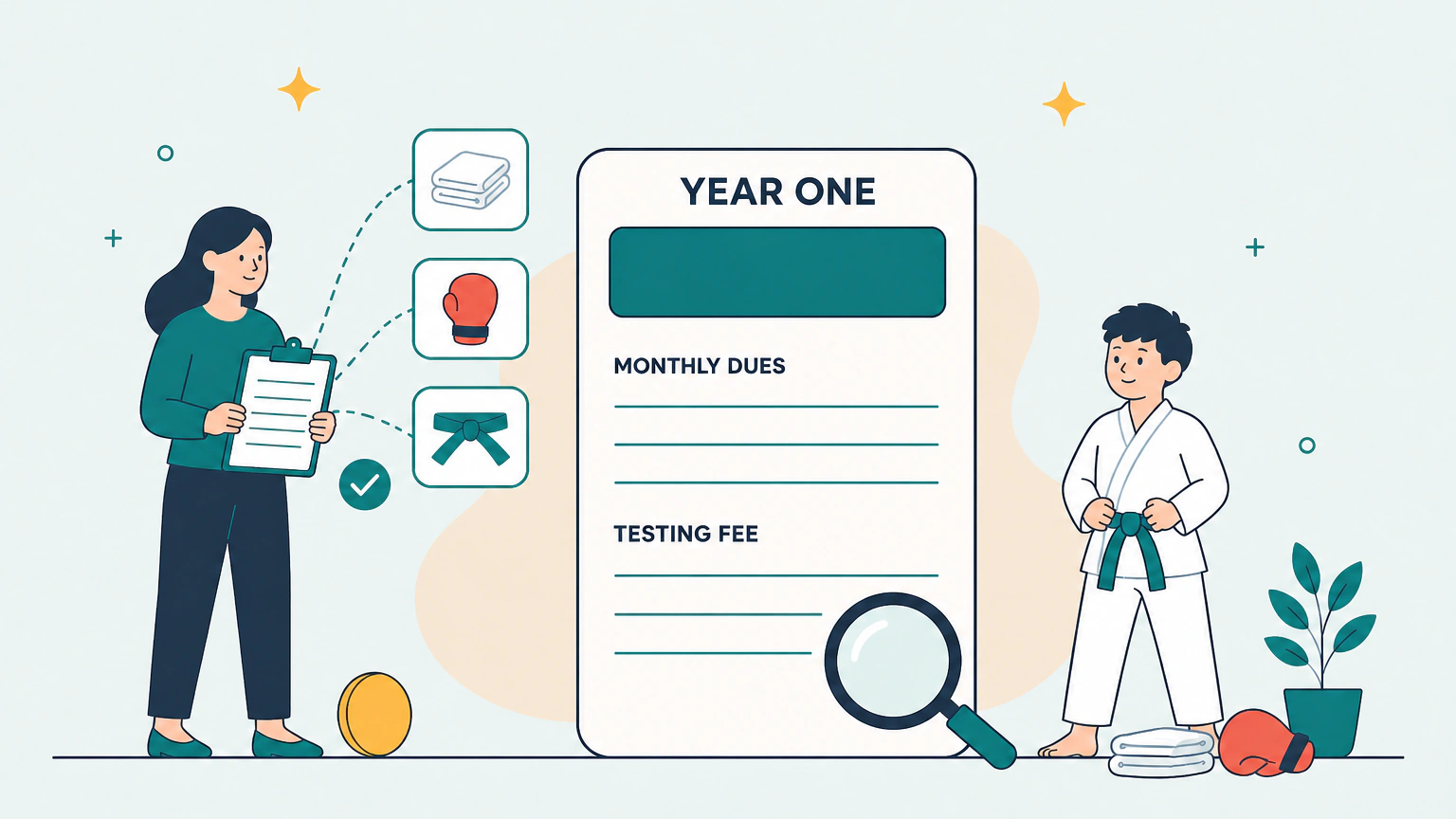
A realistic first year, two ways
Both examples start from an assumed monthly quote inside the published fair price range, and leave every school-set fee blank for you to fill in from a written fee schedule. The panel never labels its range monthly.
A seven-year-old in a recreational program
Say a school quotes $130 a month. Twelve months of that is $1,560 in tuition, and this child also has one registration fee, one uniform, a possible replacement, and two belt tests.
Test for free and get the uniform included, and the year lands close to $1,600. Pay registration plus a fee at every promotion and the same year runs well past it. Only the school's fee schedule tells you which year you're buying.
An adult training three times a week
An unlimited membership quoted at $158 a month is $1,896 in tuition over twelve months. In this example, he buys sparring gear at month four and tests once.
The shape of the year is different. No second uniform, adults test less often at most schools, and the extras arrive in one lump when the gear does rather than spreading across the months. If he competes, a governing-body membership goes on top, and that's the one number he can look up before he pays it: $60 at USA Taekwondo, $100 at USA Judo.
What actually changes the total
The total turns on three things: how often the school promotes, whether gear and uniforms are bundled into tuition or sold separately, and whether you are on a term agreement or month-to-month.
Pro tip: ask about the family rate before you ask about the discount. Sibling and family pricing can change a household martial arts budget. USA Taekwondo's family membership is $110 for a primary member plus two, with $35 for each additional member, against $60 each individually. Ask what a second child costs before you negotiate anything else.
What you are signing: contracts, terms and cancellation
A written membership agreement is normal, and it isn't automatically bad news. It fixes your rate, records what you were promised, and gives you something to point at when the schedule changes.
Read the term and the cancellation clause before you sign, not after the trial class.
Month-to-month, fixed term, or prepaid
Month-to-month keeps the term short. How much notice you owe, and what the last payment looks like, comes from the agreement and your state's law.
A fixed term, billed monthly, may buy a lower rate, and it may also leave a balance owed. If your family moves, your child quits, or the school closes, what happens next depends on the contract and your state's statute.
Prepaid hands your money over before all the services are delivered. Read the refund and closure terms before you pay.
Auto-renewal, and the federal rule that is not in force
Many agreements renew themselves at the end of the term, and some renew into a whole new fixed term rather than month-to-month. You may have heard this doesn't matter anymore, because a federal "click-to-cancel" rule makes canceling as easy as signing up. It isn't in force.
The Federal Trade Commission finalized its Negative Option Rule in October 2024. On July 8, 2025, in Custom Communications, Inc. v. FTC, No. 24-3137, consolidated with Nos. 24-3388, 24-3415, 24-3442 and 24-3469, the US Court of Appeals for the Eighth Circuit granted the petitions for review and vacated the rule in its entirety, finding the Commission had not followed the procedural requirements of the FTC Act. The FTC's own rule page now lists a February 12, 2026 Federal Register notice revising the rule "to conform these rules to federal court decisions," plus a March 11, 2026 advance notice of proposed rulemaking, so the rulemaking has restarted.
So there's nothing federal to lean on today. Your state's law and the terms you signed are what govern.
Your state may give you rights the contract does not mention
Five states regulate certain prepaid "health club," "health studio" or "prepaid entertainment" contracts, and their statutes expressly reach martial arts or self-defense schools in the circumstances described. Where one applies, a clause in the agreement can't take away a right the statute gives you.
Red flag: four things worth slowing down for. None of these means a school is dishonest. Each one is a reason to get something in writing first.
- A price you can't get in writing. Ask for a printed fee schedule covering tuition, testing and gear.
- An agreement handed over only after the trial class. Ask to read it first, and take it home.
- A term you can't see the end of. Check the length against your state's statutory cap, if it has one.
- A cancellation clause that names no circumstances at all. Check it against your state's statutory rights, which apply whether the contract mentions them or not.
| State | Statute | Are martial arts schools covered? | What the law gives the buyer |
|---|---|---|---|
| New York | N.Y. Gen. Bus. Law §§ 621, 624 | Yes, by name. § 621(1) covers instruction in "the martial arts to include, judo, karate and self-defense"; § 621(2) lists martial arts and self-defense schools as health clubs | Three business days to cancel after you receive a copy of the contract, by US mail or e-mail; all money refunded within ten business days; the contract must carry a cancellation notice in at least 12-point bold type |
| Washington | RCW 19.142.010, .040, .050 | Yes, by name. The "health studio" definition covers instruction in "the martial arts" | Payments or financing capped at 36 months, and no term measured by the buyer's life; on a contract longer than one year you may cancel for any reason on 30 days' written notice; also on death or total disability, a qualifying move under RCW 19.142.040(7)(b), or permanent closure with no comparable facility within 10 miles; dues may rise at most once per calendar year; refund within 30 days |
| Ohio | Ohio Rev. Code §§ 1345.41(A)(3), 1345.42 | Yes, by name. "Martial arts training, whether or not the training will lead to a specific degree of expertise" is a listed prepaid entertainment contract service | Term capped at three years and not measurable by the buyer's life; before the service is available for use the seller may collect no more than $50 or 10% of the total contract price, whichever is less; pro-rata refund on death or disability, on a move of 25 miles or more, or if the seller relocates or closes |
| Maryland | Md. Code, Com. Law §§ 14-12B-01(d), 14-12B-06 | Yes, where the agreement runs longer than three months and the seller collects more than three months in advance; the definition covers a "self defense school" | Three business days to cancel after you receive a copy, by written notice delivered in person or by certified mail postmarked by midnight of the third business day; full refund including any initiation, deposit or membership fee; automatic-renewal clauses are prohibited unless the agreement gives a renewal option you must actively accept; the contract must disclose a "Notice of Consumer Rights" |
| Florida | Fla. Stat. §§ 501.013(4), 501.017 | Often not. A program or facility "offered and used solely for the purpose of dance, aerobic exercise, or martial arts, and which utilizes no physical exercise equipment" may be declared exempt from the health studio law, on the business filing an affidavit with the state | Where the health studio act does apply, the contract must carry, in at least 10-point boldface type next to the signature line, a penalty-free right to cancel within three days excluding weekends and holidays, with a refund |
We read the statutory text in these five states and no others. Other states may also regulate prepaid fitness, health club or martial arts contracts, so look yours up.
One caveat: we're not your lawyer, and how a statute lands depends on the facts of your own agreement. If you're already in a dispute, call your state attorney general's consumer protection division or a licensed attorney.
If your state is not in the table
Search your state attorney general or consumer protection division site for "health club contract," "health studio" or "prepaid services." When you find the statute, read the definitions section first, and look for the words "physical skill," "self-defense" or "martial arts."
That paragraph decides whether the rest of the law reaches your school at all, which is exactly what Florida shows.
And where no specific contract statute applies, your state's general consumer-protection law may still be relevant.
How to compare two schools on price
By the second school the pitches sound identical. These nine questions, asked before the trial class rather than after it, get a real number out of both and let you compare like for like.
- Ask for the monthly tuition and what "unlimited" or "two classes a week" actually means in the schedule.
- Ask whether there is a registration or enrollment fee, and whether it is refundable.
- Ask for the promotion schedule: how many belt tests per year at your level, and the fee for each one.
- Ask what the black belt test costs, even if it is years away.
- Ask at which belt sparring gear becomes required, and what the school requires you to buy.
- Ask whether the uniform is included in the intro offer, and what a replacement costs.
- Ask whether the school is affiliated with a national governing body and whether membership is required.
- Ask for the agreement in writing before the trial class, and read the term and the cancellation clause.
- Ask what happens automatically when the intro period ends.
Questions that get you a real number
Ask for three documents instead of three verbal answers: a written fee schedule, a promotion schedule with the fee at each level, and the membership agreement itself. Say you'd like to read them at home. A school that teaches children is used to organized parents and won't find that strange.
If the answer is a monthly figure and a pen, you've learned what you needed to about the other lines.
What a fair trial offer looks like
An intro package may bundle trial classes and a uniform for a flat price. Check what happens automatically the day it ends: do you roll into another agreement, or into nothing unless you sign again?
Get that in writing before you pay for the trial and you've taken the only real risk out of it.
Is martial arts worth the cost?
At $105 to $158 a month, twelve months of tuition comes to roughly $1,300 to $1,900 before anything else lands on the bill.
Two situations make it not worth it, and neither is about the training. You can't get the price in writing, so you can't budget the year: don't sign. Or the only offer is a term longer than your family can honestly commit to, which is a reason to try a different school, a month-to-month program, or one of the short self-defense courses that teach practical skills without a multi-year membership. Adults chasing conditioning rather than a belt curriculum often do better at kickboxing gyms, which usually price like a fitness membership.
Frequently asked questions
How much do martial arts classes cost per month?
DistinguishedTeaching's published fair price range is $105 to $158, against a $126 average and a spread from $79 to $399. Read it as a guide rather than a monthly market rate: the panel doesn't state a time unit, so it doesn't establish what most US schools charge per month.
Why are martial arts classes so expensive?
Because the costs behind the price don't move. Mat space, insurance and staff are fixed, and they don't disappear when attendance dips. The rest of the bill is where you have leverage: registration, gear and testing get set school by school.
How much is a black belt test?
We couldn't find a verified national figure, and we looked. Ko Martial Arts, writing about its market in 2023, put testing fees anywhere from $0 to over $1,000 and said its own fees rise for black belt levels. Ask your school for its own figure in writing.
Do martial arts schools require a contract?
Some do, some don't. A school may discount the rate for a fixed term, or sell month-to-month, and a written agreement isn't a bad sign by itself. What matters is what's in it: the term, the cancellation clause and the auto-renewal terms, read before you sign.
Can I cancel a martial arts membership?
That depends on your contract and your state. New York, Maryland and Florida give a three-business-day cancellation right on covered contracts. Washington lets you cancel a contract longer than one year for any reason, on 30 days' written notice. Some states also attach rights to death, disability or a qualifying move.
How much does a karate uniform cost?
There's no single price. It moves with the school, the fabric weight and the size, and some schools sell their own branded gi or dobok. Ask whether one uniform is included in the intro offer, whether substitutes are allowed, and what a replacement costs.
Is martial arts worth the money?
For most families, yes, as long as you get the full cost in writing first. At $105 to $158 a month, twelve months of tuition runs roughly $1,300 to $1,900 before the other fees. It stops being worth it when a school won't put its fee schedule on paper, or when the term outruns what your family can commit to.
Find and compare martial arts schools near you
Start with two or three schools inside a realistic drive, because a class you can't get to is money spent either way. Ask each one the same nine questions, take the fee schedule and the agreement home, and compare the year instead of the month. Check how schools are reviewed and listed before you weigh what other parents have said, then browse martial arts schools near you by city to build your shortlist.