

On this page
The short answer
You mouth the words when everyone starts "Happy Birthday." You sat out karaoke night again. Maybe a teacher shushed you in fourth grade, and you've kept quiet ever since. So can you learn to sing, or are you one of the people who simply can't?
Yes. Most people can improve how accurately they sing. In a large online study, 1.5% of analyzed adults met strict criteria for congenital amusia. One in five of those who scored normally still believed they lacked a sense of music. What usually goes wrong isn't your ear but the link between hearing a note and producing it, and that link can improve with practice.
Before you decide you're the exception, look at how often people who say so turn out to be wrong.
What people believe about their singing, and what the tests found
Doubting your own voice is common. On one Texas university questionnaire, 59% of students said they couldn't copy a melody by singing.
Then researchers Peter Pfordresher and Steven Brown brought people into the lab and measured them. They recruited one group precisely because its members said they couldn't sing a tune. Only 4 of those 39 sang more than a semitone off, which is the gap between two neighboring keys on a piano. That was no higher a rate than in a group nobody had screened. As the researchers put it, "The prevalence of poor production skills may be far lower than self-assessments indicate."
What people say about their singing, and what researchers measured
| What was measured | Result | Who was tested | Study |
|---|---|---|---|
| Said on a questionnaire that they couldn't copy a melody by singing | 59% | 1,105 university students in Texas | Pfordresher and Brown, 2007 |
| Called themselves "tone deaf" | Nearly 17% | Over 2,000 first-year university students in Ontario | Cuddy and colleagues, 2005 |
| Scored normally on every pitch task, yet said they "lack a sense of music" | 20.3% | 14,686 adults with normal scores on an online test | Peretz and Vuvan, 2017 |
| Sang more than a semitone off on average, among people who had said they couldn't sing a tune | 4 of 39 (10%) | People recruited because they said they couldn't copy pitch | Pfordresher and Brown, 2007 |
| Sang more than a semitone off on average, in the whole lab group | 10 of 79 (13%) | Nonmusicians tested in a lab | Pfordresher and Brown, 2007 |
| Met the study's strict criteria for congenital amusia | 1.5% | 16,625 adults analyzed from 20,850 online participants | Peretz and Vuvan, 2017 |
These numbers come from different groups asked different questions, so read them as a pattern, not as one survey. It's the researchers' own point: far more people say they can't sing than actually sing off key, and true tone deafness is rarer still.
Hearing a note and singing it are two different skills
Singing in tune takes two separate skills. The first is hearing: noticing that two notes differ, or that one note in a tune is wrong. The second is the hand-off from ear to voice, where your brain tells your throat exactly where to land. People blame the first. It's usually the second.
In Pfordresher and Brown's lab, the off-key singers (10 to 16% of each group) were no worse than good singers at telling two pitches apart. Their mistakes weren't random, either. Each one sang consistently too high (sharp) or too low (flat), as if the voice were tuned slightly off from the ear. The researchers' word for it is "mismapping."
Sean Hutchins and Isabelle Peretz took the voice out of the test. Given a slider to match pitches by hand, musicians and nonmusicians alike did better than they did with their own voices.
Simone Dalla Bella's team came at it from another angle. When occasional singers sang a familiar song slowly, most were as accurate as professional singers. Two of the 15 stayed off key even at the slow tempo, and their hearing was fine. The researchers called it "a purely vocal form of tone deafness."
How many adults count as accurate singers depends on where a lab draws the line. A review of four studies put the share anywhere from 38% to 87%.
What true tone deafness is, and how rare it is
True tone deafness has a medical name, congenital amusia. It's a lifelong problem hearing musical pitch, so wrong notes in a melody slip by unnoticed, your own included.
Isabelle Peretz's lab in Montreal ran an online version of its test for years. Of 20,850 participants, researchers analyzed 16,625 adults. Under the strict criteria the team used, 1.5% met the cutoff for pitch-based amusia. The figure people quoted before that, 4%, came from a single test back in 1980.
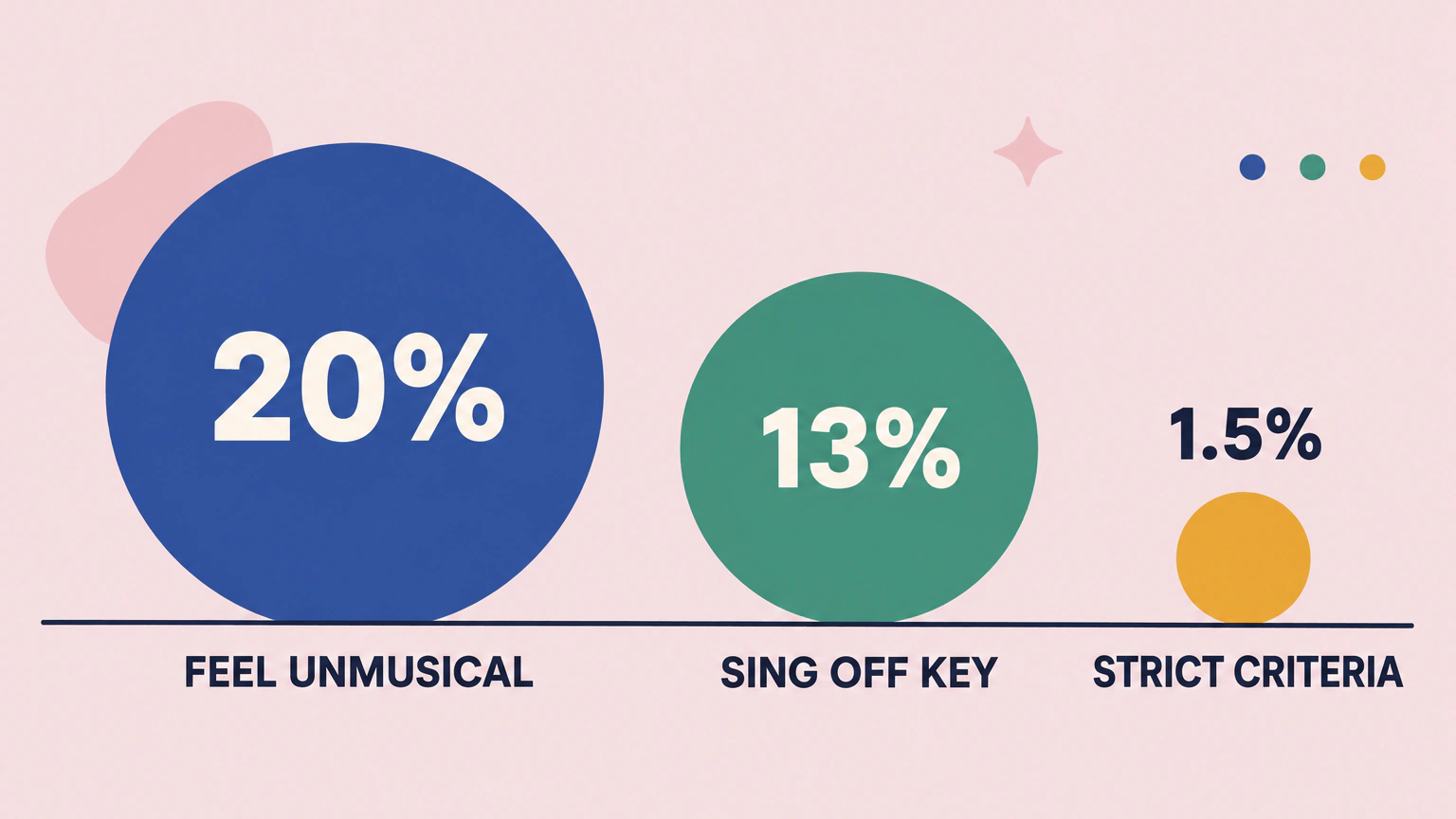
People with amusia often suspect it. Two in three of those who met the criteria said they felt they lacked a sense of music. So did one in five of the people who scored normally, and the researchers count those as false alarms.
Amusia does run in families. When Peretz's team tested relatives directly, 39% of the parents, brothers, sisters and children of people with amusia had it too, against 3% in other families. In the big Montreal study, music lessons outside school weren't linked to milder amusia.
How to tell whether it's your ear or your voice
Amusia affects the ability to catch a wrong note. Peretz and her colleague Dominique Vuvan describe "their inability to detect when someone sings out of tune, including themselves." Noticing one is useful evidence about your pitch perception, but this four-item check can't rule amusia in or out.
Clues about your ear and voice
- You notice when a singer on the radio or a friend at a party hits a wrong note.
- You can tell when a song you know well has one note changed.
- You can hear yourself drift off the tune when you play back a recording of your singing.
- Your singing gets closer to the tune when you slow it down.
Said yes to most of those? That's encouraging evidence that your pitch perception is working, and your voice may be the part to train. If you said no to the first three, or you honestly can't tell, take the lab's online screening test before you pay for lessons.
The test was built in Peretz's lab, and the BRAMS research center in Montreal puts it online as the Brief Assessment of Music Perception. It has three listening tasks. You judge whether two melodies differ by one note, then listen for an off-beat note, then for an off-key one. In the version used for the 20,000-person study, the whole thing took about 30 minutes, and people saw their scores at the end.
If the test flags a problem: A low online score is a flag, not a diagnosis. The lab that built the test treats it as a first screening step, confirmed only by fuller testing in person. In the big Montreal study, past music lessons weren't linked to milder amusia. Still, in a small workshop study, most of five people with amusia improved on a listening test and on familiar songs. One man with amusia who trained for 18 months saw gains that faded when regular lessons and practice stopped. Singing for pleasure is still yours.
How much of singing is in your genes
The best measurement here comes from Australia. Researchers recorded nearly 1,200 twins, aged 15 to 90, singing with an online tool that scored how close they got to each note and to each jump between notes. Comparing identical twins with fraternal ones lets scientists split the differences between people into three parts. In the study's model, genetic factors accounted for about 41% of the differences in scores. Shared environmental factors accounted for 37%, and unshared environmental factors for the remaining 22%.
Two self-reported childhood experiences predicted better singing scores: singing in the family home and being surrounded by music early on.
If you're 40 and reading this, here's what that means. Genes and environments both helped explain the differences across this group. Neither share is a cap on you, and the study did not measure a ceiling for any one person's learning.
What age really does to a singing voice
Age gets blamed for more than it does. Pfordresher later compared singers aged 6 to 99 in a cross-sectional online study. Accuracy scores rose steeply from childhood to young adulthood, then stayed similar across older age groups, with "no strong tendency toward age-related decline." People with vocal or instrumental training also sang more accurately.
An earlier study by Steven Demorest and Pfordresher looked like bad news at first. Accuracy was higher in sixth graders than kindergarteners, but the college group performed at kindergarten level on two of the three tasks. Northwestern University called it a "use it or lose it" effect. Demorest put it plainly: adults "who may have performed better as children lost the ability when they stopped singing."
Many American students have already stopped by eighth grade. A nationally representative 2008 survey found that 34% of eighth-graders took part in band, orchestra or choir at school, and 17% of all eighth-graders sang in a chorus or choir.
Regular singing is a habit you can restart tonight.
What the research says about practicing in tune
The research doesn't hand you a step-by-step method. It does show what happened in a handful of specific tests. Two findings run against common advice: pitch-discrimination training alone didn't improve singing, and poor-pitch singers were less accurate when the target notes played at the same time.
What researchers found about singing practice
| What you try | What the research found | What to do with it |
|---|---|---|
| Singing regularly | In an online sample aged 6 to 99, singing accuracy behaved like a learned skill, and people with vocal or instrumental training sang more accurately (Pfordresher, 2022) | Sing for a few minutes most days |
| Pitch-discrimination training on its own | Nonmusicians who trained on tiny pitch differences heard them better afterward, but their singing didn't improve (Zarate and colleagues, 2010) | Practice hearing and singing as separate skills |
| Singing with the target notes playing | In a lab task, poor-pitch singers were less accurate when a synthesized voice played the correct notes as they sang than when they sang alone (Pfordresher and Brown, 2007) | Practice the notes alone before you add accompaniment |
| Slowing the song down | Sung slowly, most of 15 occasional singers were as accurate as professional singers (Dalla Bella and colleagues, 2007) | Learn a new song slowly, then bring it up to speed |
| Watching your pitch on a screen | A visual display of pitch didn't make singers more accurate within lab sessions (Hutchins and Peretz, 2012) | Use a tuner to check where a note landed, then try again by ear |
Practicing on your own, and what a teacher adds
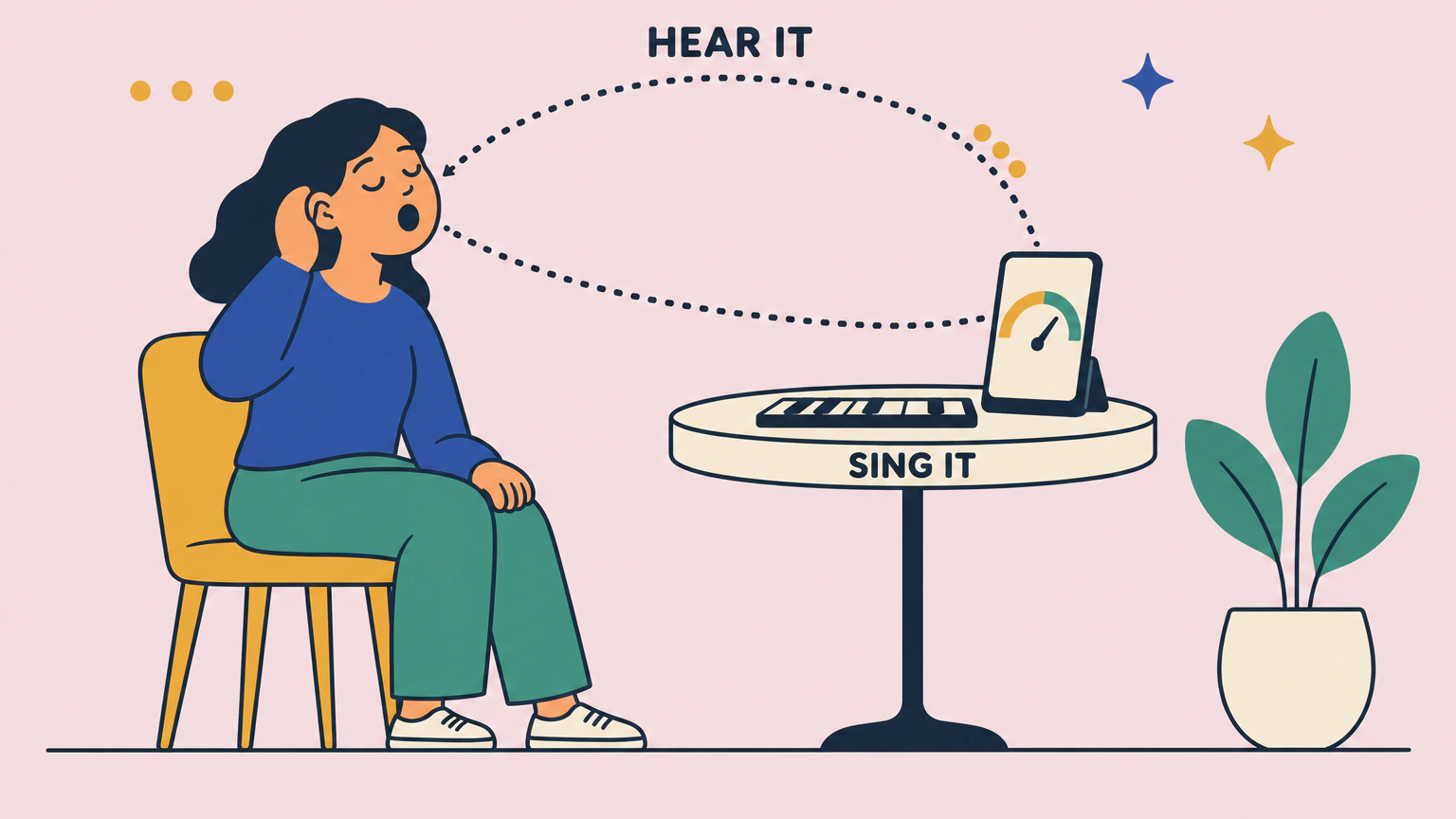
A home session needs a keyboard app, a tuner app and a few quiet minutes. Play a note, sing it back and check where the tuner says you landed. If it names the wrong note, slide your voice slowly up or down until the right name holds. A little needle wobble is fine. Natural vibrato does that. This five-minute video of the drill shows a voice teacher missing a note and sliding into it until the tuner agrees.
Start with one note at a time. Record one familiar song today and again in a few weeks.
What a teacher adds first is a second pair of ears. Hutchins and Peretz found listeners judge the pitch of a real voice less accurately than a clean electronic tone, so judging a voice by ear is harder than it sounds.
Our guide to what a first voice lesson should tell you covers the rest of that first meeting. Weighing a teacher on a screen? Read what survives a video call. And if a choir or group class feels less scary than one-on-one, here's what class size actually buys you.
Frequently asked questions
Is singing a talent or a skill?
Both. In nearly 1,200 Australian twins, genetic factors accounted for about 41% of the differences in singing scores and shared environmental factors for 37%. Unshared environmental factors accounted for the other 22%. Those group-level shares don't cap one adult's learning, and lifespan data are consistent with singing accuracy as a learned skill.
Can tone deaf people learn to sing?
Most people who call themselves tone deaf aren't, so yes, they learn the way anyone else does. In one large online study, 1.5% of adults analyzed met strict criteria for congenital amusia. Among those who met the criteria, past lessons weren't linked to milder scores, although small studies found some singing gains. One man who trained for 18 months lost those gains when regular lessons and practice stopped. Not sure which group you're in? Take the BRAMS online screening test first.
Is there a real test for tone deafness?
Yes. The BRAMS research center in Montreal offers the Brief Assessment of Music Perception online. It uses the same three listening tasks as the 20,000-person study, where the test took about 30 minutes and people saw their scores at the end. Treat your result as a screening step, not a diagnosis. The lab that built it follows up a low online score with fuller testing.
Can you teach yourself to sing?
You can teach yourself the pitch-matching part. A keyboard app, a tuner and a few recordings let you practice landing notes at home. Pitch-discrimination training alone didn't improve singing in one study, even though participants heard tiny pitch differences better afterward. A teacher adds trained ears, because listeners judge a real voice's pitch less accurately than a pure tone's, plus technique you can't easily see in yourself.
How long does it take to learn to sing?
We couldn't find a study that puts an adult timetable on it. The research shows a direction rather than a schedule. People with musical training scored more accurately in a large online sample, and gains can fade when regular practice stops, as they did for one man with amusia who trained for 18 months. We'd start with a few minutes of pitch matching most days and judge progress by your recordings, not the calendar.
Can you learn to sing at any age?
Yes. In Pfordresher's cross-sectional online study of people aged 6 to 99, singing accuracy stayed similar across older age groups, and people with musical training sang more accurately. The study supports singing into old age.
What to do next
- Run the four-item check as a set of clues. If you said no to the first three, or you aren't sure, take the BRAMS online screening test before you spend anything.
- Spend a few weeks matching single notes with a keyboard app and a tuner. Record one song at the start and again at the end.
- Book a first lesson with one of the voice teachers near you, and give the teacher a job: tell you whether your issue is pitch matching, technique or nerves, and what they'd work on first. If you'd rather sing along to your own playing, guitar lessons get you there too.
Booking a stranger to hear you sing takes nerve, so it helps to know how we vet the teachers we list.