

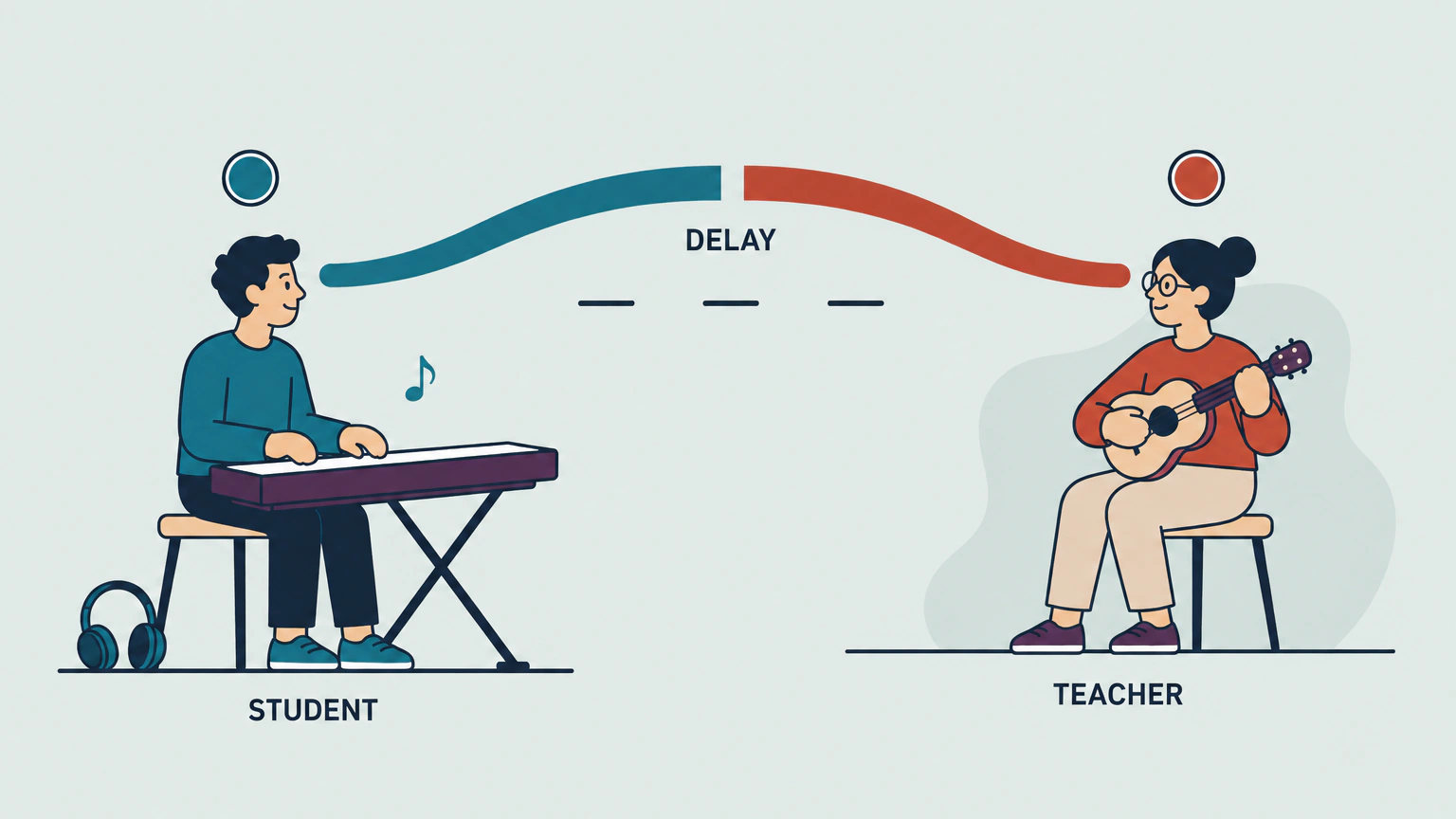
Yes, for many parts of a private music lesson. The part that changes most is playing at the same time as your teacher. Ordinary video calls add enough delay that duets, accompaniment and a shared count become unreliable. Other differences come down to what the teacher can see and hear, which is why your setup and a trial lesson matter.
On this page
- The short answer, and what changes most
- What a video call does to music, measured in milliseconds
- What survives the trip online, and what does not
- Does it work for a young child?
- What online lessons cost, and the comparison nobody publishes
- How to test it in one lesson
- When to book in person anyway
- Questions people ask about online music lessons
The short answer, and what changes most
Think about what you're actually buying in a private lesson. Someone hears whether the note was right. Someone notices the collapsed wrist, or the shoulder that climbs every time the phrase gets hard. Someone decides what you practice this week and checks next week whether you did it. And someone gets a nine year old back on the bench in February, when the novelty is long gone.
All four can survive a video call. The diagnosis, the correction and the assignment can still happen, though camera and audio quality shape how well.
What ordinary video calls handle badly is two people making sound at the same instant. Duets, accompaniment and counting in together become unreliable as delay rises. That's the clearest loss. Other differences, such as what the teacher can see and hear, depend on your setup and the skill being taught.
Two questions follow, and they're the ones worth your time: does this work for a young child, and what does it cost? If you're weighing a group class against a private teacher too, how class size changes what you are buying is the other half of the same decision.
What a video call does to music, measured in milliseconds
The competing explanation is that online lessons suffer from vague "technology limitations." That's not it. Your sound has to be captured, squeezed into a smaller package, shipped across a country, unpacked and played back, and every one of those steps costs time. The total is measured in milliseconds, and musicians have spent years working out what those milliseconds do to two people trying to stay together.
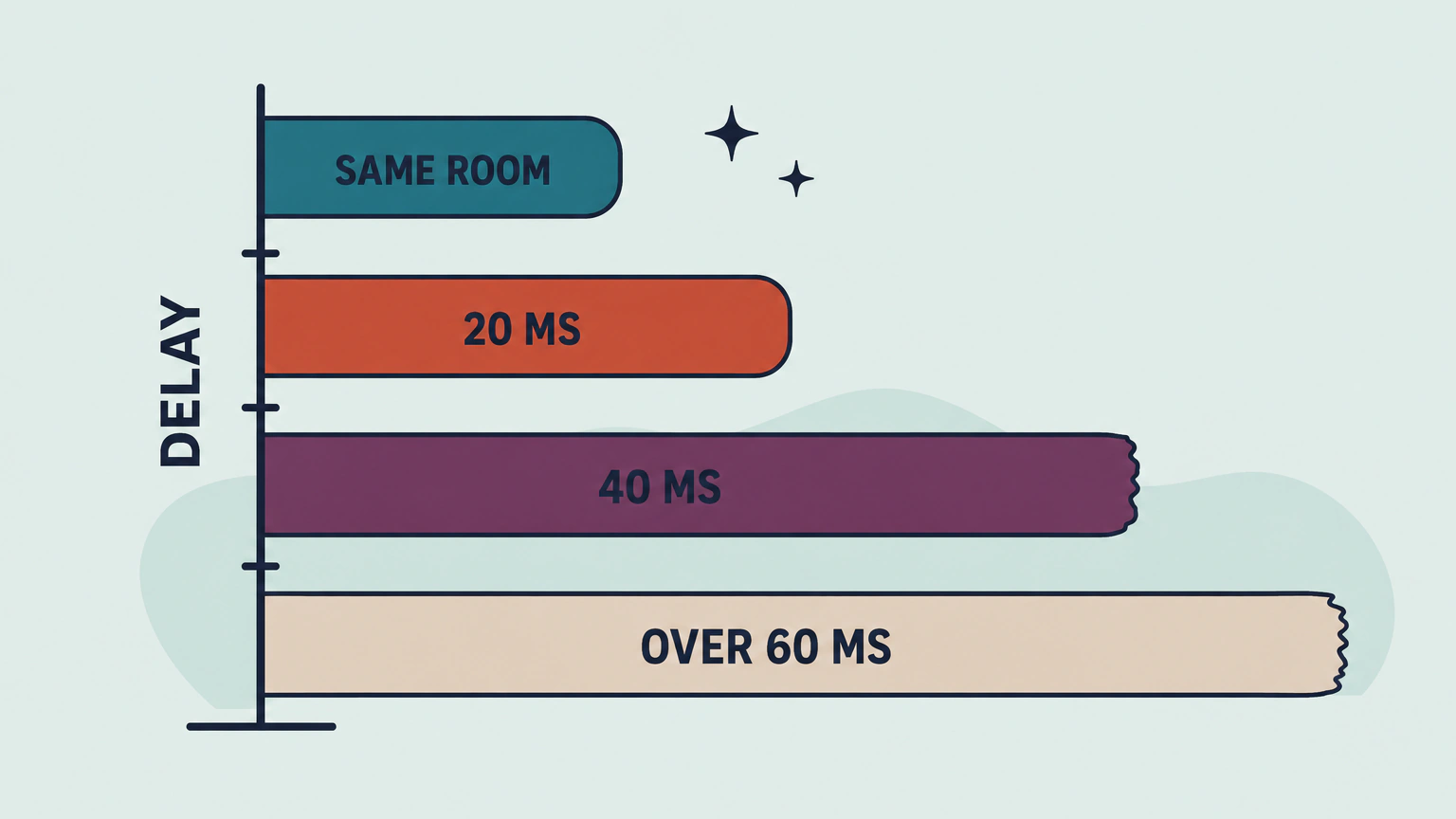
Why an ordinary video call makes playing together unreliable
Frontiers in Psychology published a study of piano duets played over a network, and it lays out the ladder. Sit two players in one room and they hear each other at roughly 6 to 10 milliseconds. Between 10 and 25 milliseconds they still stay synchronized and the tempo holds. Between 25 and 60 they cope: either the pair slows down, or one becomes the starter and the other the joiner. Past 60, coordination falls apart until the performance can't be sustained.
Now the number that decides your question. The 2021 paper noted that standard internet latencies had typically run about 20 to 100 milliseconds in the decade before it was published. That range spans the paper's stable, adapted and unsustainable zones.
The researchers put real pairs through it. At 20 milliseconds the duets held their tempo. At 40, they got progressively slower all the way through the piece, without anyone deciding to slow down. That study looked at two performers playing together rather than at lesson quality, and it measured the part ordinary video calls make unreliable.
So a good online teacher takes turns. She plays, you listen, you play, she listens. A teacher who insists on playing along anyway hasn't worked out her own format yet, and you'll spend the lesson dragging.
What a wired connection and a decent microphone actually buy you
Run a cable from your laptop to the router. Ask the house to stop streaming for half an hour. Both are worth doing, but they don't guarantee the delay stays under roughly 25 milliseconds, which is where the paper found stable tempo. What they buy is a steadier signal, because dropouts are what turn a lesson into thirty minutes of "sorry, say that again."
Audio is the bigger upgrade. Video-call software is usually tuned for speech. Its noise suppression and echo cancellation can interfere with music and cut into the range and detail your teacher needs to hear. A music mode and a good external microphone can improve what reaches her.
Then check camera placement, which costs nothing. A face-only view hides the hands and instrument your teacher may need to see. Moving the laptop back and to the side can help. If you have an old phone, prop it up as a second angle. Ask her in the first lesson what she still can't see.
What survives the trip online, and what does not
| What the lesson does | Over a video call | In the same room | What decides it |
|---|---|---|---|
| Hearing whether you played the right notes | Can come through | Comes through | The microphone, audio settings and connection |
| Correcting hand position and posture | Workable if the camera shows your hands and your face at once | The teacher can move your hand | Camera placement, and whether you have a second device |
| Playing a duet or being accompanied | Often unreliable in real time | Works | Transmission delay, see the section above |
| Counting in and holding a tempo together | Often unreliable in real time | Works | Transmission delay |
| Working through written music together | Can work well with a shared screen | Comes through | Whether the teacher shares a score on screen |
| Reviewing what happened in the lesson | Can be recorded with permission | Depends on the teacher or studio | Whether everyone agrees to record |
| Reaching a teacher your town does not have | Available | Limited to driving distance | Nothing, this is the online advantage |
| Playing in front of other people | Needs a separate arrangement | Depends on the teacher or studio | Whether the teacher runs recitals |
One line runs through most of it. Simultaneous sound is the most predictable trouble spot. Many one-at-a-time tasks can work, while camera and audio quality still decide how much the teacher sees and hears. Once you see the split, you can ask which part of the lesson matters most to you.
The parts that come through almost intact
Pitch, rhythm and wrong notes can come through, though the connection and audio settings shape what the teacher hears. A shared screen can also put the same score in front of both of you at the same size, with nobody leaning over anybody.
Practice can still be assigned and reviewed online. Another possible advantage is a recording, if the teacher agrees and the platform allows it. A parent who has spent a year hearing "she said something about the left hand" may be able to watch the lesson back on Thursday.
And then the advantage nobody argues with. If your town has one piano teacher and she's full, or your kid plays an instrument nobody within an hour teaches, online isn't the compromise. It's the only version of the lesson that exists.
The parts a room handles better
Two different things get filed under "no physical help," and they're worth separating, because one is fixable and one isn't.
The fixable half is seeing. Posture, hand shape, bow hold and the height of a wrist are visible problems, and a camera in the right place shows them. It takes a teacher who will say "move the laptop" and a student who will do it, but the information gets across.
The harder half is hands-on help and playing together. An online teacher can't guide your breathing with a hand or reposition your arm while you hold a bow. An ordinary video call also can't reliably carry a count-in and the performance that follows. Those tasks are easier in a room.
Does it work for a young child?
This is the part the internet skips. There's real evidence, though none of it is about music.
Start with the encouraging half. In one Child Development study, toddlers aged 24 to 30 months learned new verbs from a live adult. They also learned them from a video chat where the adult responded in real time. The same interaction played back without responses taught them nothing. Responsiveness made the difference in that study. A live teacher who reacts is a different product from a course of recorded videos.
Now the harder half. Work published in Developmental Science found a video deficit for spatial recall in children aged four and five. The children remembered hiding places less precisely after watching through a live video feed than through a window. Those studies measured word learning and spatial memory, not piano, so treat them as clues rather than a verdict.
Here's how we'd translate that. Hand placement has a spatial side, so the finding gives you a reason to test that part of the lesson carefully. The younger the child, and the more the lesson is about physical setup, the more we'd look at an in person option. A five year old learning where to put her thumb has more to prove in the trial than an older child working on phrasing.
What online lessons cost, and the comparison nobody publishes
Here's the honest problem with pricing this decision. The number you actually want is one teacher's price for the same lesson in both formats. We couldn't find it on the seven comparison pages we checked. What exists is our own data on one side, a marketplace's guidance on the other, and no bridge between them.
Our own cost panels publish an average of $389 for piano teachers near you and $132 for guitar teachers in your area, based on hundreds of profiles per instrument. We don't say how much lesson time or which services those figures buy, and they adapt to wherever you are. If you want to check how we build our rankings before leaning on them, we've written that down.
| Source | What the figure measures | The figure | What it does not tell you |
|---|---|---|---|
| Our own cost profiles, piano | A published average across our piano cost profiles | $389, based on 570 cost profiles | The lesson length, service bundle or online availability |
| Our own cost profiles, guitar | A published average across our guitar cost profiles | $132, based on 754 cost profiles | The lesson length, service bundle or online availability |
| Our own cost profiles, violin | A published average across our violin cost profiles | $153, based on 706 cost profiles | The lesson length, service bundle or online availability |
| Our own cost profiles, drums | A published average across our drum cost profiles | $143, based on 621 cost profiles | The lesson length, service bundle or online availability |
| Our own cost profiles, voice | A published average across our voice cost profiles | $271, based on 941 cost profiles | The lesson length, service bundle or online availability |
| Forte, an online lesson marketplace | What the company tells buyers to expect from an experienced online teacher | $60 to $100 an hour, and about $320 a month at one lesson a week | That it is the marketplace's own guidance rather than a survey of teachers |
Both sides have a hole in them. Ours doesn't tell you what you get for the money, and Forte's is advice to buyers rather than a count of what teachers charge. Multiply either one out to a year and you'd be inventing a comparison, so we won't.
You can get the real number in two questions. Ask a teacher what she charges for a 30 minute lesson online and in person. Then ask whether both appointments run the same length and include the same follow-up. Two answers from one person beat every average on the internet, including ours.
How to test it in one lesson
It all comes down to one appointment. If the teacher offers a trial, treat it as a test rather than as a first lesson. If not, ask to book one lesson before you commit to a package.
- Ask the teacher to count you in and start a phrase together, so you both hear the delay once and stop expecting it to go away.
- Put the camera where your hands and your instrument are both in frame, then ask the teacher what she still cannot see.
- Plug into the router with a cable if you can, and run the lesson with nothing else streaming in the house.
- Wear headphones so the teacher's sound does not loop back through your microphone.
- Turn on the platform's music or original sound setting if it has one, and ask the teacher whether it changed anything on her end.
- Ask how she plans to handle the parts that need a room, such as posture, bow hold or breath support.
- Ask whether the lesson can be recorded, and where the recording lives afterward.
Pro tip: If the teacher offers a trial lesson, run all seven checks inside it. Then watch what she does when the sound drops out, rather than how the lesson goes when everything works. A teacher with a plan for the bad minute is the one to hire.
When to book in person anyway
Several readers should drive. Start with a young child whose lessons are still mostly about physical setup. A beginning singer may also prefer singing teachers near you, because a teacher in the room can watch posture and breathing from more than one angle.
Third, anyone who needs the appointment to be somewhere else to actually happen. Some of us practice because a person is waiting in a room, and there's no shame in knowing that about yourself. It's the same calculation behind whether a personal trainer is worth it: part of what you're buying is the commitment.
Fourth, anyone whose real goal is playing with other people. Ensembles, recitals, a band, a church group. That's the one thing the delay takes off the table, and it's worth choosing a format around.
If those limits don't match your goal, an online trial is a sensible place to start. If you'd rather drive, compare the teachers within range first, then run the seven checks either way.
Questions people ask about online music lessons
The six that come up most, answered short.
Are online music lessons as good as in person lessons?
For a private lesson, it can be close. A teacher may hear wrong notes, see a collapsed wrist with the right camera angle, and set your practice for the week. What ordinary video calls handle badly is playing together in real time. If duets, accompaniment and ensemble timing matter to you, that's the clearest difference.
How much do online music lessons cost?
Forte, an online lesson marketplace, tells buyers to expect $60 to $100 an hour for an experienced online teacher, and budgets around $320 a month for one lesson a week. Our cost panels publish averages from $132 for guitar to $389 for piano, but don't state the lesson length. The two aren't measuring the same thing, so ask a teacher for both prices.
Can you really learn an instrument online?
Yes. Many core parts can work online: hearing whether a note was right, checking a hand shape, assigning practice and reviewing it the following week. Playing at the same moment as somebody else is the hardest part for an ordinary video call. That's a genuine limit, but it isn't a verdict on the whole lesson.
How does an online music lesson actually work?
You and the teacher meet on a video call at a set time, the same as a studio appointment. You place the camera so she can see your hands and your face. She listens, stops you, and demonstrates by taking turns instead of playing along. The teacher can assign practice at the end, and you can ask whether the session may be recorded.
Are online singing lessons worth it?
Usually, with one caveat. With the right audio settings, a teacher can hear pitch, vowel shape and breathiness, and she can watch your jaw and shoulders. What she can't do online is guide your breathing by touch. An absolute beginner may prefer a room, where the teacher can watch posture and breathing from more than one angle.
Can my child learn piano over a video call?
Often, yes. Toddlers in one Child Development study learned new words from a responsive video chat about as well as from an adult in the room. The recorded-video group performed at chance. The study doesn't test music, but it shows why a responsive call isn't the same as a video course. A separate study found a spatial-recall deficit at four and five, which may matter when hand placement is the lesson.