

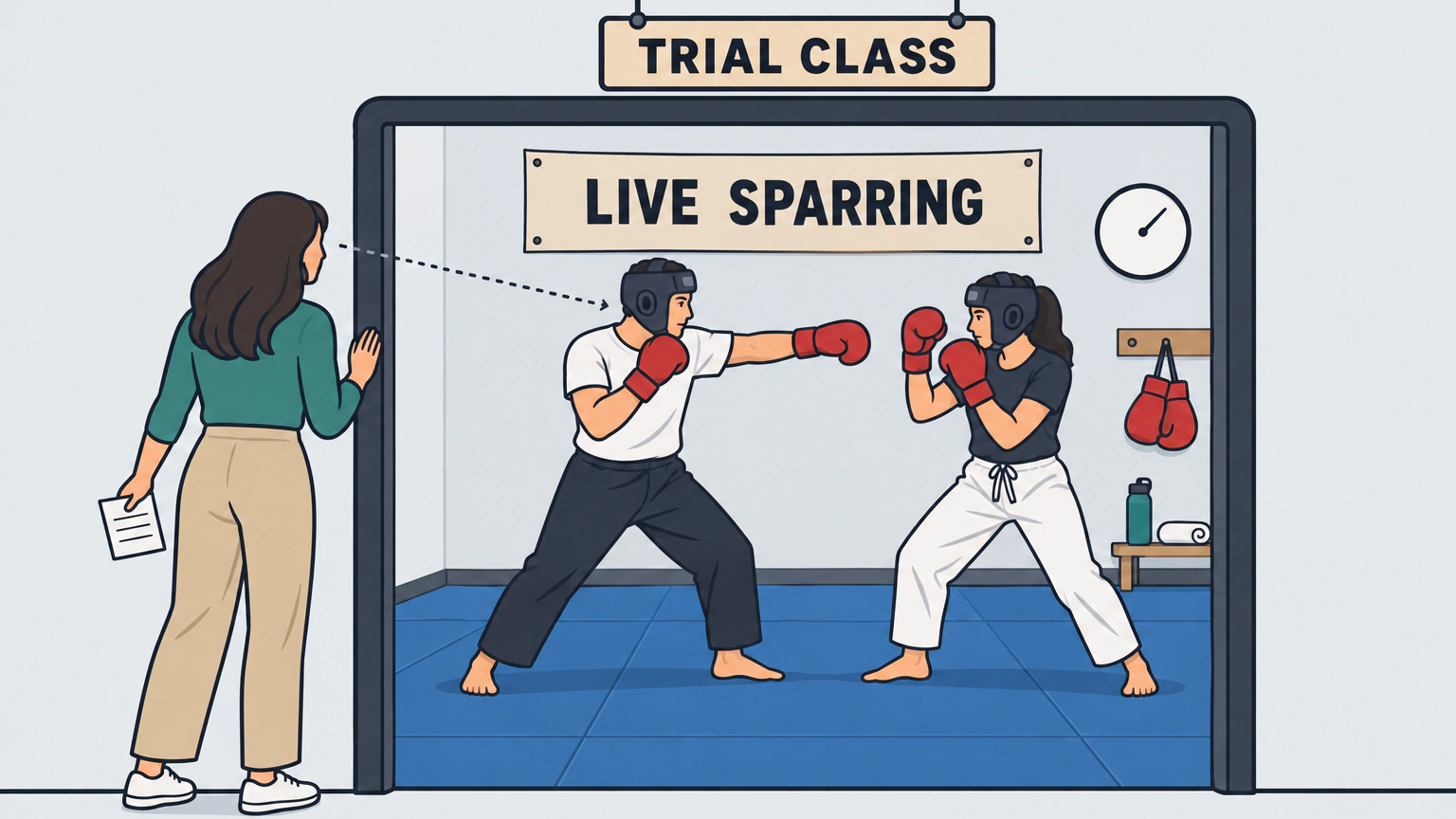
So don't shop for a trophy style. Shop for a class that passes one test, and run that test yourself on a free trial visit.
On this page
The short answer: pick the class that spars
Boxing, Muay Thai and kickboxing, wrestling, judo, Brazilian jiu-jitsu and MMA share one habit. In each of them, students practice against a partner who resists, and that's built into the style rather than added by an eager coach. Karate, taekwondo and Krav Maga can be taught that way too. Whether they are depends on the school. Aikido sits at the far end. The Aikikai Foundation says in plain words that "there are no tournaments or competitions where inferiority and superiority are decided."
That's the first half of the verdict, and it's why we'd pick the class that spars.
The second half matters just as much. The style you'll keep showing up for beats the "best" style you quit in March. A friendly boxing gym you like is worth more than a famous academy you dread driving to.
Resistance is the dividing line for a reason, and the clearest evidence for it comes from an unlikely place: police officers in the Netherlands.
Why practicing against a partner who resists matters so much
Dutch researchers spent years testing how officers' arrest and self-defense skills hold up when things get frightening. The story runs in three steps.
First, the skills fell apart under pressure. When an attacker's rubber knife was swapped for one that could deliver a real shock, officers reacted faster, leaned back, ducked and performed worse. Fear changed how they moved.
Second, officers with extra training performed better. Those who did kickboxing or karate/jiu-jitsu several times a week held up better under high anxiety than officers who relied on regular police training, which ran only four to six hours a year. So did officers who trained Krav Maga just once a week.
Third, rehearsing whole violent encounters, talking included, improved performance in a way the regular training didn't.
Even officers with extra training still performed worse under high anxiety. Researchers found no clear difference in the drop across the four groups. A drill where your partner politely cooperates can't teach you what a partner who's fighting back will. So when you watch a class, ask two things: how hard is the sparring, and how much resistance do students feel?
The main styles, and what live practice looks like in each
Every one of these styles can be taught well or badly. For each, there's one question that tells the difference in a single visit, and it's worth asking out loud.
The main styles, side by side
| Style | What live practice looks like | What to ask on your trial class |
|---|---|---|
| Boxing | Sparring in gloves and headgear, in timed rounds | How soon do beginners spar, and how hard? |
| Muay Thai and kickboxing | Sparring with punches and kicks, plus clinch work in Muay Thai | Is sparring kept light and technical for new students? |
| Wrestling | Live wrestling against a partner who fights your takedown | Are beginners paired with partners near their size? |
| Judo | Randori, free practice of throws against a resisting partner | Do you learn to fall safely before your first randori? |
| Brazilian jiu-jitsu | Rolling, live grappling that mostly happens on the ground | Do classes ever start standing, and do you practice getting up? |
| MMA | Sparring that mixes striking, takedowns and ground work | Can beginners stay out of hard sparring until they're ready? |
| Karate and taekwondo | Varies by school, from light point sparring to full contact | What does sparring look like here, and how much contact is allowed? |
| Krav Maga | Scenario drills and sparring, with intensity set by each school | Do you ever drill against a partner who's really trying to stop you? |
| Aikido | Partners take turns applying and receiving techniques; the Aikikai holds no competitions | Is any class time spent against a partner who resists? |
Once two or three styles appeal to you, compare martial arts classes near you or kickboxing and Muay Thai gyms on our category pages, and take those questions along.
What the research actually tested
We couldn't find a study that compares martial-arts styles on whether the people who train them get attacked less or hurt less.
What does exist is better evidence for something narrower, and it points somewhere you might not expect. The strongest results come from short courses that teach women to resist sexual assault, most often by men they know. The police studies add the other half. Training under real pressure is what carries over, whichever door you walk through.
What the research actually tested
| Study | Who took part | The training | What happened |
|---|---|---|---|
| Senn and colleagues, New England Journal of Medicine, 2015 (randomized trial) | 893 first-year women at three Canadian universities | EAAA: four 3-hour units | Completed rape within a year: 5.2% of trained women vs 9.8% of women given brochures. Attempted rape: 3.4% vs 9.3% |
| Senn and colleagues, Psychology of Women Quarterly, 2017 | The same 893 women, followed for two years | EAAA | Reductions of 30% to 64% across the assault outcomes still held at two years |
| Senn and colleagues, European Journal of Psychotraumatology, 2023 | Women at five Canadian universities, with the course run by the schools themselves | EAAA | Completed rape down 57.3% at six months, against students who signed up but didn't attend |
| Hollander, Violence Against Women, 2014 | University women | A 10-week self-defense class | Less likely to be sexually assaulted over the next year than similar women without the class |
| Baiocchi and colleagues, Prevention Science, 2017 (cluster-randomized) | 5,686 girls aged 10 to 16 at 28 schools in Nairobi, Kenya | Six 2-hour sessions | Past-year risk of sexual assault fell 3.7 percentage points, from 7.3% at baseline |
| Sarnquist and colleagues, Prevention Science, 2024 (cluster-randomized) | 3,263 girls aged 10 to 14 in Nairobi, Kenya | A 12-hour program | No significant difference in reported rape two years later |
| Kettrey and colleagues, Journal of Adolescent Health, 2023 (meta-analysis) | 80 studies of US campus prevention programs | Many program types | A small effect on victimization, a larger one on attitudes |
| Renden and colleagues, Ergonomics, 2015 | Dutch police officers | Extra kickboxing or karate/jiu-jitsu several times a week, or Krav Maga once a week | Performed better under high anxiety than officers without extra training, but still worse than under low anxiety |
The 12-hour course that cut completed rapes nearly in half
The program is called EAAA, short for Enhanced Assess, Acknowledge, Act, and it's offered today as Flip the Script with EAAA. It runs as four 3-hour units. Women learn to size up risk from men they know, to push past the feelings that make it hard to admit they're in danger, and to act, with both verbal and physical self-defense. Only 2 of the 12 hours go to physical self-defense practice.
Its results are the strongest we found anywhere in this field. In the New England Journal of Medicine trial, about 5 in 100 women who took the course experienced a completed rape over the next year, against nearly 10 in 100 of the women who got brochures. Attempted rapes fell from about 9 in 100 to about 3. Two years out, the drops still held, at 30% to 64% across the different kinds of assault the researchers measured. And when five Canadian universities later ran the course themselves, completed rapes among women who took it fell by more than half at six months, compared with women who signed up and didn't attend. A smaller follow-up with some of the original women found the course also roughly halved partner violence in new relationships.
Scope matters here. The course was built and tested for university women aged 17 to 24, in Canada. It has since run at US schools including Florida Atlantic University, the University of Iowa and the US Air Force Academy.
No class can promise you'll never be hurt. If something has already happened to you, you can call RAINN's national hotline (the Rape, Abuse & Incest National Network) at 800-656-4673.
Where the evidence gets thinner
A course isn't a vaccine, and the wider research says so. A 2023 review that pooled three decades of US campus prevention studies found only a small effect on victimization and a bigger one on attitudes. Programs framed around reducing women's own risk were linked to weaker results than others. A group of researchers, including the authors of the EAAA trial and the 10-week class study, answered in the same journal that empowerment self-defense does prevent rape. Treat it as a live argument, not a settled one.
Kenya shows the same split. An earlier trial in Nairobi schools found a modest drop in sexual assault among girls who took six 2-hour sessions. A 2024 trial of a 12-hour program in Nairobi found no difference in reported rape two years later.
The specific program matters, and so does how faithfully it's taught. A class that can't tell you what it's based on is asking for trust it hasn't earned.
Who you're most likely defending yourself against
Most people picture a stranger in a dark parking lot. The federal numbers are more complicated. Of the violent crimes victims described to the National Crime Victimization Survey for 2024, just under half (46%) involved a stranger. About one in six were committed by a current or former partner or a family member.
The EAAA trial opens on the same point. University women face "substantial risk for being sexually assaulted, primarily by male acquaintances," its authors write.
That changes what good training looks like. Noticing pressure from someone you know, and saying no loudly and early, aren't soft extras. They're the skills for the most common situations, and they don't depend on your size or strength. A course that spends real time on them is still teaching self-defense.
None of this makes the fight-shaped scenario imaginary. When the person is a partner or a relative, "just run" can be hard advice to follow, and some hand-to-hand skill still counts. The physical half matters too, and it's worth learning somewhere that makes it real.
Choosing for your size and your age
The same test works for everyone. Two situations change which class fits best, though.
If you're smaller than the people you worry about
Size is real, and a good school will admit it. Even Brazilian jiu-jitsu, the art most often sold as the great equalizer, runs its tournaments in weight divisions. At the IBJJF's 2026 Pan Championship, the lightest adult men's black-belt division topped out at 127 lb. Weight matters in striking, but it doesn't decide punching force by itself. Technique and speed matter too.
Technique narrows a size gap. It doesn't erase it.
What helps most when you're the smaller one is a grappling base for escaping and getting back to your feet, and training partners near your size while you learn. Then add the non-physical skills from the course research, which don't care what you weigh.
If you're over 60
For most older readers, the injury most likely to find you is a fall, not an attacker. At least a third of people over 65 living outside nursing homes fall each year, according to a Cochrane review of exercise trials. The same review found tai chi cut the number of people who fell by about a fifth, and it rated that evidence high-certainty.
So the martial art with the best evidence for protecting an older body is the gentle one, and tai chi classes are a sensible first stop. If you still want self-defense skills, the same trial-class test applies. Add one question: how does the school teach falling, and how does it pair partners of different ages?
What sparring costs your body
Gym pages rarely mention this part. Sparring is where the real learning happens, and it also brings injury risk.
In a large international survey of Brazilian jiu-jitsu practitioners, most injuries happened in training rather than in competition, and 79% of those training injuries came during sparring. Knees and shoulders took the most damage.
Boxing raises a different worry, and it's your head. Cadets in a beginners' boxing course at West Point wore sensor mouthguards and took about four head impacts per sparring bout. The forces were similar to those reported for service-academy football. Those were early numbers. A small 2026 study of competitive boxers found that changes in concussion-type symptoms after sparring were rare and subtle, with no clear link to the hits. Nobody should be casual about it either way.
Here's what we'd want from any gym. Light, technical sparring should be the default for beginners. A bigger or more experienced partner should let the smaller one set the pace, and a partner who hits hard first is the one breaking the etiquette. Hard sparring belongs to people getting ready to compete, with a partner they trust, and only some of the time. Before you sign up for boxing classes or anything else, get a straight answer about head contact.
How to judge a class on a trial visit
Many schools will let you try a class for free. Use that visit to test the one thing that matters, and bring these questions with you.
Seven questions for a trial class
- Stay for the whole class, not just the warm-up, and watch whether anyone practices against a partner who's trying to stop them.
- Ask how soon new students spar and how hard. The answer you want is a gradual start at light intensity.
- Ask who you'll be paired with at first. A bigger or more experienced partner should let you set the pace.
- Ask what head contact is allowed in sparring and what protective gear the school requires.
- Ask how the class practices getting back to your feet and away, not only winning a position.
- For a self-defense course, ask whether it covers people you know as well as strangers, and whether you'll practice refusing out loud.
- Ask whether the price covers the whole course or one month, and take any contract home before you sign.
Red flag: four signs to keep looking
- Techniques described as too dangerous to ever practice against a resisting partner.
- A promise that one course, one belt or one technique will keep you safe.
- Pressure to sign a long-term contract on your first visit.
- Beginners thrown into hard sparring in their first week, or bigger students allowed to go hard on smaller ones.
Frequently asked questions
Do self-defense classes actually work?
Some do, and the best of them have trial evidence behind them. The EAAA course nearly halved completed rapes among first-year university women over the following year. Across three decades of campus programs, though, the average effect was small, and one Nairobi trial found no difference at all. What a course teaches, and how faithfully it's taught, matters more than the label on the flyer.
How long does it take to learn enough self-defense to matter?
The best-evidenced course took 12 hours. For martial arts there's no research-backed timeline, but the Dutch police study found that officers who trained once a week performed better under stress. Steady attendance beats a heroic first month. If you're weighing a short course against the long road, it helps to know how long belts actually take.
What's the best martial art for self-defense for women?
If the goal is protection from sexual assault, a resistance course built for women has better evidence than any martial art, and EAAA is the strongest example. If you want a martial art as well, choose one that spars. Look for a school where you can start with partners near your size, and where the coaches build contact up slowly instead of testing you on day one.
Is Krav Maga good for self-defense?
It can be. In the Dutch police study, officers who trained Krav Maga just once a week performed better under stress than officers with no extra training. How much a Krav Maga school spars varies widely, though. On your trial class, ask whether you'll ever drill against a partner who's really trying to stop you, and then watch whether anyone does.
Do most fights really end up on the ground?
The gym pages we checked didn't show it. Plenty of gyms repeat the idea, and one jiu-jitsu academy prints a precise "85-90%" with no study behind it. Even a Krav Maga school that says most real fights end up on the ground warns that "going to the ground with one attacker while others may be present creates dangerous vulnerabilities." Learn some ground skills, and practice getting back to your feet.
What's the best martial art for self-defense for kids?
For younger children, pick a class where sparring is light, supervised and matched by size. Grappling classes often manage that with less head contact than striking ones. The school-based programs tested on girls in Nairobi produced mixed results, so treat any class as one layer of a child's safety, not the whole plan. It's also worth checking what age kids can start.
How much do self-defense classes cost?
Ask whether the quoted fee buys one session, a whole course or a month of classes. Ongoing martial-arts tuition runs monthly, often with extra fees, and our guide to what martial arts classes really cost covers it.
What to do next
Book a free trial class at two schools, and run the seven questions at both. Watching two classes side by side teaches you more than any ranking.
If you're a college student, or the parent of one, ask the campus women's center or Title IX office whether it runs Flip the Script or another empowerment self-defense course.
Then compare self-defense classes near you and martial arts classes near you on our category pages.