

On this page
- The short answer
- The chart everyone prints, and where it actually comes from
- The five things a voice teacher listens for
- Four things that are not your voice type
- Teenagers, and why nobody should classify a changing voice
- Does your voice type matter for the music you want to sing
- What a first voice lesson should tell you
- Frequently asked questions
- What to do next
The short answer
Somebody just asked for your voice type, and you don't know what to say. Classical singing sorts voices into seven main voice types: soprano, mezzo-soprano and contralto for the higher voices, tenor, baritone and bass for the lower ones, with countertenor for men who sing in the alto or soprano range. What no chart will tell you is which one you are. The two standard music reference works can't even agree where a tenor's range starts, and the research on how voices actually get classified points at timbre and vocal weight, not at the highest note you can reach. So start with the ranges and see which categories you overlap, then let a teacher weigh in. One lesson gets you an honest first read, and it's genuinely the fun part.
Children's unchanged voices get one more name, treble, because boys and girls sound so alike before puberty. Before you lean on any chart, though, find out who drew it.
The chart everyone prints, and where it actually comes from
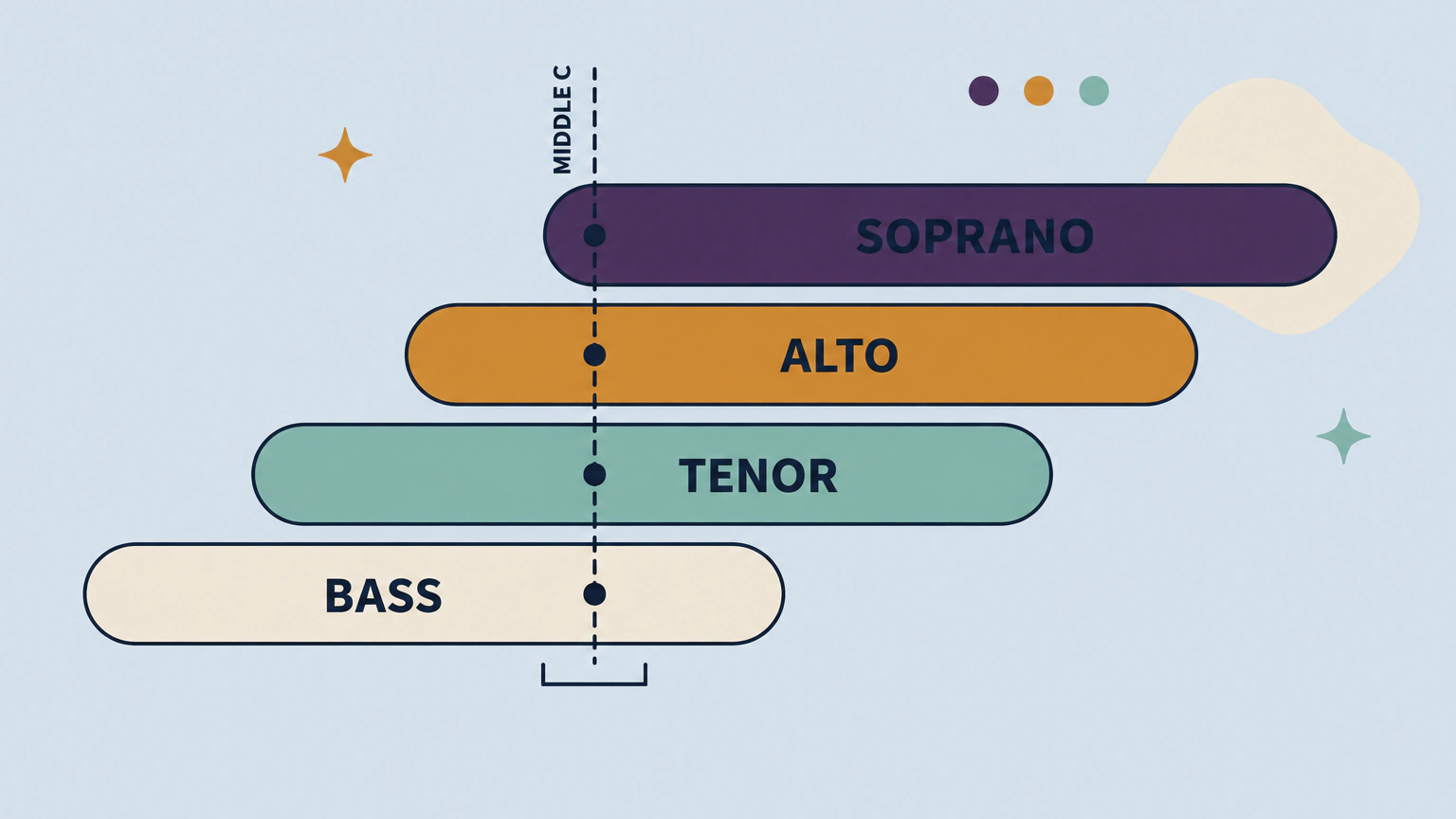
Search for singing voice types and nearly every page hands you a note range for each one. We read the consumer pages that come back, and not one says who decided those numbers. One bit of notation first: middle C is C4, and the C an octave below is C3.
What two standard reference works actually say
Yale University Library's music catalogers keep a short reference page that prints two sets of voice ranges, one from The New Harvard Dictionary of Music and one from Grove Music Online. Here's how they line up.
| Voice type | New Harvard Dictionary of Music | Grove Music Online | Where the two disagree |
|---|---|---|---|
| Soprano | C4 to A5 | C4 to A5 | They agree exactly |
| Mezzo-soprano | A3 to F5 | A3 to F#5 | Grove reaches a half step higher at the top |
| Alto | F3 to D5 | G3 to E5, with contralto listed separately at F3 to D5 | Grove sets alto a whole step higher at both ends and keeps contralto apart |
| Tenor | B2 to G4 | roughly C3 to A4 | Grove starts a half step higher and reaches a whole step higher |
| Baritone | G2 to E4 | A2 to F4 | Grove starts a whole step higher and stops a half step higher |
| Bass | E2 to C4 | F2 to E4 | Grove starts a half step higher and reaches a major third higher |
Neither reference work lists countertenor, which is a way of singing in the alto or soprano range rather than a separate span, and neither is trying to classify a singer. C4 is middle C under the ISO octave designation.
Five of the six rows disagree. Take the tenor. Harvard starts it at B2 and Grove at C3, and Grove tops out a whole step higher, at A4. So B2 falls inside the tenor range in one book and below it in the other. Yale's page admits it plainly: "Vocal ranges for solo or choral works may differ, as evidenced from the different ranges found in other sources."
Why a shelving rule became a singer's chart
The Harvard ranges have a narrow job, which is filing printed music. The cataloging rule Yale follows is to go by what the score itself says, like "high voice," and to reach for the Harvard ranges only when the score is silent. Yale even pairs them up: soprano and tenor count as high voice, mezzo and baritone as medium, alto and bass as low. That's a filing system for sheet music, never a test for people.
The University of Puget Sound's free theory textbook narrows things again, for part-writing homework. Its ranges are "likely more limited than those found among vocalists in the class," and "based on those most commonly found in J.S. Bach's 371 Chorales."
And one page that looks like a fourth academic source isn't. A "Vocal Types and Ranges" chapter in a music appreciation course on Lumen Learning names Wikipedia as the provider of its voice type content, right in its own citation block. Two dictionaries, a filing rule and a theory class, and none of them was built to tell a person what they are.
The five things a voice teacher listens for
A teacher placing your voice runs five checks at once. You can do only one of them alone, and it's the one that tells you least.
| What the teacher checks | What it tells them | Can you check it yourself |
|---|---|---|
| Range, the notes you can produce at all | The least of the five, because the types overlap heavily | Yes, at a keyboard |
| Tessitura, where the voice sits comfortably across a whole song | Narrows the field, because comfort tracks type better than extremes do | Partly, and only over a full song |
| Timbre, the color of the sound | A strong clue when ranges overlap | Not reliably on your own |
| Vocal weight, how heavy or light the sound carries | Another clue a teacher weighs alongside range and tessitura | No, this needs an experienced ear |
| Passaggio, where the voice shifts gear | Locates the seams, which sit at different pitches by type | Sometimes, if you slide slowly and listen for the flip |
Range is the least useful of the five
Range is every note you can sing, bottom to top. It settles the least because the types overlap so much: on Harvard's numbers, middle C sits inside the soprano, alto, tenor and bass ranges at once.
Still, find yours honestly. You need a keyboard, or a friend who plays, or a piano teacher to call out the notes. Sing down a half step at a time on an easy syllable, staying in your normal chest voice as long as you can. Sooner or later the sound slips into vocal fry, that low crackle at the end of a tired sentence. The last clean note before it is your true bottom. The gravelly ones underneath don't count.
Tessitura, timbre and weight
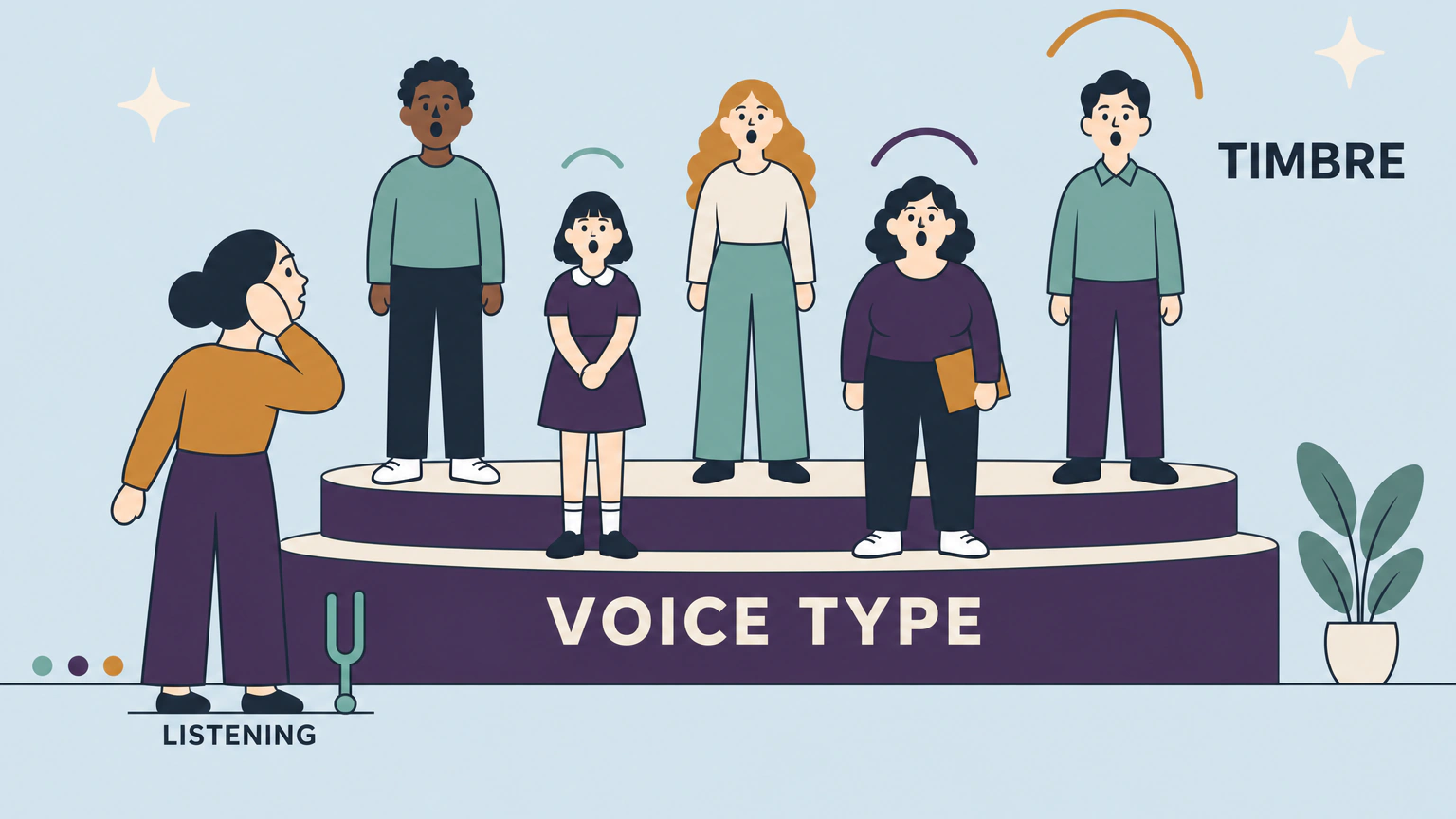
This is where a voice really gets placed. Tessitura (tess-ih-TOOR-uh) is where your voice sits comfortably across a whole song, not the one heroic note you can hit once. Timbre is the color of the sound, the reason two people on the same note sound different. Vocal weight is how light or heavy the voice sounds, bright and nimble at one end, fuller and darker at the other.
A study in the Journal of Voice put those qualities to the test. Twelve classically trained female voice students, six sopranos and six mezzo-sopranos, sang the same three notes. Then 56 listeners with no voice training heard the recordings in pairs and rated how different each pair sounded.
Their ratings matched the teachers' voice types on the lowest note and the teachers' weight ratings on the two higher ones. Those listeners had no range and no tessitura to go on, only timbre, and it was enough. And with limited exceptions, "no single acoustic variable" explained what they heard. The study tested only women, so it says nothing directly about tenors or basses. But it shows why this is a job for a trained ear rather than a chart.
The passaggio, and why a teacher asks you to slide
Every voice has seams. The passaggio (pah-SAH-jo) is where the voice shifts gear between registers, the way chest voice hands off to lighter head voice higher up. Where the seams fall depends on voice type, which is why a teacher goes looking for them.
So a first lesson may start with a slow slide on one vowel, low to high and back. You aren't being graded. The teacher is listening for where the sound flips, thins or cracks. It's far easier to hear than to read about, and this 11-minute video lesson on the passaggio sings a phrase straight through the seam in a man's voice, then shows the ways it goes wrong: a flip into falsetto, or a sound that turns too dark, too tight or too loud.
Four things that are not your voice type
Four things that are not your voice type
- Your speaking voice. A study of 75 professional opera singers found speaking pitch does track voice type on average, and concluded it still can't be used to classify anyone.
- The section you sing in choir. Choirs sort parts by range, and medium voices often land in a neighboring part. Being put with the altos or baritones doesn't settle your voice type.
- Trouble with high notes. That can point at how you're moving between registers, which is trainable, rather than at a ceiling you were born with.
- Your favorite singer's classification. Pop, rock and musical theater run through a microphone, and the classical categories were built for rooms that didn't have one.
Your speaking voice. In that opera study, the gap in speaking pitch between baritones and basses wasn't even significant, and the borders between types varied widely in every group. The authors' verdict: speaking pitch "can not be used for the classification of singing voices." Countertenors prove it from the other side. They sing in a mezzo's range and talk like ordinary tenors or baritones.
Your choir section. Most choirs sort four parts by range alone. Since most people have medium voices, a natural mezzo gets put on soprano or alto, and a natural baritone on tenor or bass. So if your twelve-year-old came home an alto, that's news about this year's choir, not a verdict on her voice.
Trouble with high notes. Registration is how smoothly you cross from chest voice into head voice, and you can train it. Notes you once had and have lost are a different story, and a health one.
Your favorite singer's label. Online lists love to file pop stars under opera categories. Even Wikipedia's voice type entry says classification grew up in European classical music and "is not generally applicable to other forms of singing."
Teenagers, and why nobody should classify a changing voice
Your twelve-year-old was just put in a section, and the voice they bring to rehearsal in October may not be the voice they have in March. Girls change too. A study of more than 2,600 children and teens found girls' speaking pitch falls steadily through adolescence, while boys' falls much further and fastest at around thirteen and a half. In both, the drop tracked the stage of puberty rather than body weight or singing.
So keep the rule modest. Write down the lowest and highest notes that come easily this month, and check again in a few months. A good teacher treats any label as a pencil mark, because a changing voice may settle into a different category in adulthood.
What the research found in boys
Two small studies are worth knowing. The first, in Archives of Disease in Childhood, followed 26 boys through puberty. Their voices changed late and abruptly, between the third and fourth Tanner stages of physical development, and more gradually on the Cooksey scale, a set of stages for the changing male voice. The two scales lined up well. Testosterone levels didn't predict the change.
The second, in the Journal of Voice, followed 28 choirboys aged 8 to 13 whose voices were unchanged or just starting to move. Pitch breaks showed up mostly on higher notes and wider leaps. Seven boys were recorded again at the fourth Cooksey stage, and by then their voices broke more often and sounded breathier. The authors call the change "variable and often unpredictable," which is the one line a parent should keep. If your child sings in a choir, ask the director whether they use Cooksey stages.
What to ask a teacher who teaches teens
How do you pick songs for a voice that's mid-change? How often do you check range again? When a note that worked in September cracks in November, do you move the song into a lower key or push for the old note? A teacher who understands changing voices answers those easily. If you hear a fixed plan for a fixed voice, keep looking.
Does your voice type matter for the music you want to sing
It depends on whether there's a microphone. In opera and serious choral work, voice type matters enormously, because an unamplified singer has to be heard over an orchestra. That's what the German Fach system is for. It sorts opera singers by the weight and color of their voices as well as range, especially in German-speaking countries, and companies cast from Fach lists so a role doesn't go to an unsuited voice. Dramatic roles are often written with a larger orchestra in mind, since heavy voices carry over it more easily.
In pop, rock and most contemporary singing, the label matters far less than the internet implies. The microphone does the carrying, and any song can move into a key that suits you. Musical theater sits in between: amplified, but with roles written for particular voices. If that's your goal, pair voice lessons with acting and musical theater classes, where you'll learn which parts fit.
So for opera or a classical choir, find a teacher who classifies carefully and slowly. For your playlist, don't let a label decide what you try.
What a first voice lesson should tell you
A good first lesson has a shape. Scales up and down map your range, and a slow slide finds the seams. Then comes a song you already know, because timbre and weight are easiest to hear in real music, and finally a talk about what you want to sing. A teacher who hands you a label in the first five minutes, before hearing you sing, is guessing. Even a careful teacher's first read is a working answer that may shift as your technique settles.
Thinking of a first lesson online? Read what actually survives a video call before you book, since timbre and weight are exactly what the teacher needs to hear clearly. And if your top notes have gone missing, notes you could sing last year, that's not a voice type question at all.
When a lost note is a health question
The National Institute on Deafness and Other Communication Disorders lists "Have you lost your ability to hit some high notes when singing?" and "Does your voice suddenly sound deeper?" among its warning signs, along with hoarseness and a throat that often feels raw or strained. It says to see a doctor, and names an otolaryngologist, an ear, nose and throat specialist, as the one who can best diagnose a voice problem. We're a lesson directory, not a clinic. A voice that has changed for no clear reason belongs in front of a doctor before a teacher.
What to ask before you book
Six questions cover most of what you need to know before you pay.
- Will the first lesson include hearing me sing a full song, not just scales?
- Do you teach the style I want to sing, or mostly classical?
- Have you taught singers whose voices are still changing?
- What will you tell me about my voice at the end of the first session?
- What does a package cost, and what happens if I miss a lesson?
- Where did you train, and are you a member of a teaching association?
People skip the last one. A teaching association such as the National Association of Teachers of Singing runs workshops, master classes and conferences for its members, so belonging is a fair sign of a teacher who keeps learning. Our guide on how to verify an instructor's credentials covers what to ask when there's no registry to search.
Frequently asked questions
How many voice types are there?
Most classical systems recognize seven main voice types: soprano, mezzo-soprano and contralto for women, and countertenor, tenor, baritone and bass for men. Children's unchanged voices are called treble. Choirs boil that down to four parts, soprano, alto, tenor and bass, while opera splits each type into subtypes, which is where the longer lists of different voice types come from.
Is alto a voice type, or just a choir part?
Strictly, alto is a choir part, the lower women's line in a four-part choir, judged by range alone. The matching classical voice type is contralto, which also takes in timbre, vocal weight and tessitura. The words blur in practice: Harvard's dictionary gives alto its own range, while Grove lists alto and contralto separately. A choir alto might be a contralto or a mezzo-soprano.
What is the rarest voice type?
The usual answer is the contralto, the lowest female voice. Wikipedia's voice type entry calls a true operatic contralto rare enough that contralto roles often go to mezzo-sopranos. Among men, a countertenor who sings that high in full voice rather than falsetto is very rare, and most countertenors use falsetto for their upper range.
Can your voice type change with age?
Yes. The biggest shift comes at puberty, sharply for many boys and gradually for girls, and voices keep maturing into early adulthood. It doesn't stop there: some well-known opera singers changed voice type over their careers, and some voices get lower with age. A sudden change is different. Lost high notes or a voice that suddenly sounds deeper are reasons to see a doctor.
What is the highest male voice type?
The countertenor, the highest of the male voice types. Countertenors sing in the range of a mezzo-soprano or contralto, and a few, called sopranists, reach a soprano's notes, mostly using falsetto up there. If you mean the highest male voice in ordinary full voice, without falsetto, that's the tenor, the top male type on both the Harvard and Grove lists.
How is tessitura different from range?
Range is every note you can produce, lowest to highest. Tessitura is the part of that range where your voice sits comfortably most of the time, often called the heart of the range. Choirs sort by range, while solo voice types lean on tessitura. Wagner's Siegfried spans C#3 to C5, yet it counts as a high role because most of its phrases sit between C4 and A4.
What to do next
First, use the chart to see which categories your comfortable notes overlap, and stop there. Second, book one lesson and ask the teacher to explain their reasoning out loud: what they heard in your timbre, your weight and your seams. Third, if a choir placement is why you're here, ask the director whether it was about your voice or about the balance of the section. Only one of those answers is about you.
When you're ready, compare singing and voice teachers near you. Across 941 cost profiles for voice lessons, our average is $271 and our fair price range runs $146 to $396. Our category pages price to a location, so treat that as a snapshot rather than a rate card, and we explain how we score the teachers we list on our own page. For a real local list, see voice teachers in New York. And if you're weighing more choir time against one-on-one lessons, we've set out what class size actually buys you.