

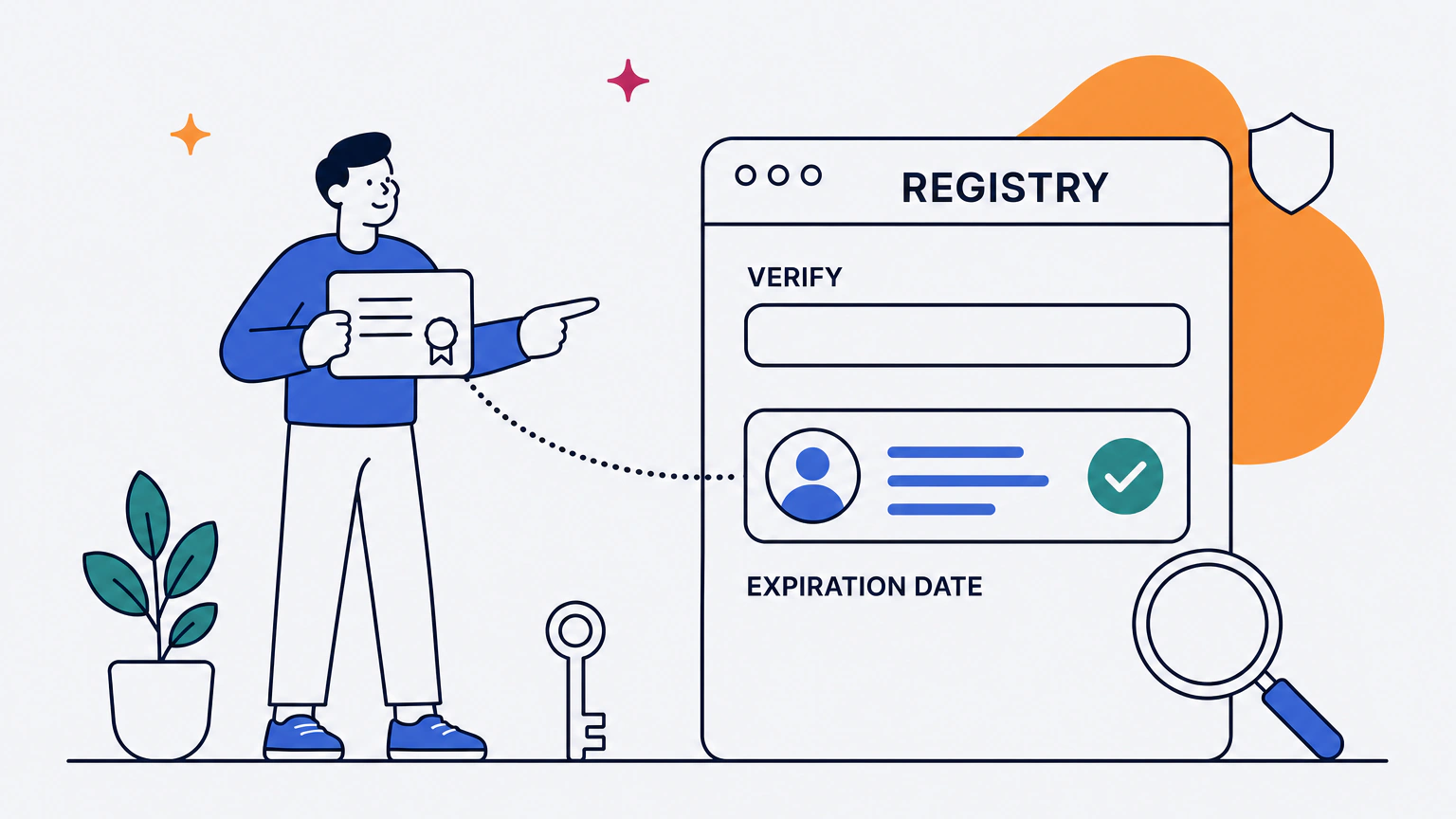
Here's the awkward part. There's no state license for a personal trainer, so there's no government database to search. The credential is a private certification, and you check it in the certifying body's own free registry. Ask for two things, the exact certification name and the certification number, then search the U.S. Registry of Exercise Professionals at usreps.org/registry, which covers NCCA-accredited and ISO 17024-compliant certifications from several bodies at once. Not listed? Go to the issuer's own verifier, because ACE, ISSA, NASM, NSCA and NCSF each publish one. A clean result gives you the name, the credential and an expiration date that hasn't passed. Anything short of that, treat as unverified. And if this person teaches your child, credentials are only the first of two checks.
On this page
- The 60-second check
- Why there is no personal trainer license to look up
- What NCCA accreditation means, and why it is the first thing to check
- Verify a personal trainer's certification, step by step
- What a valid certification does not prove
- How to verify instructors in every other lesson category
- If the student is your child: the second check
- Red flags, and what to do when verification fails
- Frequently asked questions
- Your next step
The 60-second check
Text four questions, then open one website. Type the last name and the credential code into usreps.org/registry, which asks you to search on both fields and wants the number exactly as it was issued.
Ask for these four things before your first paid session:
- The exact certification name and the issuing organization. "ACE Certified Personal Trainer" is an answer. "I'm certified" is not.
- The certification number and the expiration date. Ask for the card or issuer record that shows them.
- Proof of current CPR/AED certification. Ask to see it, not a description.
- Whether they carry professional liability insurance, and in a gym, whose policy.
Why there is no personal trainer license to look up
Plenty of people type "personal trainer license lookup california" into a state search box, get nothing back, and assume the tool is broken. It isn't. No U.S. state licenses personal training as an occupation, so there is nothing in the box to find.
License vs. certification: two different words doing two different jobs
A license is government permission to practice an occupation. Practicing a licensed occupation without one may be illegal. A certification is a different animal: a private body's attestation that someone met its program requirements. Employers and insurers may require one even when the law does not, which is why your gym cares about a piece of paper the state has never heard of.
Proof you can run yourself in 30 seconds
Don't take our word for it. Open your state's consumer-affairs license search and read the list of boards. California's Department of Consumer Affairs lists boards for accountancy, acupuncture, automotive repair, cosmetology, dental, medical, pharmacy, physical therapy, psychology, nursing, veterinary medicine and twenty more. There is no board for trainers. None for yoga teachers or music teachers either.
The one exception: driver training
Teach someone to drive and the state is suddenly involved. Texas regulates Driver Education and Safety through its Department of Licensing and Regulation, which runs a "Verify a License" tool. California requires driver training schools to be licensed and bonded by the DMV, sends parents to its Occupational License Lookup, and publishes a number, (916) 229-3126, for checking an individual instructor.
What NCCA accreditation means, and why it is the first thing to check
Certification programs vary in rigor, and the acronym on somebody's website won't tell you which is which. That's what accreditation is for, and it's the first thing we'd check. NCCA accreditation means the program was reviewed against standards for exam development, governance and operation. It does not promise that this particular instructor can coach.
Who accredits the accreditors
The National Commission for Certifying Agencies sits inside the Institute for Credentialing Excellence, and what it accredits is programs. ICE reports over 300 accredited ones across healthcare, fitness, government, trades and legal services. The review asks whether the exam holds up psychometrically and whether the program is governed the way it claims.
How to check whether a certification itself is accredited
The public search at ice.learningbuilder.com is free. Type an organization into the field, click Filter, and a listed program comes back with the acronym, the program name, NCCA or ACAP status and an "Accredited through" date. Search "exercise" and the ACE Certified Personal Trainer program turns up, accredited through March 2029.
Read a blank result carefully, though. The directory disclaims responsibility for errors and omissions, and our searches for ISSA, "Sports Sciences" and "International" returned no ISSA program at all, though ISSA runs a verifier of its own. A gap in one directory is a question to ask, not a verdict.
Verify a personal trainer's certification, step by step
Four steps. Only the first one involves talking to anybody.
Step 1: Ask for the credential name and the certification number
Send it as a text before you book. You're asking for two credential details the issuer itself uses for verification, so this is an admin question, not an accusation. Reluctance is information.
Pro tip: Copy and send this. "Quick admin question before we start. What's the exact name of your certification and your certification number? I like to check credentials for anyone I work with." Sent that way it lands as routine paperwork rather than suspicion.
Step 2: Search USREPS first
One search covers several certifying bodies at once. USREPS returns, in its own words, "Name, locations, credentials, and expiration date" for anyone holding "valid NCCA-accredited or ISO 17024-compliant certifications."
The limit matters more than the feature. USREPS lists only organizations that participate, and its dropdown names six: ACE, ACSM, the Collegiate Strength and Conditioning Coaches association, the National Council for Certified Personal Trainers, NCSF and NSCA. NASM isn't there. Neither is ISSA. So an empty result here means keep looking, not that somebody lied to you.
Step 3: If they are not there, go to the issuing body's own verifier
Each issuer built its own tool, and no two behave the same way.
- ACE wants the certification number and nothing else.
- NASM takes a last name or a certificate ID, covers AFAA as well as NASM, and tells you how current its data is.
- ISSA needs the last name and the certification ID together, then returns valid or expired with both dates.
- NCSF accepts a name or a number, and warns that a new certification can take two to three business days to appear.
- NSCA doesn't answer on screen at all. It takes a written request and asks for one to two business days.
Step 4: Read the expiration date, then ask for the CPR/AED card
Check what the issuer requires of its holders to stay current, including whether continuing education and CPR/AED are part of renewal. Then read the expiration date on the verifier, and make sure it is still ahead of you. Then ask for the CPR/AED card itself, not a description of it.
What a valid certification does not prove
A clean result is good news, and it is worth having. It also proves less than most people assume.
Scope of practice
A fitness certification covers exercise: assessing how you move, building a plan, coaching technique, adding load over time. It does not cover prescribing a diet, diagnosing the thing that hurts, or rehabilitating an injury. Those belong to clinicians.
Insurance, complaints and background checks are three separate questions
None of the three shows up in a certification registry, so a clean lookup tells you nothing about any of them. You have to ask out loud. Do you carry professional liability insurance, and through whom? Has a complaint ever been filed with your certifying body? Who ran your background check?
A certificate is a floor, not a recommendation
Verification removes one category of risk. It says nothing about whether this person can coach you, with your body, your history and your schedule. So book one paid trial session before you buy ten. We'd do that even after a spotless registry result.
How to verify instructors in every other lesson category
Trainers are the straightforward case. Move to yoga, swimming or a dojo and the rules change with every category, and in a few of them there is nothing to search at all.
| Lesson category | Credential to ask for | Free public lookup (verified live August 10, 2026) | What the lookup does not tell you |
|---|---|---|---|
| Personal training, gyms | NCCA-accredited: ACE-CPT, NASM-CPT, NSCA-CPT, NCSF-CPT, ACSM-CPT | usreps.org/registry plus the issuer's verifier | Insurance, complaints, background checks, quality |
| Group fitness, Pilates, cycling | The same, plus ACE-GFI, AFAA-CGFI or NPCP Pilates | usreps.org/registry for participating organizations; otherwise the issuer's verifier | Whether it covers the format taught |
| Yoga | RYT 200 or RYT 500 registration | yogaalliance.org/find-a-yoga-teacher/ | Training hours, not an exam passed |
| Swim lessons | Red Cross Water Safety Instructor, plus lifeguard and CPR/AED cards on deck | redcross.org/take-a-class/digital-certificate | One certificate ID, not supervision |
| Gymnastics, tumbling | USA Gymnastics membership and SafeSport training | usagym.org/safety/ineligible/, usagym.org/safety/suspended-restricted-persons/, cdd.uscenterforsafesport.org | Anything outside affiliated clubs |
| Martial arts, karate, kickboxing | No universal rank registry; ask who issued the rank | cdd.uscenterforsafesport.org only for people connected to the U.S. Olympic and Paralympic Movement; otherwise no universal national lookup | Belt rank has no universal external standard |
| Music, dance, art, tutoring | Ask the relevant state agency whether a license applies; no universal registry covers all four categories | No universal national lookup | Use references, a trial lesson and the background-check policy |
| Driver training schools | A real state license, school and instructor | Your state regulator (Texas: TDLR; California: DMV Occupational License Lookup) | Lesson quality or pass rates |
Outside Texas and California, search your own state's motor-vehicle agency or consumer-affairs board for "driver training school license." Those two are the ones we opened ourselves.
Categories with a registry you can actually search
Yoga. The Yoga Alliance directory searches by designation: RYT 200, RYT 500, the E-RYT tiers, children's and prenatal. Read what the designation means, though. RYT 200 records a 200-hour training completed with a registered school. It is not an exam anybody passed, and no yoga program appeared in the NCCA directory at all. Build your shortlist from the yoga studios in your area.
Swim. Every Red Cross digital certificate carries a unique ID and a QR code, and anyone can enter it at the validation page. What comes back confirms one document. It does not tell you who is watching the water, which for a parent is the whole question, so ask how many lifeguards work the deck at swim schools near you.
Gymnastics. USA Gymnastics publishes two lists, one of permanently ineligible members and one of suspended or restricted persons. Both cover affiliated clubs only, which makes membership the thing to establish first. Check whether gymnastics clubs in your area belong.
Categories where nothing exists to search
Martial arts, music, dance, art and academic tutoring do not share one universal occupation-specific license or national registry. That is the honest answer, and it is not the end of the answer. Four questions stand in for the search box.
Ask which organization issued the rank, and whether it publishes standards. Ask two enrolled families for references. Pay for one trial lesson and watch the room. And ask whether the school is affiliated with an Olympic or Paralympic national governing body, which helps determine whether the U.S. Center for SafeSport has jurisdiction there. While you are weighing the shortlist, here is what martial arts classes actually cost.
If the student is your child: the second check
This is the part parents came for, and it is where the honest answer is least comforting. A credential answers competence. It says nothing about supervision. And the federal child-protection rules that parents assume cover anywhere with children in it are narrower than that. If you are still deciding whether to enroll at all, start with what age kids are actually ready to start.
What the federal SafeSport rules actually reach
The law people mean is 36 U.S.C. § 220530. Where it applies, an amateur sports organization must follow federal child-abuse reporting requirements, limit one-on-one interactions between minor athletes and adults who are not their legal guardians, train adults in regular contact with minors, and prohibit retaliation against anyone who reports.
Now the catch. They reach an amateur sports organization that is not already covered by the Olympic and Paralympic Movement rules, that participates in interstate or international amateur athletic competition, and that has adults in regular contact with minor athletes. A studio's name does not decide that test, and neither does its size. Ask whether it is a nonprofit sports organization that arranges amateur competition, and whether it competes across state or national borders. Those are the facts that settle it.
The reporting standard, stated correctly
The reporting duty sits in a different statute, 34 U.S.C. § 20341. A covered individual who has reason to suspect child abuse must report it "as soon as possible" to the agency the Attorney General designates. Then the statute defines its own phrase: as soon as possible means within a 24-hour period. Both halves together are the standard.
Covered individual is defined too, and the definition is wider than the affiliation shortcut suggests. It reaches an adult authorized to interact with minors by a national governing body, by one of that body's members, or by an amateur sports organization that participates in interstate or international competition. It also reaches employees and representatives of the U.S. Center for SafeSport.
The Centralized Disciplinary Database, and its edges
The U.S. Center for SafeSport publishes a database at cdd.uscenterforsafesport.org. You can search it by name, city, state or sport affiliation, and a hit returns the name, city, state, sport affiliations, the misconduct, the action taken and the date it was issued.
Then read a clean search precisely. It means "not listed in this database." It does not mean "cleared." The database covers certain restrictions, sanctions and eligibility decisions within the U.S. Olympic and Paralympic Movement. It is not a general background-check database, and it cannot be used as one.
Red flags, and what to do when verification fails
Red flag: Five answers that should stop you from paying.
- "I'm certified," with no organization named. Ask which body, and write the answer down.
- Reluctance to give a certification number. Don't prepay. Book a single session or nothing.
- A certifier with no verifier that is also absent from the NCCA search. Treat the credential as decoration, and judge the trial session instead.
- An expiration date that has passed. Ask whether renewal is under way. A lapse is fixable. A lapse presented as current is not.
- No current CPR/AED card where someone can get hurt. Ask who on site holds one, and where the AED is kept.
When an answer doesn't check out, ask once more, plainly, and let them send a corrected number. What you don't do is prepay while the question is open. If you have already paid for sessions you haven't used, ask for a refund by email so a record exists, then take your shortlist elsewhere. You don't have to name anyone publicly to walk away.
Frequently asked questions
Do personal trainers need a license?
No. No U.S. state licenses personal training as an occupation, which is why a state license search comes back empty and why "personal trainer license lookup" leads nowhere. What a trainer holds instead is a private certification from a body such as ACE, NASM, NSCA or ISSA, and you check it in that body's own registry.
Is it illegal to be a personal trainer without a certification?
Not in itself. No U.S. state requires a personal trainer certification, though employers usually prefer certification and requirements vary by facility. Where a legal line does appear is scope. Prescribing a diet or treating an injury can enter regulated practice, and that is the part to watch.
What does NCCA accredited mean?
It means the program's exam and governance were reviewed against the National Commission for Certifying Agencies' standards, which test whether the exam is psychometrically defensible and independently governed. The Institute for Credentialing Excellence reports over 300 accredited programs. Hold onto the distinction: accreditation covers the program, not the person holding the card.
Is an ACE certification accredited?
Yes. The NCCA accredited-program directory at ice.learningbuilder.com lists the ACE Certified Personal Trainer program as accredited through March 31, 2029, alongside ACE's group fitness, health coach and medical exercise programs. Run the search yourself anyway. Accreditation dates roll over, and the directory is free.
How can I tell if a personal trainer is qualified, not just certified?
Certification is the floor, not the finish line. Ask how many clients they have trained toward your goal, in your age range, with your injury history, and what your program looks like by month three. Then judge the first session on one thing: did it assess you, and did the plan change once it had the answer?
Do swim instructors have to be lifeguard certified?
Not for Red Cross Water Safety Instructor certification. The Red Cross lists a minimum age of 15 by the end of the course and does not list lifeguard certification as a prerequisite. So ask the facility instead. Who watches the water during lessons, and what lifeguard coverage does it require?
How do I report or complain about a personal trainer?
Two different routes, and it matters which one you are on. For service or billing issues, use the gym or studio's management, the certifying body's complaints process and your state consumer-protection office. For suspected child abuse or neglect, report to local authorities first. If the person is within the U.S. Olympic and Paralympic Movement, report to the U.S. Center for SafeSport as well.
Your next step
One honest limit first. We are not clinicians, and nothing here is medical or legal advice. Anything involving pain, an injury or a diagnosis belongs with someone licensed to treat it.
Everything else is just asking. Before your next paid session, ask for three things: the credential name and number, the CPR/AED card, and the insurance answer. One search at usreps.org/registry settles the first. If it comes back empty, put the same three questions to personal trainers and gyms near you and book with whoever answers them without flinching.