

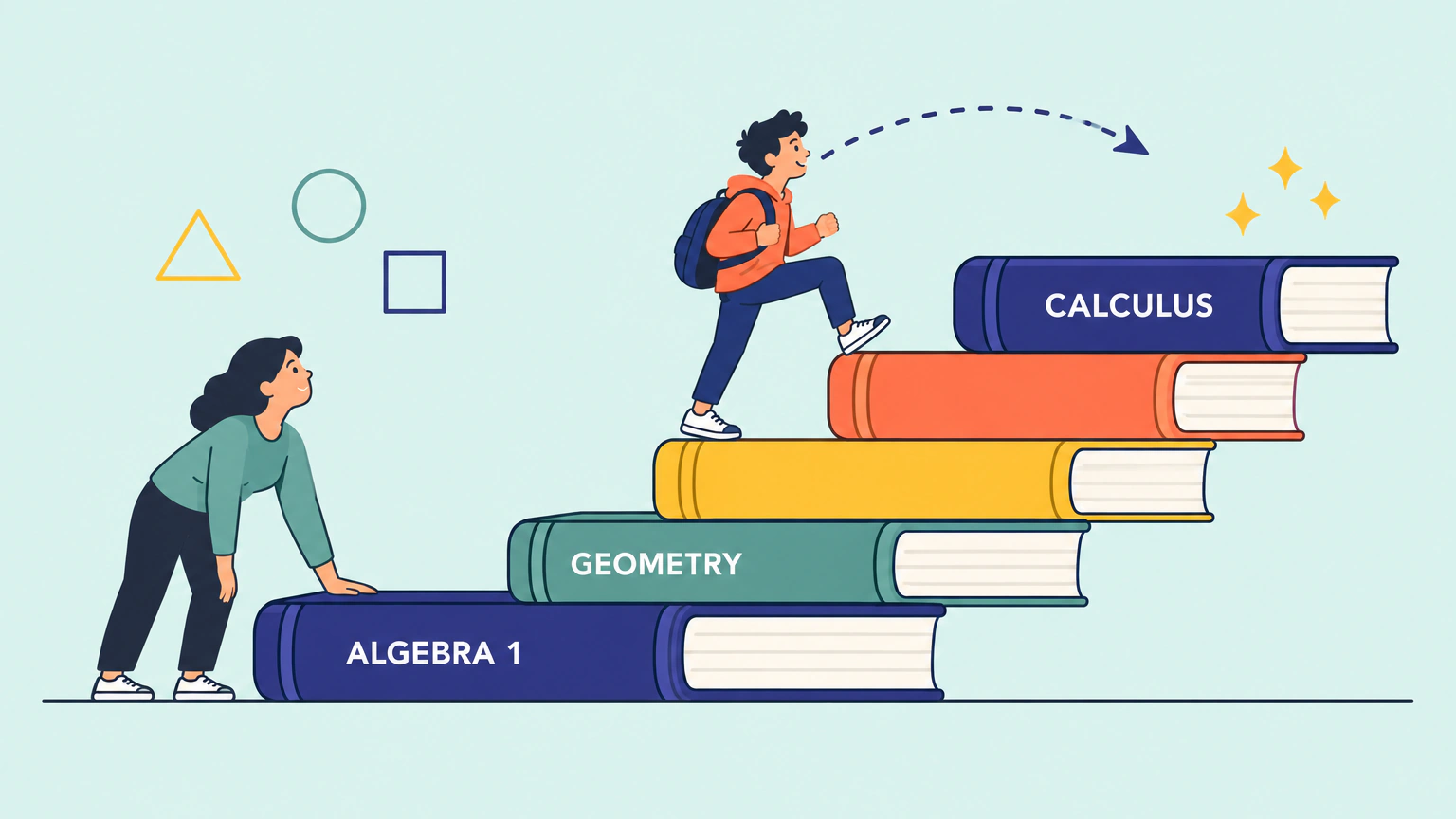
Here it is. One route through high school math is Algebra 1, Geometry, Algebra 2, Precalculus, then Calculus, one course a year. Statistics is another option after Algebra 2. Count the years, and a student who starts Algebra 1 in 9th grade usually finishes with Precalculus, while one who starts it in 8th grade can reach Calculus. Whether Algebra 2 is required to graduate depends on the state. Of the 11 states we checked, four include it or an integrated equivalent in their standard path: Georgia, Michigan, North Carolina and Ohio. Pennsylvania leaves it to districts, and the other six don't for a standard diploma.
Next come the grade-by-grade tracks, the state rules, what colleges count, and what to do when the track feels wrong for your kid.
On this page
- The usual order of high school math classes
- What math your child takes in 9th, 10th, 11th and 12th grade
- What is the highest math class in high school?
- Do you need Algebra 2 to graduate? It depends on your state
- What colleges and the NCAA look for
- How to speed up the sequence, or slow it down
- When a math tutor actually helps
- Questions parents ask about high school math
The usual order of high school math classes
The standard ladder of math classes in high school has five courses, taken one a year. The AP courses at the top belong to the College Board, and each one is built to match a specific college class.
| Course | What has to come first in Texas's state table | What the College Board says it equals |
|---|---|---|
| Algebra 1 | Grade 8 math or its equivalent | Not an AP course |
| Geometry | Algebra I, or Algebra I in the same year where the district allows it | Not an AP course |
| Algebra 2 | Algebra I | Not an AP course |
| Precalculus | Algebra I, Geometry and Algebra II | Not an AP course |
| AP Precalculus | Recommended: Algebra II and Geometry | A college precalculus course, or college algebra with trigonometry |
| AP Statistics | Recommended: Algebra II and Geometry | A one-semester college statistics course without calculus |
| AP Calculus AB | Recommended: Precalculus | A first-semester college calculus course |
| AP Calculus BC | Recommended: Precalculus | First-semester college calculus plus the next single-variable course |
Prerequisites come from the Texas Education Agency's statewide table, and your district may order courses differently. The College Board itself recommends less for two courses: algebra and geometry for AP Precalculus, and first-year algebra for AP Statistics.
Some schools teach Algebra 2 before Geometry. Texas's state table allows that, because Algebra II needs only Algebra I. Precalculus is the course that needs all three first. For AP Precalculus and AP Statistics, the College Board asks for less than Texas recommends, and your school decides which bar it uses.
If your school calls it Math 1, Math 2 and Math 3
Integrated math mixes algebra, geometry and statistics inside each year instead of giving each subject its own year. North Carolina calls its courses NC Math 1, 2 and 3, and all three belong to its standard graduation sequence. The News & Observer describes Math 1 as a blend of algebra, geometry, functions and statistics.
Other rules make room for it too. California's law counts "Mathematics I" alongside Algebra I, and Illinois lets the course with geometry content be an integrated one. The University of California (UC) takes approved integrated courses for part or all of its math requirement, as long as the geometry is there. Its own example is Math II. If you move between an integrated school and a traditional one, ask the new school how it maps each course before the schedule is set.
Where AP Precalculus and AP Statistics fit
AP Precalculus is the newest rung. The College Board announced it in May 2022, and it debuted in fall 2023. It's built to match a college precalculus course or college algebra with trigonometry. UC counts a 4 or 5 on the exam as two of its three required years of math, though not as geometry.
AP Statistics is the route that skips calculus. It matches a one-semester college stats course, and it's hardly a fringe choice. In 2019, slightly more graduates had finished probability and statistics (17%) than calculus (16%), according to the National Center for Education Statistics. Texas counts AP Precalculus, AP Statistics and plain Statistics as a third or fourth math credit.
What math your child takes in 9th, 10th, 11th and 12th grade
The whole track hangs on when Algebra 1 happens. That's usually settled in middle school, and every later year follows from it.
| If Algebra 1 comes in | 9th grade | 10th grade | 11th grade | 12th grade |
|---|---|---|---|---|
| 9th grade | Algebra 1 | Geometry | Algebra 2 | Precalculus or Statistics |
| 9th grade, doubling up in 10th | Algebra 1 | Geometry and Algebra 2 | Precalculus | Calculus |
| 8th grade | Geometry | Algebra 2 | Precalculus | Calculus AB or BC |
| 7th grade | Algebra 2 | Precalculus | Calculus | Statistics or a college math course |
One course a year after Algebra 1. Schools that teach Algebra 2 before Geometry swap the middle years, and the 12th grade course stays the same.
Doubling up in 10th grade is how a student who starts Algebra 1 in 9th grade still reaches calculus. Not every school allows it.
Is Algebra 1 in 8th grade advanced?
Yes. It puts your child a year ahead of the standard 9th grade start, which is the accelerated track.
Texas turned that choice into law in 2023. Students who score in the top 40% statewide on the grade 5 math STAAR, or the top 40% on a district's own measure, are automatically enrolled in advanced math in 6th grade. The Texas Education Agency (TEA) says the goal is to give strong students the chance at Algebra I in 8th grade, not to make 40% of kids take it. Parents can opt out, and districts can enroll every student if they choose.
Readiness still counts. TEA's math FAQ says students "should be able to demonstrate proficiency in all the Grade 8 Math" standards before Algebra I. Texas parents can also ask for an accelerated class, "with the expectation that the request is not unreasonably denied," unless the school expects the child can't handle it.
Our take: a child who is shaky on 8th grade math gains nothing by meeting Algebra 1 a year sooner.
Does 8th grade Algebra 1 count for high school?
It depends on the state, and then on the high school. California's Education Code is unusually direct. A student who finishes Algebra I before 9th grade skips the Algebra I rigor rule but still owes two math courses in grades 9 to 12. Florida's statute assumes middle schoolers take high school courses "for high school credit," and it even gives them their own grade-forgiveness rule. UC counts 7th and 8th grade math if the high school accepts the course as equal to its own.
So ask the high school, before 9th grade starts, whether the course goes on the transcript as a credit or only decides placement.
What is the highest math class in high school?
On the AP menu, it's AP Calculus BC. The College Board says AB matches a first-semester college calculus course. BC matches that course plus the next calculus course, so it covers more college math than any other AP math course. A student who gets there early can keep going with a college course. Texas, for one, lets a college-endorsed math course taken after Algebra II count toward graduating.
Now the numbers we'd tape to the fridge. In the same federal data, 85% of 2019 graduates had completed Algebra 2, 40% precalculus and just 16% calculus, down from 18% in 2009. Calculus is a fine goal. It isn't the line between on track and behind.
Do you need Algebra 2 to graduate? It depends on your state
There's no national rule. The 11 states we checked ask for anywhere from two years of math to four.
| State | Math to graduate | Algebra 2 required? | What families miss | Rule |
|---|---|---|---|---|
| California | 2 courses in grades 9 to 12 | No | One course must match Algebra I in rigor. Algebra I finished before 9th grade still leaves two high school math courses to take. | Educ. Code §§ 51225.3, 51224.5 |
| Florida | 4 credits | No | Algebra I and Geometry are required. Your child needs an Algebra I exam pass, a comparative score or an eligible IEP assessment waiver. | Fla. Stat. §§ 1003.4282, 1008.22 |
| Georgia | 4 units | Yes, Advanced Algebra or an equivalent | For students starting 9th grade in 2023-24 or later: Algebra, Geometry and Advanced Algebra, or approved substitutes, plus another core course. Career pathways can meet some requirements. | Ga. Comp. R. & Regs. 160-4-2-.49 |
| Illinois | 3 years | No | One year must be Algebra I and one must include geometry content. AP Computer Science can count as one of the three. | 105 ILCS 5/27-605 |
| Michigan | 4 credits on the standard path | Yes, with personal-curriculum options | Algebra I, Geometry and Algebra II, plus math in the final year. Algebra II can take two years. An approved personal curriculum can change Algebra II and require 3.5 credits, with math in either of the final two years. | MCL 380.1278a, 380.1278b |
| New York | 3 credits | No | Students normally need a math Regents exam or a state-approved alternative. Eligible students have appeals, safety nets and exemptions. Ending diploma exam requirements in fall 2027 remains proposed. | 8 NYCRR 100.5, NYSED graduation requirements |
| North Carolina | 4 credits | Yes in the standard sequence, as NC Math 3 | NC Math 1, 2 and 3 plus a fourth course tied to your child's plans. A rare principal exemption allows Math 1 and 2 plus two other approved courses. New standards start in 2028-29, and news reports say Math 3 will stop being required. | State Board policy GRAD-004, NC DPI graduation requirements |
| Ohio | 4 units | Yes, Algebra II or an equivalent | Advanced computer science can replace Algebra II if a parent signs a statement accepting the college-admission risk. Career-technical students can take an approved alternative. | Ohio Rev. Code § 3313.603 |
| Pennsylvania | Set by your district | Set by your district | Students must also show math proficiency through the Algebra I Keystone Exam or one of the state's alternative pathways. | 22 Pa. Code § 4.24 |
| Texas | 3 credits | No | Algebra I, Geometry and one more advanced course. An endorsement adds a fourth credit, and the STEM endorsement requires Algebra II. | 19 Tex. Admin. Code §§ 74.12, 74.13 |
| Virginia | 3 credits for the Standard Diploma | No, for the Standard Diploma | At least two different courses from a state list that includes Algebra I, Geometry and Algebra II. The Advanced Studies Diploma needs 4 credits, with at least one at the Algebra II level or higher. | 8VAC20-132-51 |
From each state's own law, regulation or education department page. The rules that apply are usually the ones in place when your child started 9th grade. State tests can add their own requirement, so check your state's testing rules too.
California requires two courses. Illinois, New York, Texas and Virginia require three, and Florida, Georgia, Michigan, North Carolina and Ohio require four. Pennsylvania leaves the number to each district. Four of the 11 include Algebra 2 or an integrated equivalent in the standard path. Four years of math doesn't always mean Algebra 2, though. Florida asks for four credits but names only Algebra I and Geometry.
Three rows also name a test, because the math rule itself names one: Florida's Algebra I exam, New York's Regents exam, and Pennsylvania's Keystone exam or an alternative pathway. Other states can tie the diploma to state tests too. If your state isn't in the table, start with its education department's graduation page and your school's course guide.
When your district or diploma asks for more
The state rule is a floor. California's law sets two courses and makes room for districts that require more. In Texas, the standard Foundation program needs three credits and an endorsement adds a fourth. The STEM endorsement and the distinguished level of achievement both require Algebra II. Virginia's Advanced Studies Diploma needs four credits, at least one of them Algebra II or higher. Ohio lets advanced computer science replace Algebra II only if a parent signs a statement that skipping it "may have an adverse effect on college admission decisions."
Two states are mid-change. New York has proposed ending its Regents exam requirement starting in fall 2027. North Carolina's new math standards start in 2028-29, and news reports say they drop NC Math 3 as a required course. The state's graduation page still lists Math 3 for every entering class it covers, including students starting 9th grade in 2026-27, so we'd plan on it until that page changes.
The rules that bind your child usually date from the year they started 9th grade, and Virginia's regulation says so outright.
What colleges and the NCAA look for
Graduating is one bar. Colleges and college sports set their own rules for high school math courses, and they don't always match your state's.
| Who's asking | How much math | What counts |
|---|---|---|
| University of California | 3 years of college-prep math, a 4th strongly recommended | Elementary and advanced algebra and geometry. Math from 7th or 8th grade counts if the high school accepts it. |
| NCAA Division I | 3 years | Algebra 1 or higher, from the high school's approved core-course list |
| NCAA Division II | 2 years | Algebra 1 or higher, from the high school's approved core-course list |
UC wants geometry inside those three years, as its own course or as part of an integrated one. A 3 or higher on AP Calculus AB or BC, or a 4 or 5 on AP Precalculus, covers two of the years but not geometry. The NCAA counts only courses on your high school's approved core-course list, so a student-athlete's family should check that list before the schedule is set.
How to speed up the sequence, or slow it down
Both directions are legitimate. The right one depends on where your child needs to finish and how solid the last course felt.
Doubling up to reach calculus
One option is Geometry with Algebra 2, because in Texas's state table both need only Algebra I. Texas law also lets districts allow Algebra I and Geometry in the same year. Where a district doesn't, Algebra I stays the prerequisite. Texas parents can use the same right to request an accelerated class here as in middle school. Elsewhere, ask your district whether a summer or online course can stand in for one of the years.
Then count the hours. Two math classes plus homework take a real bite out of a week, so check how many weekly hours a child can carry before you add the second one.
Spreading one course over two years
Florida lets a student take Algebra I as two full-year courses and earn two math credits for it. Michigan lets Algebra II run over a year and a half or two years, for 1.5 or 2 credits.
The trade-off is plain. Spreading a course over two years leaves less time for later courses. For a student who barely passed 8th grade math, the slower pace is often the right call, and we'd take a solid Algebra 1 over a rushed one any day.
When a math tutor actually helps
TEA puts the risk in two sentences: "the material for each grade builds to the next grade. A student missing the material of one grade may be at a disadvantage in subsequent grade levels or classes." That points to three moments when a tutor earns the money: the spring before 9th grade placement, the first grading period of Algebra 1 or Algebra 2, and the summer before a doubled-up year.
What a tutor can't fix is placement itself. That's the school's call, and in Texas, a parent's request. For price, see what a math tutor costs. For format, weigh whether one-on-one or small-group help suits your kid.
Five questions to ask a math tutor before the first session
- Have you taught this exact course recently, with the same textbook or online platform the school uses?
- How will you find the gaps from earlier grades before working on this week's homework?
- How many sessions a week do you suggest until the next unit test, and why that number?
- Will you look at graded tests and the teacher's comments, not just the homework?
- How will you show us the plan is working, and after how many weeks?
Tonight, pull up your child's school course guide and find their row in the state table. If the next course is the one that worries you, compare local math tutors on our Mathematics Lessons page. You can also start from a state hub: math tutors across California, math tutors across Texas or math tutors across Florida.
Questions parents ask about high school math
What math do most students take in 9th grade?
Algebra 1, on the standard track. A student who finished Algebra 1 in 8th grade usually moves on to Geometry. Schools that teach integrated math start 9th grade with Math 1, which North Carolina calls NC Math 1. Before high school course selection closes, ask the middle school which course it recommends for your child, and why.
Can you skip Geometry and go to Algebra 2?
You can often change the order, but you usually can't skip Geometry altogether. In Texas's state table, Algebra II needs only Algebra I, so Geometry can come later. Texas and Florida both require Geometry to graduate, and Illinois requires a course with geometry content. The University of California requires geometry for admission.
Can you take Geometry and Algebra 2 at the same time?
Often, yes, and it's one way to gain a year. In Texas both courses list Algebra I as their only prerequisite, so a school can schedule them together. Texas law also lets districts allow Algebra I and Geometry in the same year. Schools differ, so ask yours whether it allows doubling up before you plan around it.
What comes after Algebra 2?
Usually Precalculus, AP Precalculus or a statistics course. AP Precalculus started in fall 2023, and the College Board treats it like a college precalculus course or college algebra with trigonometry. AP Statistics is the non-calculus route and matches a one-semester college statistics course. Texas counts all of these as third or fourth math credits.
What's the difference between AP Calculus AB and BC?
BC covers more. The College Board says AB matches a first-semester college calculus course, and BC matches that course plus the next single-variable calculus course. It recommends the same background for both: algebra, geometry, trigonometry, analytic geometry and elementary functions. Texas's state table lists Precalculus as the recommended course before either one.
How many years of math do colleges want?
It depends on the college. The University of California requires three years of college-prep math and strongly recommends a fourth. For college sports, the NCAA asks for three years of Algebra 1 or higher for Division I and two years for Division II. Check the admissions page of each college on your child's list before choosing senior-year classes.
Do you have to take math senior year?
Of the 11 states we checked, Michigan's standard path requires math in the last year of high school. An approved personal curriculum can move it into either of the last two years. Elsewhere it depends on whether your child already has the state's credits and on the school's own rules. The University of California strongly recommends a fourth year of math, so a teen aiming there should plan on one.