

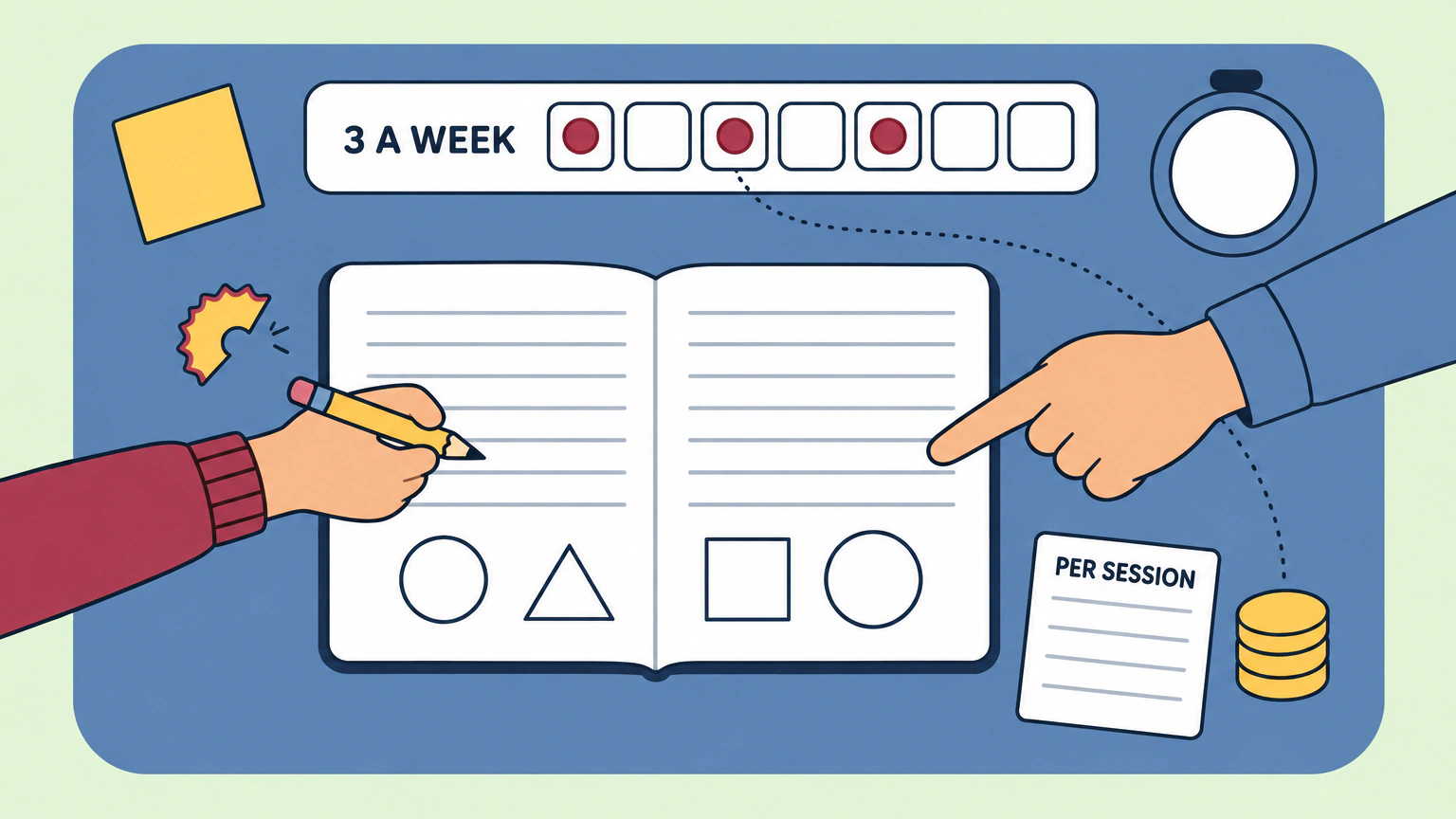
Here's the short version. Many public schools offer tutoring, and Schoolhouse.world offers it free. A university reading clinic like UVA's works out to about $35 an hour. Sylvan lists "$50+ per session," and a marketplace like Wyzant adds 9% to whatever the tutor charges.
Then there's the number nobody quotes you. The tutoring programs the research backs meet three or more times a week for at least ten weeks, and at $50 a session that's $1,500.
An hourly rate is half the answer. The pace is the other half.
On this page
What the big tutoring names charge, and what they leave to your local center
The first thing you learn is that most of the names you've heard won't print a price. Sylvan, Mathnasium, Kumon and Huntington all send you to your nearest center for a number, and Sylvan says its centers are "locally owned and operated, so pricing varies by location." We read what all five publish on their own sites, Wyzant included, and we priced three university programs by hand. We didn't survey what private tutors charge city by city, and we'd treat any single national hourly figure with suspicion.
| Provider | What they publish about price | How you pay | Weekly pace they describe | One-on-one or group |
|---|---|---|---|---|
| Sylvan Learning | "$50+ per session" for personalized tutoring; local rates can be higher or lower | Pay over time, prepay for a discount, or pay monthly for your schedule | Two or three sessions a week for a child who needs to catch up; sessions usually last an hour | "Most of our tutoring is done in small groups" |
| Mathnasium | No price; ask your local center | A flat enrollment fee, then regular visits "much like a gym membership" | Two to three times a week | Ask your center |
| Kumon | No price; ask your local center | Monthly tuition, charged per subject | Two center visits a week, plus daily work at home of under 30 minutes a subject | Daily practice assignments, with center visits for guidance |
| Huntington Learning Center | No price until after an academic evaluation | Hourly rates and payment options, discussed at a meeting after the evaluation | At least twice a week, three or more in summer | Ask your center |
| Wyzant | Each tutor posts an hourly rate; you pay a 9% service fee on top | After each lesson, with no upfront commitment | Whatever you and the tutor agree | The tutor you hire; group rates are the tutor's call |
Sylvan is the only one of the four chains that puts a figure on a page at all, and it hedges it. Wyzant is the only provider here that prices every lesson in the open, because the tutor posts the rate before you book.
Why a monthly price is hard to hold up against an hourly rate
Kumon bills monthly tuition per subject. A child doing math and reading is usually two tuitions, not one. Most students visit the center twice a week, and the daily work at home is built to take under 30 minutes a subject. Mathnasium describes a flat enrollment fee and then regular attendance "much like a gym membership," and it recommends two to three visits a week.
So ask for the monthly price at the pace they recommend. Then divide it by the visits in a month, and again by the minutes in a visit. That's the figure you can hold against an hourly rate.
One more thing changes what an hour is worth: whether your child has the tutor to herself or shares one with a few other kids. That trade is worth understanding before you compare prices, and we've laid out what a group session trades for one-on-one time.
What a tutoring marketplace adds to the tutor's rate
On Wyzant, the tutor sets an hourly rate and you pay it after each lesson, plus what Wyzant calls a service fee of "9% of the total lesson cost." Cancel late and you pay the tutor's cancellation policy plus the same 9%. The tutor keeps 75% of the posted rate.
Walk that through once. A tutor who posts $50 an hour costs you $54.50, and takes home $37.50. If you want a background check on that tutor, it's $15.99. If a first lesson goes badly, Wyzant will refund that hour as long as you say so within 30 days.
For scale, the Bureau of Labor Statistics put the median pay for tutors at $20.84 an hour in 2025, counting only the ones on someone's payroll rather than the self-employed. That's what tutoring jobs pay, not what you'll be charged.
How many sessions a week actually help
Price the week, not the hour. Ask every tutor or center three things: how many sessions a week they'd put your child in, how long each one runs, and how many kids share the tutor. Then multiply the session price by the sessions you'll actually buy. That's the number to compare.
This is the part of the bill nobody quotes by the hour. Two providers can charge almost the same for a session and still end up $1,000 apart over ten weeks, because one of them means three afternoons a week and the other means one.
What the research counts as tutoring that works
The National Student Support Accelerator, based at Stanford, defines high-impact tutoring by its shape rather than its brand. Sessions run "3+ times per week for 10+ weeks." One-on-one is best, and it caps a group at three or four students. The child sees the same well-trained tutor each time, and the lessons track what she's doing in class. Programs built that way, it says, produce "3-15 months of additional learning."
The independent evidence points the same way. In a 2020 review of the experimental studies for the National Bureau of Economic Research, Nickow, Oreopoulos and Quan found tutoring's effects "consistent and substantial," and stronger with teachers and paraprofessionals than with volunteers or parents.
Set that beside what the chains recommend. Two or three sessions a week, every one of them. The pace you're quoted is the price you're really being quoted.
Three afternoons a week is also a real share of a child's time, and it's worth thinking about how much a child's week can hold before you sign anything.
What ten weeks of tutoring costs at one, two or three sessions a week
Ten weeks is the research minimum, and $50 is the per-session figure Sylvan prints. Hold the rate still, change only the pace, and watch what happens to the bill.
| Sessions a week | Who builds around this pace | Hours over 10 weeks | At $50 a session | On Wyzant with a $50 posted rate |
|---|---|---|---|---|
| One | Duquesne's reading clinic | 10 | $500 | $545 |
| Two | Kumon's center visits, UVA's fall reading program, and the low end for Mathnasium and Sylvan | 20 | $1,000 | $1,090 |
| Three | The high-impact tutoring standard, and the top end for Mathnasium and Sylvan | 30 | $1,500 | $1,635 |
Hours assume one-hour sessions, the length Sylvan says is usual. Kumon's visits and UVA's lessons run shorter.
Spread across a year, $50 a session works out to about $217 a month once a week, $433 twice a week and $650 three times a week. Going from one session to three triples your bill. The 9% marketplace fee adds less than a tenth. How much a tutor costs per hour sets the floor. The pace sets the bill, and no amount of shopping around will fix the wrong pace.
Why after-school tutoring has a harder job
The sales conference skips this part. The Accelerator is blunt about timing: "Tutoring interventions that are conducted during the school day consistently result in greater student attendance and academic outcomes than those that are held after school or during the summer." The NBER review found the same direction. Programs run during school tend to have larger impacts.
Almost everything you can buy works around the school day instead. Sylvan offers sessions "after school, evenings and even weekends." UVA's fall program is an after-school program. Duquesne's clinic meets on Saturday mornings.
That doesn't make paid tutoring a waste of money. It means the things you can control matter more: showing up every week, and a tutor who talks with your child's classroom teacher. It's also why the first call should be to the school.
Most of the research covers in-person programs, and the Accelerator calls the evidence for live virtual tutoring "emerging," while saying it "can also be effective."
Where tutoring costs little or nothing
Before you sign a contract, spend a week on the routes that charge nothing or charge by the semester. Some cost nothing at all, the paid ones run well under the chains' rates, and the good ones fill up early.
| Where | What it costs | What your child gets | Good to know |
|---|---|---|---|
| Your child's public school | Ask the school | Standard tutoring at 60% of public schools; high-dosage tutoring at 42% | 15% of public schools said they offered no tutoring at all |
| D.C. Public Library's Brainfuse HelpNow | Ask the library | Live online tutoring for grades K-12 in English and Spanish, 1 p.m. to 10 p.m. | Ask your own library whether it offers live tutoring |
| Schoolhouse.world | Nothing | Tutoring on Zoom, including four-week SAT bootcamps | Tutors are trained volunteers who tutor their peers |
| UVA McGuffey Reading Services, Charlottesville, VA | $525 for the fall 2026 program, with a sliding scale | 18 one-on-one reading lessons, twice a week, about 50 minutes each | Works out to $29.17 a lesson, about $35 an hour |
| Duquesne University Reading Clinic, Pittsburgh, PA | $200 a semester, with scholarships for hardship | Nine weekly sessions of individual and group reading help, plus an assessment session for new clients | Works out to $22.22 a session; paying by card adds $5 |
Ask your child's school first
In the Education Department's June 2025 School Pulse Panel, 60% of public schools said they provided what the survey calls standard tutoring, and 42% offered high-dosage tutoring. Another 15% said they provided none at all. Those are shares of schools across the country, not a promise about yours or about a seat for your child.
So ask. Your child's classroom teacher or the school counselor can tell you in one conversation whether the school runs tutoring, whether it happens during the day or after it, and whether your child qualifies. If the answer is yes, ask which kind it is, because a weekly homework club and a small group that meets several times a week are two different programs wearing one word. Ask before you pay for the same thing twice.
Free online tutoring from your library and nonprofits
D.C. Public Library cardholders get Brainfuse HelpNow, which runs "live tutoring for grades K-12 ... in English and Spanish from 1 p.m. - 10 p.m." Yours may run something similar under a different name, so search your own library's site for live homework help before you assume it doesn't. A card is the only thing standing between your child and a tutor at 8 p.m., which is worth knowing on the night the homework surfaces at bedtime.
Schoolhouse.world is free. It's a nonprofit founded by Sal Khan, it runs on Zoom, and its sessions are led by trained volunteers who tutor their peers, including four-week SAT bootcamps.
The NBER review found the biggest effects with teachers and paraprofessionals, so free peer help suits homework and test practice better than it suits a child who's a year behind.
University reading clinics that charge by the semester
A school of education needs children for its graduate students to teach. That's why a university clinic can charge a fraction of a learning center's price, and why its seats go fast.
UVA's McGuffey Reading Services runs 18 one-on-one lessons over the fall, two a week at around 50 minutes each, for $525 a semester, with a need-based sliding scale set from your most recent 1040. That's $29.17 a lesson, or about $35 an hour. Eighteen Sylvan sessions at its printed $50 would be $900.
Duquesne University's Reading Clinic charges $200 a semester for nine weekly sessions of individual and group work, with scholarships for families in hardship. Its clinicians come from its own Reading Specialist program and work alongside practicing reading specialists. Towson University's clinic charges $100 for a fall or spring semester of one-hour one-on-one sessions, run by experienced classroom teachers finishing a graduate reading degree.
The catch: these are reading programs, not math, and they have application windows and few seats. Duquesne's fall window closed in August, and its spring applications open in November. Search your nearest university's school of education plus "reading clinic," and get on the list early.
Paying for a tutor from a 529 plan
Since July 2025, federal law has counted one more thing as a K-12 expense you can pay from a 529 plan: "Tuition for tutoring or educational classes outside of the home, including at a tutoring facility." The conditions are specific. The tutoring happens outside your home, the tutor isn't related to your child, and the tutor is licensed as a teacher in any state, has taught at an "eligible educational institution," or is an expert in the subject. Your child has to be enrolled at an elementary or secondary public, private or religious school. Starting with the 2026 tax year, a 529 can cover up to $20,000 a year of K-12 expenses in total.
We're not tax advisers, so check your own plan's rules before you take money out. If you want the wider picture on what activities and lessons do and don't reach your return, we've written up what else reaches your tax return.
What to ask before you sign up
Every one of these questions has a number or a policy behind it. The one about stopping comes from Sylvan's own FAQ, which says its locations "are locally owned and operated and handle their own billing in-center" and that "Sylvan corporate is not able to issue any refunds." Worth knowing before you prepay for a semester. Take the list to the meeting and write the answers in the margin.
- What does one session cost, and how many minutes is it?
- How many students work with one tutor at a time?
- How many sessions a week would you put my child in, and what does that come to each month?
- Is there an enrollment, assessment or registration fee, and is it charged once?
- Is there a minimum number of months, and how do we stop?
- Will my child see the same tutor every time?
- How will you show me progress, and how often?
- Will you check in with my child's teacher about what's being covered in class?
Ask two or three providers, not one. The answers diverge more than the rates do.
We have a number of our own, and it comes with a caution. Across 867 cost profiles, our figures for math tutors near you show a typical range of $115 to $208. Those figures shift with where you are, and they name no unit, which is exactly why the first thing to ask is what a quote covers: an hour, a session or a month.
We put in writing what we promise when you book through us, including that a business can't pay to be included on our lists, and you can see the people behind our listings before you trust one. Then go compare the math tutors near you with those eight questions in hand.
Tutoring costs: your questions answered
How much does a math tutor cost per hour?
Sylvan puts its personalized tutoring at "$50+ per session," usually an hour, and says local rates vary either way. On Wyzant you pay the tutor's posted rate plus 9%, so a $50 tutor costs you $54.50. Our own cost profiles put the typical range for math tutors at $115 to $208, though those figures move with your location and name no unit. Ask what any quote covers.
How much is Kumon per month?
Kumon doesn't publish a price. Its own FAQ says tuition varies by location and is charged monthly per subject, so math and reading usually means two tuitions. Most students visit the center twice a week and do daily work at home. Its centers are individually owned and operated, which is why the price follows the zip code. Ask your local center for the monthly price per subject, and ask whether there's a registration fee on top.
How much is Mathnasium per month?
Mathnasium doesn't publish a price either. It describes a flat enrollment fee, then regular attendance "much like a gym membership," and it recommends two to three visits a week. Ask your center for the monthly price at that pace, then divide by the visits in a month. And check whether the enrollment fee is charged once or again each year. That's the only way to compare it with an hourly tutor.
How often should my child see a tutor?
Three or more sessions a week for at least ten weeks is the high-impact standard the Stanford-based Accelerator uses, and Mathnasium and Sylvan both recommend two or three. Huntington recommends at least twice a week, and three or more in summer. Once a week is what some university reading clinics offer, and it's a lighter dose than that standard. Price the pace before you pick the provider.
Is online tutoring cheaper than in person?
Not automatically. UVA charges the same $525 for its virtual and in-person reading programs, and D.C. Public Library's online tutoring is available with a card. On a marketplace the tutor sets the rate either way, and the 9% fee still applies. The research is thinner for online tutoring, though the Accelerator says live virtual tutoring can also be effective. Ask what a virtual session costs at the same pace before you assume the screen is a discount.
Can I use a 529 plan to pay for a tutor?
Yes, for a K-12 student, on money taken out after July 4, 2025, as long as the tutoring happens outside your home. The tutor can't be a relative, and has to be a licensed teacher, have taught at an eligible school, or be an expert in the subject. From the 2026 tax year, K-12 withdrawals can total up to $20,000 a year.