

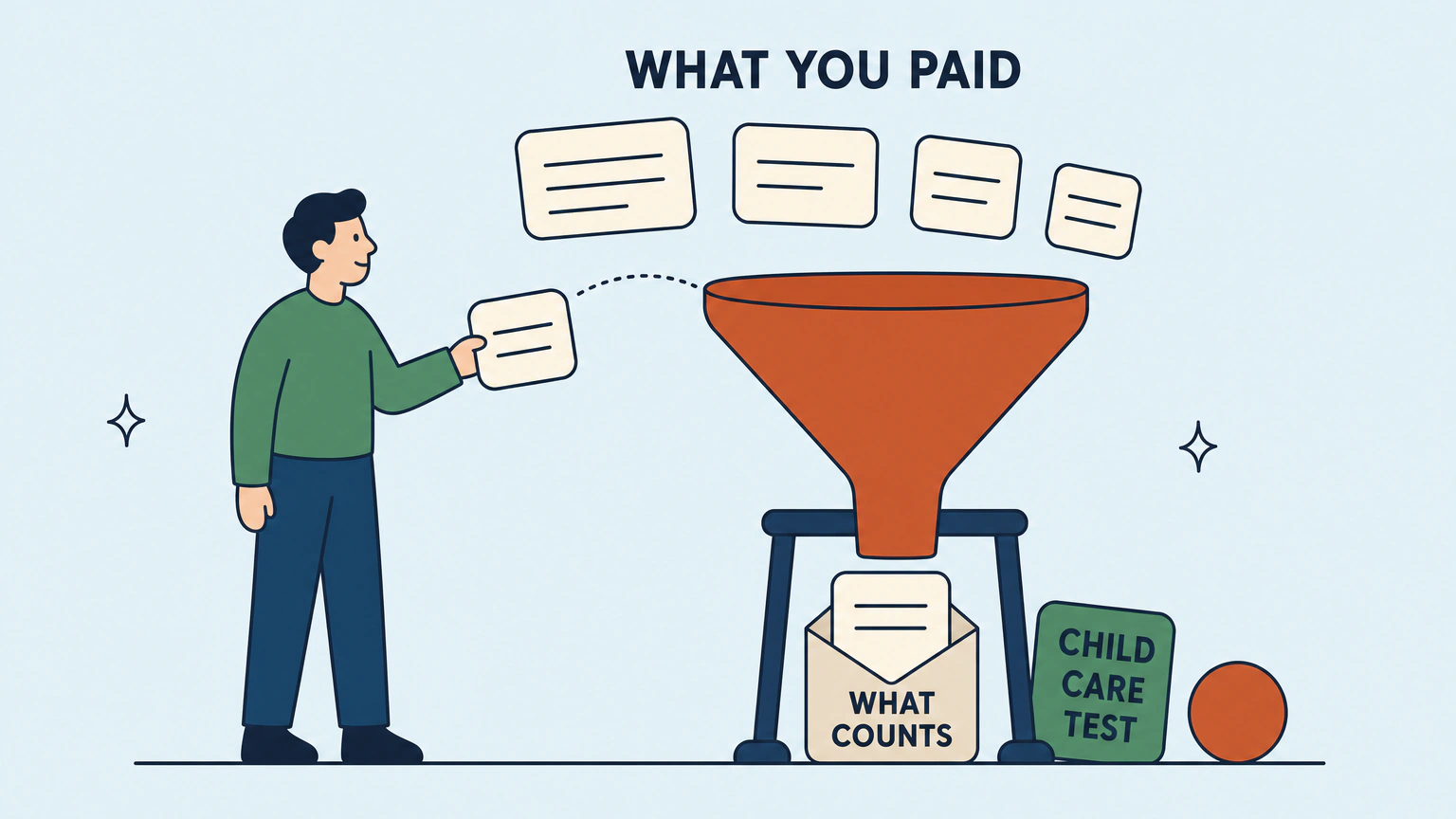
Almost none of it is deductible, and the reason is simpler than the exceptions: the tax code treats what you pay a piano teacher or a soccer club the way it treats groceries. Three things change that answer, and none of them turns on which activity your child picked. One is a federal credit for care that lets you work. One is a savings account Congress rewrote in July 2025. The third is your own state. Start with the first, because the benefits election can close long before tax time.
On this page
Why the IRS calls your lesson fees personal spending
The default comes first, because everything after it is an exception. Family spending isn't deductible. Not the swim club, not the recital fee, not the belt test, not the tutor. Those bills sit in the same bucket as your groceries, and the tax code leaves them there unless a specific rule pulls one out.
That's why all three routes look so narrow, and why they turn on odd little facts like whether a camp has beds.
What the tax code actually says about family money
The sentence doing the work is short. Section 262(a) of the Internal Revenue Code says that "no deduction shall be allowed for personal, living, or family expenses," except where the code expressly provides otherwise. Piano lessons are family expenses. So is the soccer registration, the dance costume, the tutoring hour, the gas to get there.
We hear one misreading more than any other: the club is a nonprofit, so the fee must be deductible. Nonprofit status describes the organization, not your payment. A registration fee buys your child a season, you got the season, and the club's paperwork doesn't change what you bought.
Which puts the question back on your budget instead of your return. If martial arts is the one on your counter, we've priced out what a first year of martial arts actually costs.
Why the club's tax ID number doesn't make the fee deductible
A booster club may hand you its tax ID number, and it's natural to ask what that changes. The club is a registered charity, so can the registration fee ride along as a donation?
No, and IRS Publication 526 says why in one line. When you get something back for what you gave, "you can deduct only the amount of your contribution that is more than the value of the benefit you receive." Registration buys a season. If you pay more than that season is worth, only the excess can count, and only if you meant the excess as a gift.
A second sentence closes the side door. Even at a nonprofit childcare center, the IRS says, "if your contribution is a substitute for tuition or other enrollment fee, it isn't deductible as a charitable contribution." Rename the fee a donation and it's still the fee.
What can qualify is the extra if the club is an eligible charitable organization. In 2026, a non-itemizer can deduct up to $1,000 in qualifying cash gifts, or $2,000 on a joint return; an itemizer uses the regular charitable deduction rules. Write $150 for the season, then $100 more because the team needs mats, and that second hundred is a gift with nothing coming back. Ask the treasurer to receipt it separately.
Route one: when the program is really child care
One federal rule does reach ordinary activity spending, and it turns on a single word. The child and dependent care credit can cut your federal tax by part of what you spend on care that lets you work. Not talent. Not enrichment. Care, so you can hold a job. Read it that way and the confusing cases sort themselves.
The test is care, and it has to let you work
Start with four facts you can check at the kitchen table. Your filing status and earned-income limits can change the result, too.
Your child was under 13 when the care was provided and is your dependent, unless the special rule for divorced or separated parents applies. You were working or actively looking for work, and so was your spouse if you're married and filing jointly. A spouse who was a full-time student or couldn't care for themselves can be treated as having earned income. The payment bought care rather than instruction, which is the line the rest of this section draws. And you paid someone outside a short list: not your spouse, not the other parent of a child under 13, not one of your own children who was still under 19 at year end, and not a dependent you or your spouse can claim.
If the rest of Form 2441's tests also fit, you claim the credit there, listing each provider's name, address and taxpayer ID number. For a tax-exempt provider, enter "Tax-Exempt" instead of a number. That's why the paperwork matters in September rather than April. Camps close. Ask while someone still answers the phone.
Day camp can count. Overnight camp never does.
This is the hinge, and the IRS states it in two flat sentences. "The cost of sending your child to an overnight camp isn't considered a work-related expense." And: "The cost of sending your child to a day camp may be a work-related expense, even if the camp specializes in a particular activity, such as computers or soccer."
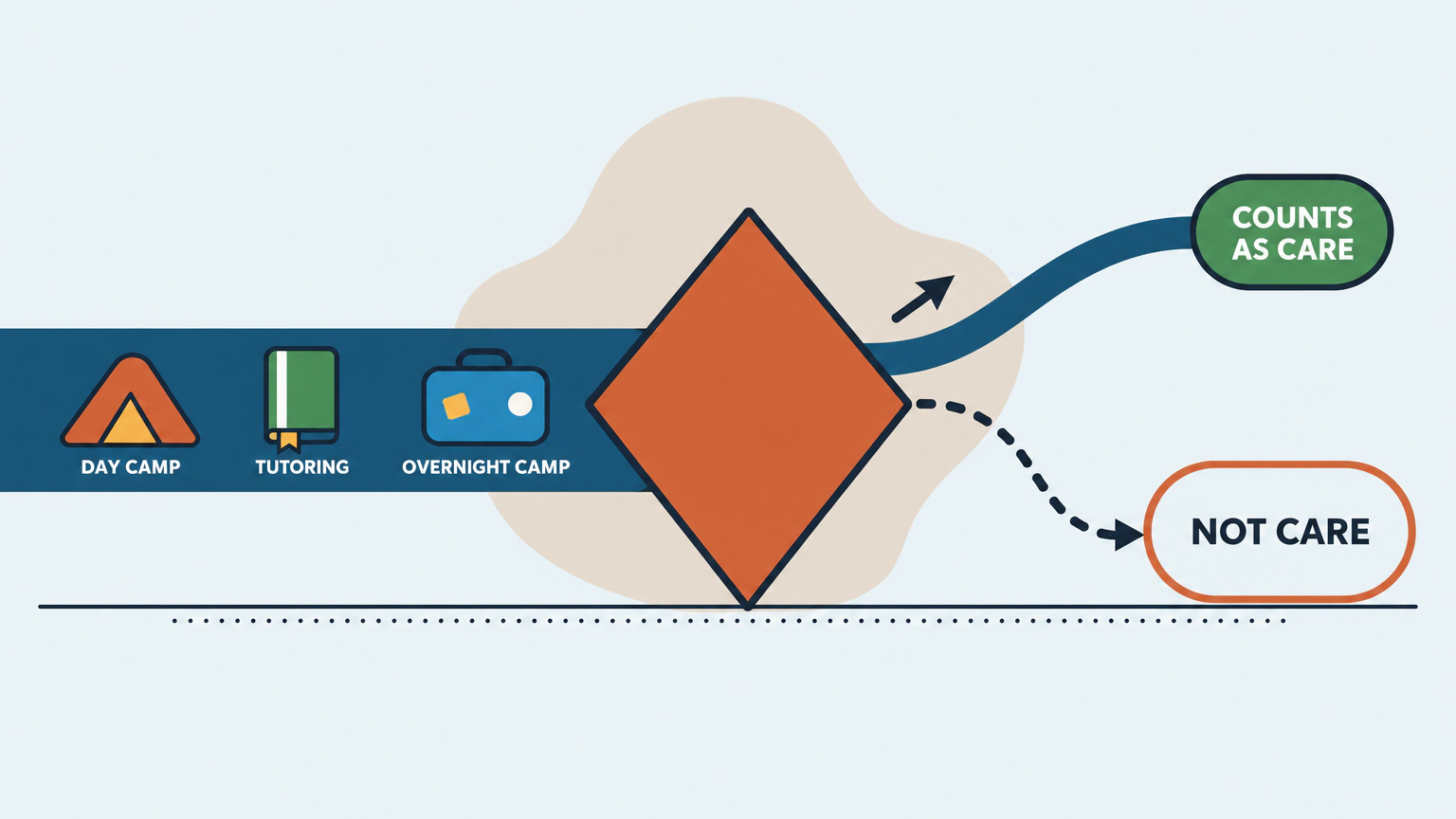
Read that second clause again, because it's the gift. Specializing doesn't disqualify a camp. Soccer camp, coding camp, horse camp: if your child came home at night and the program covered your working hours, the fee is in play. The IRS's own example is a nine-year-old at a day camp offering computer activities plus swimming and arts and crafts, where the full cost may be for care.
What flips the answer is the sleeping bag. Beds turn the same soccer program into an overnight camp, whatever the brochure promises.
Tutoring, summer school, and the kindergarten line
The other half of the hinge disappoints people, so here it is plainly. "Summer school and tutoring programs aren't for care." The IRS builds its example around the case parents most hope will work: a ten-year-old in a math tutoring program for two hours a day during the summer while a parent works.
Grade level draws the second line. Nursery school, preschool and similar programs below kindergarten count as care, even though the children are learning. Kindergarten and up don't, because now the payment buys school. The exception that survives is the one most families use anyway. Before-school and after-school care for a child in kindergarten or higher can still be care.
So one building can produce two answers on the same invoice. The after-school room can count as care. The Saturday tutoring block doesn't.
| What you paid for | Counts as care? | What the IRS says |
|---|---|---|
| Nursery school or preschool, below kindergarten | Yes | Programs for children "below the level of kindergarten are expenses for care" |
| Before or after school care, kindergarten and up | Yes | These "may be expenses for care" |
| Summer day camp, including one that specializes | Yes | "May be a work-related expense, even if the camp specializes in a particular activity, such as computers or soccer" |
| Overnight camp | No | "The cost of sending your child to an overnight camp isn't considered a work-related expense" |
| Math or academic tutoring program | No | "Summer school and tutoring programs aren't for care" |
| Kindergarten tuition, or any higher grade | No | "Expenses to attend kindergarten or a higher grade aren't expenses for care" |
| A weekly private music, dance or swim lesson | No | Instruction rather than care, and it doesn't cover your working hours |
| A sports team registration fee | No | Same reason as the lesson above |
The first six rows quote IRS Publication 503 for 2025 returns. The last two are our own reading of that rule applied to a lesson fee, which the publication doesn't name.
What gets bigger in the 2026 tax year
Fall is the right time to sort this out, not April. Congress changed the numbers on July 4, 2025, and the main ones start with tax years beginning after December 31, 2025. That means the 2026 tax year.
The credit's top rate climbs from 35 percent to 50 percent. Its first phaseout stops at 35 percent. A second phaseout begins above $75,000 of adjusted gross income, or $150,000 on a joint return, and bottoms out at 20 percent. The pot of expenses it applies to stays put.
| What | 2025 | 2026 onward |
|---|---|---|
| Top credit rate | 35% | 50% |
| How low the rate can go | 20% | The first phaseout stops at 35%. A second one begins above $75,000 AGI ($150,000 joint) and bottoms out at 20%. |
| Expenses that count: one child / two or more | $3,000 / $6,000 | $3,000 / $6,000, unchanged |
| Dependent care FSA exclusion | $5,000 ($2,500 married filing separately) | $7,500 ($3,750) |
| 529 withdrawals for K-12 expenses, per year | $10,000 | $20,000 |
Red flag: the same dollar only works once. Those $3,000 and $6,000 caps get reduced by whatever you excluded from income through a dependent care FSA. Run $7,500 through the FSA in 2026 and the credit has an empty pot, even with two children in care. Price both, then split the spending on purpose.
Route two: what a 529 will now pay for
529 plans are often associated with college, but K-12 tuition was already on the qualified-expense list. In July 2025, the same act that lifted the FSA limit added more K-12 expenses.
A 529 gives you no federal deduction going in. What you get instead is growth that stays untaxed on the way out, as long as the money lands on a qualified expense. Your own state may add a break for contributions, so check your state plan's site.
Tutoring outside the home, with three strings attached
The rewritten K-12 list covers tuition, curriculum, books, online materials, test fees and dual enrollment fees. And one more, which is why you're here: "Tuition for tutoring or educational classes outside of the home, including at a tutoring facility."
Then come the strings, sitting in that same sentence. The tutor can't be related to the student. They also have to be one of three things: licensed as a teacher in any state, someone who has taught at an eligible educational institution, or a subject matter expert in the relevant subject. A retired algebra teacher may clear the subject-matter-expert test. A related tutor doesn't.
Two more limits, both easy to miss. The expenses have to connect to enrollment or attendance at an elementary or secondary school, public, private or religious. And whether a piano lesson or a dance class counts as an "educational class" has no IRS guidance behind it yet. We'd want that in writing before treating a violin lesson as a qualified expense.
Therapies, and what a 529 still won't touch
One line on that list matters enormously to some families. A 529 can now cover "educational therapies for students with disabilities provided by a licensed or accredited practitioner or provider, including occupational, behavioral, physical, and speech-language therapies."
If you've been paying for speech therapy out of pocket while a 529 sits there growing for a college eight years away, that's a real change in your favor. The annual K-12 ceiling doubles to $20,000 for tax years starting after 2025.
Now the part that closes the door. Ordinary team fees, uniforms, competition travel and recreational lessons aren't named on the list. A 529 got broader in 2025. It didn't turn into an activity budget.
Route three: the states that put lesson fees on a return
Federal law treats a lesson fee as family spending. Some states offer their own education credits, and the three we checked put real money on the table for the categories parents actually pay for.
We verified three against the statutes and the forms. That's how many we checked, not how many exist. Other states run their own education credits with their own definitions. Take Minnesota, Arizona and Iowa as proof that the answer can be yes where you live, then go check your own.
| State | What it can cover | How much | Where the rule lives |
|---|---|---|---|
| Minnesota | Fees for instruction by a qualified instructor outside the regular school day or year, including tutoring and music lessons | 75% of qualifying expenses, up to $1,500 per child in K-12, refundable; income limits apply | Minn. Stat. § 290.0674; Schedule M1ED (2025) |
| Arizona | Fees paid or cash given to an Arizona public school, including for extracurricular activities | $200 single or head of household, $400 married filing jointly; unused amount carries forward 5 years | Ariz. Rev. Stat. § 43-1089.01 |
| Iowa | Tuition and textbooks at an accredited Iowa K-12 school, where "tuition" reaches extracurriculars | 25% of the first $2,000 per dependent, so $500 at most | Iowa Code § 422.12(1)(f), (2)(b) |
Minnesota can pay back 75 cents on a music lesson
Minnesota is the strongest of the three, and it isn't close. Its K-12 education credit refunds 75 percent of qualifying education expenses for a child in kindergarten through grade 12, up to $1,500 per child. Refundable means the state sends the money even when you owe nothing.
Two gates stand in front of it. Married filing separately, and you're out. Income is the other one, and the thresholds move every year. On the 2025 schedule, the $1,500 per child starts shrinking above $75,820 of adjusted gross income. One or two qualifying children put you out entirely at $81,820. Three pushes that to $84,820.
Then the definition that decides your teacher. A "qualified instructor" isn't a lineal ancestor or sibling of the child, and is either an instructor under the state's own schooling statute or a member of the Minnesota Music Teachers Association. Line 3 of Schedule M1ED says it out loud: "Fees for individual instruction by a qualified instructor taught outside the regular school day or year, such as tutoring or music lessons." That can include your piano teacher, if the teacher meets the state's definition. Worth asking about the association when you look for piano teachers in your area.
Keep the boundary straight, because it decides more of your invoice than the rate does. A qualifying instruction fee counts. An instrument counts only when it's used during the regular school day. Costumes and travel don't. For a competition family that's the whole conversation: a competition season, line by line.
Arizona credits the fees you pay your public school
Arizona's credit turns on where the money lands. It covers fees you pay, or cash you give, to a public school located in Arizona. The statute lists what that money can go toward, and item five is "Extracurricular activities."
It caps at $200, or $400 on a joint return, and the definition is specific: school-sponsored activities that charge enrolled students a fee. The statute names band uniforms, equipment or uniforms for varsity athletics, science lab materials, and trips solely for competitive events. Senior trips and anything recreational or touristy are ruled out by name.
So the boundary sits at the school gate. The band trip to a competition can qualify. The private trumpet teacher on Thursdays doesn't.
Iowa counts the school's own extracurriculars
Iowa's tuition and textbook credit is worth 25 percent of the first $2,000 you pay per dependent in kindergarten through grade 12, which tops out at $500 a child. The school has to sit in Iowa, be accredited, and run without profit. Or the child gets private instruction as the state defines it.
Iowa's own definition of tuition is what makes the difference. It "includes those expenses which relate to extracurricular activities including sporting events, musical or dramatic events, speech activities, driver's education, or programs of a similar nature." Iowa expressly includes those activities in the credit.
Checking your own state's rules beats trusting any blog, ours included. Go to your state revenue department's site, search "education credit," and open the form as well as the explainer. The line instructions often carry details the summary page leaves out.
What to do before you write the fall checks
Here's the honest summary. For an ordinary activity fee, the tax code usually isn't where the money is. The credit can apply only when a program provided care that let you work. A 529 helps only when the expense is on its qualified list and any tutor or instructor clears the bar. State credits turn up in some states and not others.
Two moves are worth checking. The first is the dependent care election in your benefits portal.
Pro tip: Open enrollment is when your employer takes the dependent care election for the next plan year. Check the dates, because employers set their own windows. Annual elections are generally locked for the plan year, though your plan may allow a change after certain status changes. 2026 is the first tax year with the $7,500 limit.
The second is comparing formats you can carry for a whole year. Our own cost profiles put math tutoring in an average price range of $115 to $208 across 867 profiles, martial arts in a fair price range of $105 to $158 across 668, and dance in a typical price range of $368 to $735 across 667. Our panels don't attach a time period to those ranges, so the signal is the gap between categories rather than any single number.
If a cheaper format is the answer, start with the category rather than one studio: math tutors near you, martial arts schools near you and dance studios near you can help you compare local instructors and schools in one place. And if the real problem is how much is on the calendar, we've written that one up too: how many activities a week is too many.
What to keep before you file:
- The provider's name, address and taxpayer ID number, or tax-exempt status, for every program you plan to claim as care
- Receipts that split the instruction fee from uniforms, materials, travel and competition entries
- Your employer's open enrollment dates and the last day to set your dependent care election
- Written confirmation on the invoice that a camp was day camp, not overnight
- Your child's 13th birthday, because only care provided before that date can qualify
- Your state revenue department's education credit page, if your state runs one
We can tell you which rule applies, but we can't see your return. A possible credit is worth checking with someone who can.
Check your benefits portal for the dependent care line and its election deadline.
Questions parents ask
Is summer camp tax deductible?
Day camp can be. Overnight camp never is. If the camp covered hours you spent working, your child was under 13 when care was provided, and the other credit tests fit, the fee can count even when the camp specializes in soccer or coding. Add an overnight stay and it flips to no.
Can I use a 529 to pay for tutoring?
Yes, for distributions made after July 4, 2025, with conditions. The student has to be enrolled at or attending a K-12 school. The tutor has to be unrelated to your child and either licensed as a teacher in any state, someone who has taught at an eligible postsecondary institution, or a subject matter expert in that subject.
Are booster club donations tax deductible?
The part you gave for nothing in return can be deductible if the club is an eligible charitable organization. A registration payment may count only to the extent it exceeds the season's fair value and you intended the excess as a gift. In 2026, qualifying cash gifts can be deductible even if you don't itemize, up to $1,000 or $2,000 on a joint return. Write the extra donation separately and keep the receipt.
Can I claim after school care on my taxes?
It can, when the program provided care while you worked and the other credit tests fit. Before-school and after-school care for a child in kindergarten or higher may be an expense for care, even though the school tuition itself can't. A homework room that watches your child can count. A tutoring session in the same building doesn't count as care.
Are music lessons tax deductible in Minnesota?
They can cut your Minnesota tax, yes. The state's K-12 education credit refunds 75 percent of qualifying education expenses, up to $1,500 per child. Schedule M1ED lists fees for individual instruction by a qualified instructor outside the regular school day, "such as tutoring or music lessons." Income limits apply, and married filing separately is out.
Does my kid's sports registration fee count for anything?
A typical team registration fee doesn't count on a federal return. A sports day camp can be different if it is care that lets you work. Arizona credits certain fees paid to an Arizona public school for extracurricular activities, and Iowa's tuition credit reaches sporting events at an accredited, nonprofit Iowa school. Fees paid to a private club sit outside those two state credits.
My employer offers a dependent care FSA. Should I take that or the credit?
Price both, because one shrinks the other. Every dollar you exclude through the FSA comes off the $3,000 or $6,000 of expenses the credit can count. In 2026 the FSA ceiling is $7,500, more than the credit's biggest cap, so excluding the full amount leaves the credit with nothing.