

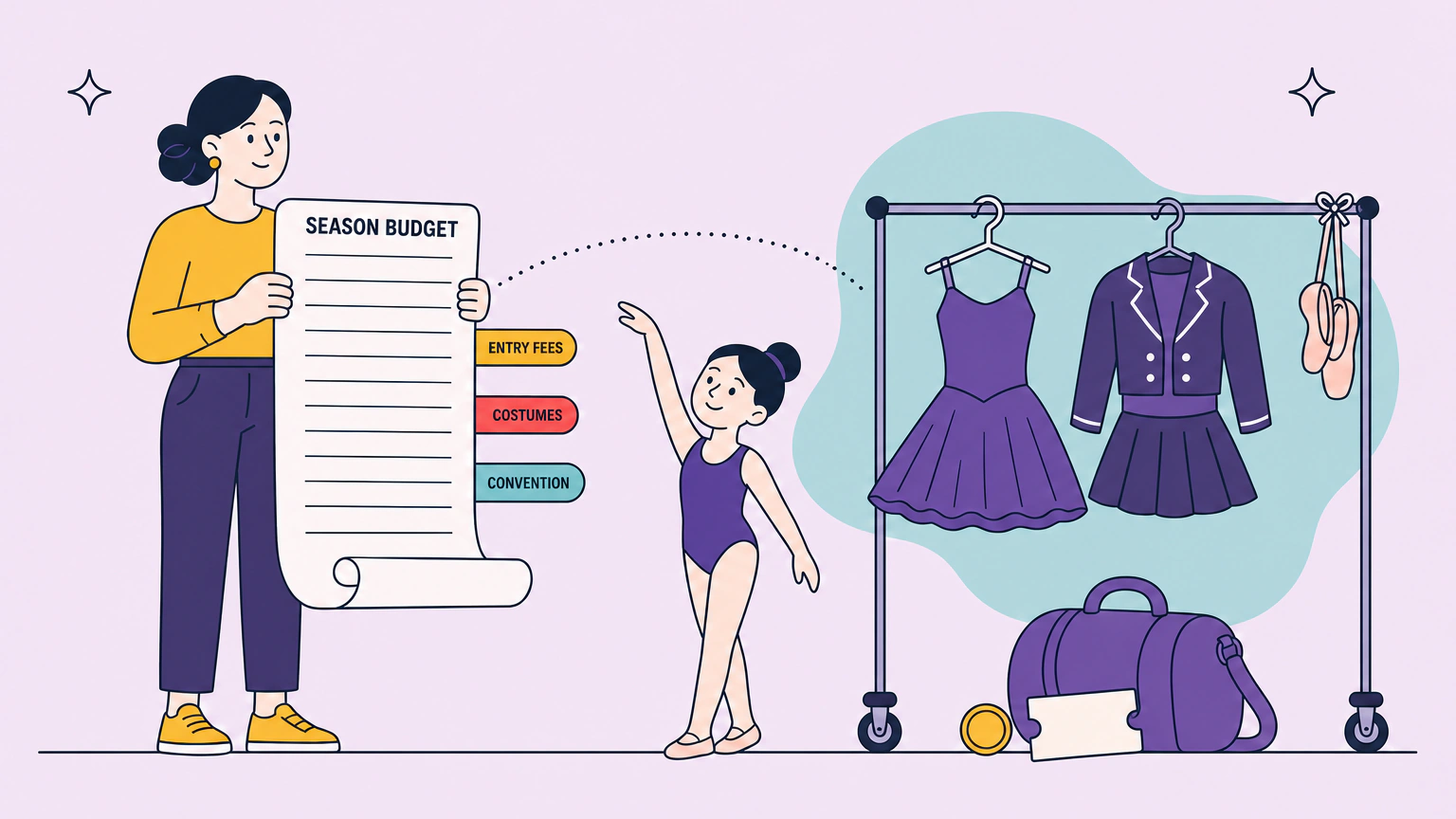
Those are the rates producers published for 2026-2027. $45 to $100 per dancer for each group routine at each competition. $125 to $235 for a solo. $335 to $390 per dancer for a convention weekend at ages 8 to 16. $90 to $200 per costume. Tuition sits outside all of it, and usually goes up the month your dancer joins the team.
On this page
- The short answer, and what it does and does not include
- What competitions actually charge: published 2026-2027 rates
- The convention rule nobody tells parents about
- Costumes, choreography and the fees your studio sets
- The tuition trap: why your monthly bill goes up before any competition does
- Build your own season number
- What this compares to
- Nine questions to ask before you accept a team spot
- Red flags on a season fee sheet
- How to bring the number down without quitting
- Frequently asked questions
- Your next step
The short answer, and what it does and does not include
That band covers entry fees, convention registration and costumes. It leaves out tuition, travel, private lessons, dancewear and spirit wear, which is why published totals never agree.
| Line item | Who sets it | What we found published | How it scales |
|---|---|---|---|
| Monthly tuition | Your studio | $368 to $735 typical range and a $420 average across 667 cost profiles on our dance category (no time period stated) | With weekly hours |
| Entry fees | The producer | $45 to $100 per dancer per group routine; $125 to $235 per solo | Routines times competitions |
| Convention registration | The producer | $335 to $390 per dancer per weekend at ages 7 to 16; $225 to $295 at ages 4 to 7 | Conventions attended |
| Costumes | Your studio | $50 to $1,000 depending on embellishment (Dance Parent 101's table) | Roughly one per routine |
| Travel and lodging | You | Nothing national is published; one parent budgets $150 a night at nationals | Out-of-town events |
What "competitive dance" actually means here
A competition team is a selected group at a private studio, rehearsing set routines for judges across several competition weekends. It's not a recreational class, and it's not the school dance team.
Your fee sheet uses the producers' vocabulary. A solo is one dancer. A duo or trio is two or three. Small groups usually run 4 to 9 dancers, and production thresholds vary by producer.
Why published totals range from $1,500 to more than $10,000
Dance Parent 101 puts it plainly: competitive dance in the USA "easily starts with prices in the $1,500 range and can far exceed $10,000 annually." That counts fees, conventions, choreography and costumes, but not tuition.
Most of a spread that wide is yours to set. How many routines. Whether one is a solo. How many competitions and conventions you agree to.
What competitions actually charge: published 2026-2027 rates
Four producers publish their rates where a parent can read them. Compare a producer against itself before you compare it to the one next door: fee basis, deadlines and add-ons all differ.
| Competition | Solo | Duo/Trio | Group (4-9) | Fee basis | Rates published for |
|---|---|---|---|---|---|
| NYCDA Regionals | $215 early / $235 after deadline | $100 / $120 | $85 / $100 | Per dancer, per routine | 2026-2027 |
| NYCDA Nationals | $215 / $235 | $115 / $135 | $100 / $120 | Per dancer, per routine | 2026 Nationals, latest posted |
| REVEL | $200 | $105 | $80 | Per dancer, per routine | 2026/27 |
| Streetz | $195 (+$10 late) | $95 (+$10 late) | $75 (+$10 late) | Per dancer, per routine | 2026-2027 |
| Team Dance | $125 (+$45 title solo) | $145 per duo, $175 per trio | $45 per dancer | Mixed: duo and trio per routine | August 2026, no season printed |
Table note. Showstopper publishes a $25 per-routine deposit but sends studios to a login-gated Studio Center for prices. Add-ons are billed separately: extra time at $5 per dancer per minute (NYCDA, Streetz), $15 (REVEL) or $2 (Turn It Up), plus the $10 photo and video charge Team Dance bills every dancer.
Entry fees by routine type
A group routine costs $45 to $100 per dancer at every competition, a solo $125 to $235. At the same producer that solo runs about two and a half times the group entry.
Which is why "she only wants one solo" is the most expensive sentence in competitive dance.
Every routine is charged again at every event: three routines at four competitions is twelve charges, not three.
Per dancer or per routine? The difference that changes your total
NYCDA, REVEL and Streetz charge per dancer for each routine. Team Dance doesn't. It prices a duo at $145 for the duo, a trio at $175 for the trio, then $45 per dancer for groups.
Read the two as the same and you'll misjudge a sheet badly. That $145 duo is $72.50 a dancer. The same pair charged $100 each costs $200.
Early-bird deadlines, late fees and change fees
Some of this is avoidable. The calendar is the lever.
NYCDA's after-deadline rates run $15 to $20 more per routine. Streetz adds $10 per routine after its cutoff, 30 days out. Turn It Up charges $20 per routine late and $20 per change inside 30 days. 8 National Talent charges $10 per change once scheduling starts.
Deposits come first and rarely come back: $50 an entry at NYCDA, $25 a routine at Showstopper.
The competitions that do not publish prices
Showstopper's 2026 Regionals rulebook offers one sentence on price: "Visit the Studio Center for 2026 entry prices and registration." That center wants a studio login, so you can't price-check your fee sheet.
Ask your director for the per-routine fee by category, in writing.
The convention rule nobody tells parents about
The biggest line most parents never see coming isn't a competition fee. It's the convention bolted onto one, and at three of those four producers it isn't optional.
What a dance convention is
A convention is a two-day weekend of master classes with a traveling faculty, run in a hotel ballroom alongside the competition. Dancers take classes Saturday and Sunday and compete the same weekend.
You usually cannot compete without buying it
Three producers say so in their own rule books. NYCDA: "Competing dancers must be registered for the 2-day workshop in the convention city they are competing in." REVEL: "Dancers registered for the competition must also be registered for the convention." Streetz: "All contestants must be registered along with their teachers for the entire convention in the city where competing."
For a dancer aged 8 to 16 the 2026-2027 rates land close together: $350 before the deadline and $390 after at NYCDA, $340 studio or $390 independent at REVEL, $335 plus a $20 late fee at Streetz.
The 4-to-7 programs run $225 to $295. If your dancer is that young, what age kids are actually ready comes first. An observer pass is $80 at NYCDA, $85 at REVEL.
How to check whether your tour includes conventions
Ask which events on the calendar are convention-competitions, and the per-dancer fee at each, then check the producer's page. Budget entry fees without conventions and you're short by roughly a third.
Costumes, choreography and the fees your studio sets
Entry and convention fees are producer-set and published. Costumes and choreography are set by your studio and published nowhere, so ask, and ask in writing.
Costumes
Dance Parent 101's table puts a non-embellished costume at $50 to $200, an embellished one at $75 to $500 and a custom costume at $250 to $1,000, with accessories adding $50 to $300.
Those are a dance-parent publication's bands, not a price list. We tried the vendors and couldn't get a usable price from any of them.
One Utah studio bundles instead: $500 covers team wear, shoes and three costumes, then $90 per costume.
Choreography and cleaning fees
A choreography fee pays whoever sets the routine, plus the rehearsal hours spent cleaning it.
In one published family account, group and production charges included choreography, while solos, duos and trios carried their own. One studio publishes $35 to $65 per dancer. A California studio charged one parent $2,250 for a single solo.
The line items that appear later
These arrive after you've said yes. Ask now.
Team and spirit wear: one parent put a jacket at $70. Competition shoes, and hip hop classes may need a separate pair. Tights, hair and makeup. Photo and video, $10 a dancer at Team Dance. Recital and banquet fees, $145 at one studio that also charges $30 registration and a $40 tryout. Acro routines can pull in tumbling classes billed outside the package.
The tuition trap: why your monthly bill goes up before any competition does
Here's what catches families out: the monthly bill can rise before a single entry fee is charged.
Studios price tuition by weekly hours
Some studios don't price by class at all. They price by total weekly hours in the building, whatever fills them. A team adds technique classes plus rehearsal, so joining one moves a family several rungs up a ladder like this.
| Weekly hours in the studio | Published monthly tuition |
|---|---|
| 1 hour | $55 |
| 3 hours | $120 |
| 6 hours | $190 |
| 9 hours | $240 |
| 12 hours | $285 |
That's one Utah studio's published 2026-2027 chart, there for the shape of hours-based pricing, not as a national average. A team schedule adds weekly hours, which is a scheduling question too: how many hours a week is too many. Some may be ballet, and ballet schools in your area publish $99 to $167.
Where your studio sits
Across 667 cost profiles on our dance category, the typical price range is $368 to $735, against a $420 average and a spread from $158 to $945. That's our own aggregate, not a market survey, and it never says whether it's pricing a month or a term. Use it for scale.
It reads your location too, so dance studios near you may sit elsewhere. Compare your studio at the required team hours, not what you pay now.
Required summer training
Some teams require a summer intensive, billed separately from tuition and competition fees. One studio publishes required six-week workshops at $160 to $195. Miss a day and it isn't pro-rated or made up.
Build your own season number
Four numbers drive the total, so set them yourself. The estimator covers dancers aged 8 and older, and its default of three group routines, no solo, four competitions and one convention returns $1,145 to $2,190: $540 to $1,200 in entry fees, $335 to $390 for the convention, $270 to $600 in costumes.
Travel and lodging aren't in there. We couldn't find a national figure worth printing. For a dancer aged 4 to 7, swap in the $225 to $295 convention band from the producer's page.
Competition Season Cost Estimator
What a season costs on top of your monthly tuition, built from published 2026-2027 competition rates.
Published group rates run $45 to $100 per dancer, per routine, per competition.
A solo entry runs $125 to $235 per competition - about two and a half times a group entry at the producers listed.
Every routine is charged again at every competition.
At NYCDA, REVEL and Streetz, you must register for the convention to compete: published ages 8+ rates run $335 to $390 per dancer.
Your season, on top of tuition:$1,145 to $2,190
Set at least one routine to see a season estimate.
- Entry fees
- $540-$1,200
- Conventions
- $335-$390
- Costumes
- $270-$600
Monthly studio tuition is separate and usually rises when your dancer joins a team. Travel and hotels are not included - there is no reliable national figure for them, and for out-of-town nationals they are often the largest line of all.
2026-2027 rates published by NYC Dance Alliance, REVEL and Streetz, plus Team Dance's undated rates page. Costume planning range from a published studio fee schedule and Dance Parent 101. Competition pricing changes every season - check your own events' current fee pages.
What this compares to
Set your number beside another family's. The Aspen Institute's Project Play survey found the average family spent $1,016 on a child's primary sport in 2024, up 46% since 2019, plus $475 on that child's other sports.
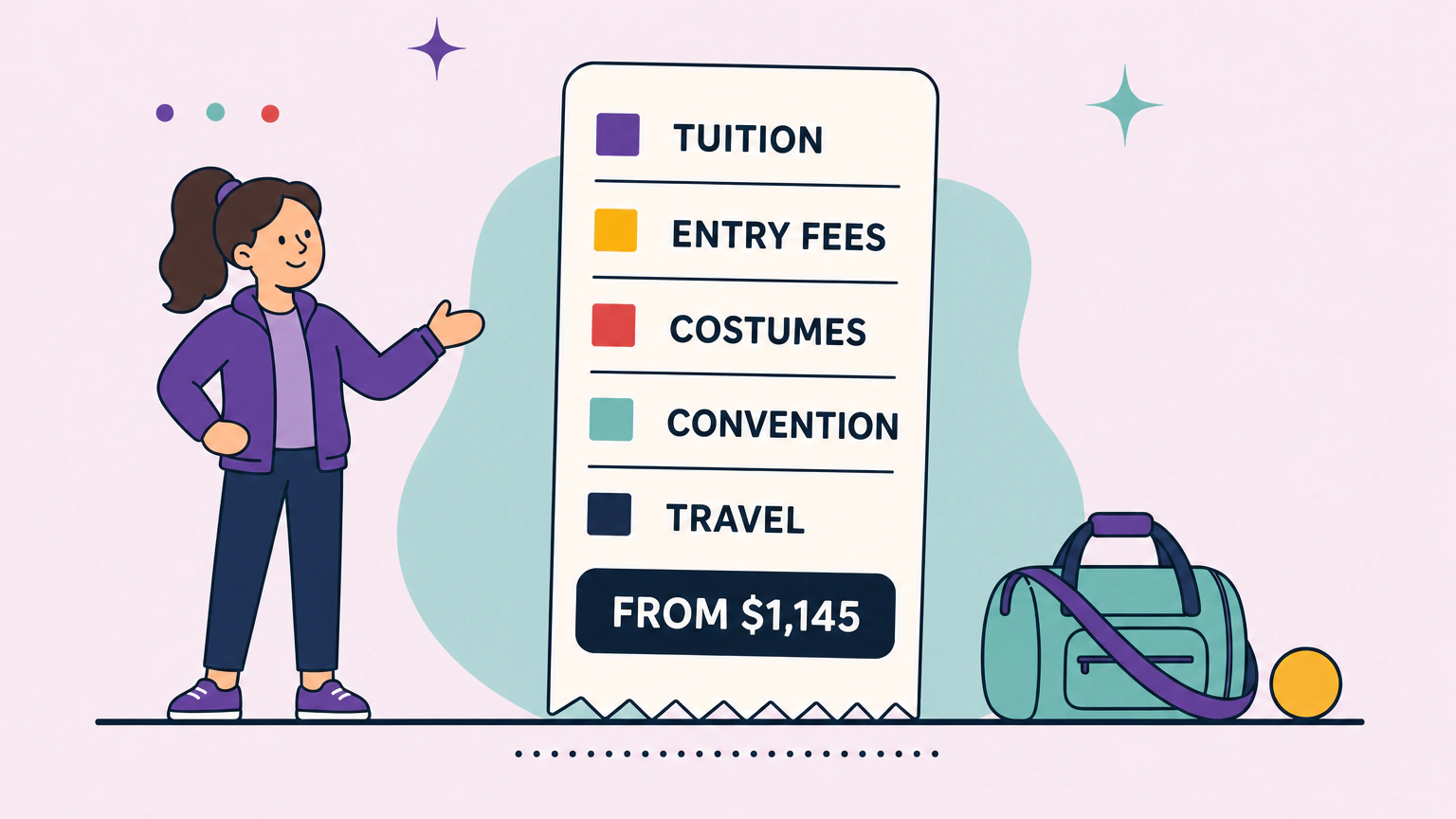
Project Play counts sports, not dance, so hold it loosely. But a dance season's add-ons alone, before a dollar of tuition, cost about what a year of the average child's main sport costs.
Nine questions to ask before you accept a team spot
A studio with its season organized answers all nine in one email, before you sign.
- What is the total number of routines my dancer is being placed in this season, and can that number change after I commit?
- What is the per-routine entry fee, by category, at each competition on the season calendar?
- Which events on the calendar are convention-competitions, and what is the per-dancer convention fee for each?
- What is the monthly tuition at the required weekly hours for this team, not the current tuition?
- Is there a separate choreography fee, and is it per routine or per dancer?
- What is the costume cost per routine, and does it include shoes, tights and hair pieces?
- What is required over the summer, and what does it cost?
- What is refundable, and until when? Specifically: deposits, costume payments and entry fees.
- If we need to withdraw mid-season, what remains owed?
Red flags on a season fee sheet
None of these means the studio is doing anything wrong. Each one means a number is missing.
Five things to ask about on a season fee sheet.
- A fee sheet with no total. Ask for the season total at the placement you've been offered, in writing, before you sign.
- "Costume fees TBD." Ask what last season's costumes actually cost, and whether shoes were in that number.
- Entry fees quoted as one lump sum. Ask for the per-routine, per-competition breakdown. It's the only version you can check against the producer's published rates.
- A calendar without event names. Ask which producers the studio competes with, then look up their fee pages yourself.
- No written withdrawal terms. Ask what you'd owe if you left in October, in January and in March. Deposits usually don't come back, and entry fees typically stop being refundable about 30 days out.
How to bring the number down without quitting
You can take real money out of this season without leaving the team.
Levers that actually move the total
Cut routines before competitions. Dropping one from a four-competition season saves four entry fees and a costume.
Skip the solo in year one: that's $125 to $235 an event, plus choreography and a costume.
Then local events over convention tours, early-bird deadlines over late ones, secondhand costumes over new.
What to ask about financial assistance
Ask, even if you're sure the answer is no. Does the studio offer scholarships, and how do you apply? Can the season be spread over a payment plan, the way one studio invoices tuition, competition, costume and showcase fees across ten months? Is there work-trade for a reduction?
Frequently asked questions
How much does competitive dance cost per year?
Budget about $1,100 to $2,200 per dancer for a typical three-routine, four-competition season with one convention, on top of monthly tuition and before travel and hotels. What pushes a family past $5,000 for the year is solos, extra routines, more conventions and a trip to nationals.
Why is competitive dance so expensive?
Because the fees multiply instead of adding up. Every routine is charged again at every competition, so three routines across four events is twelve charges. At NYCDA, REVEL and Streetz, convention registration is mandatory alongside that, at $335 to $390 per dancer aged 8 to 16 per weekend. And tuition can rise with a team's required weekly hours.
How much are dance competition entry fees?
A group routine runs $45 to $100 per dancer and a solo $125 to $235, charged again at each competition, across five published 2026-2027 schedules. Late entries add $10 to $20 per routine, changes inside 30 days cost $10 to $20, and deposits rarely come back.
How much do dance competition costumes cost?
Dance Parent 101's published table puts a non-embellished costume at $50 to $200, an embellished one at $75 to $500 and a custom costume at $250 to $1,000, plus $50 to $300 for accessories. Expect one per routine, and ask whether shoes are in the price.
What is a dance convention, and do we have to go?
A convention is a two-day weekend of master classes held alongside the competition. At a convention-competition you usually don't get a choice: NYCDA, REVEL and Streetz each state in their rules that a dancer must register for the convention to compete.
Is competitive dance worth the money?
It depends what you think you're buying. The fees pay for stage time, adjudication, faculty classes and, at conventions, scholarship auditions. They don't buy training quality, which comes from the studio you already chose, and they don't buy a college place. If that's why you're saying yes, we'd think again.
Can you do competitive dance on a budget?
Yes, and the levers are specific. Fewer routines rather than fewer events. No solo in year one. Local competitions instead of convention tours, early-bird deadlines instead of late, secondhand costumes instead of new. Then ask about scholarships, payment plans and work-trade.
What happens to the money if my child quits mid-season?
Expect a lot of it to be gone. NYCDA, Turn It Up and Streetz all state that entry fees aren't refundable. Showstopper's become non-refundable 30 days out, and REVEL issues a credit on convention fees rather than a refund. One studio makes costume fees expressly non-refundable, and what to check before you pull them out covers the rest.
Your next step
Price the season before you accept it. Get the tuition at required team hours, the routine count and the calendar in writing, then send the nine questions.
If you're still comparing, dance studios near you lists local programs and their class structures, and how studios are reviewed and listed explains how the rankings are built.
Sources. Fee, workshop and rules pages from NYC Dance Alliance, REVEL, Streetz, Team Dance, Showstopper, Turn It Up and 8 National Talent, seasons as named; Rhythm Works Dance, Clearfield, Utah, 2026-2027 team fees; Dance Parent 101; Aspen Institute Project Play.
One caveat: competition pricing changes every season and varies by city, so open the producer's current fee page before you budget.