

If you're sitting with a stack of fall enrollment forms and wondering how many extracurricular activities is too many, that's the check to run tonight.
On this page
- The short answer: count hours, not activities
- The sport-load limits youth-sports medicine actually publishes
- What these limits do not cover
- Run the numbers on your own child's week
- The five-minute schedule audit
- Warning signs that the load has gone too far
- How to cut back without making it a punishment
- What to do next
- Frequently asked questions
The short answer: count hours, not activities
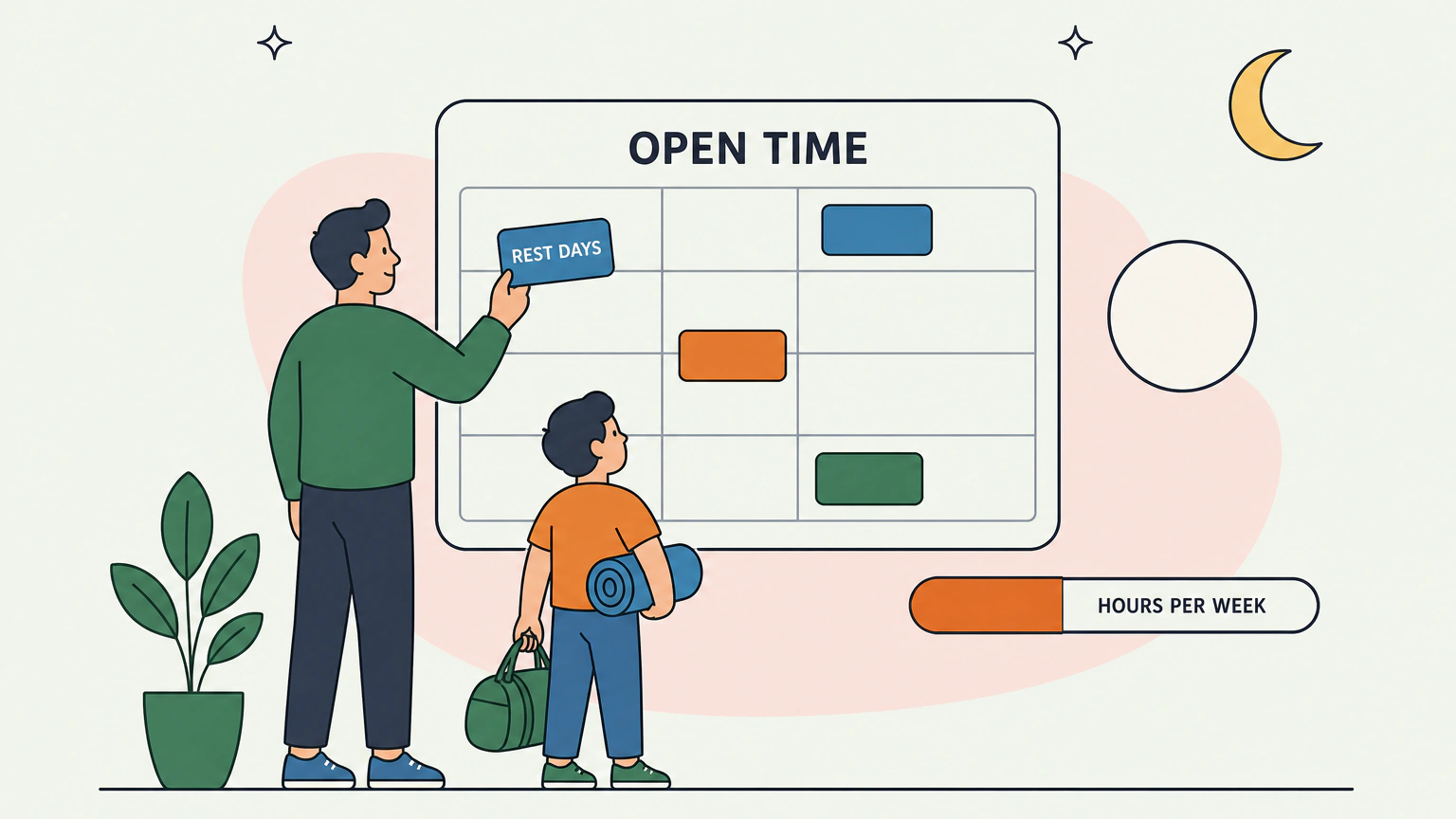
Three numbers cover most of it. Total your child's weekly hours in organized sport and physical-activity classes, practices and games, then compare that to their age in years. Count next week's days off from organized training and competition; you want at least two. Count the organized sports running this season; the recommendation is one.
The cited guidance does not set a limit on commitments. It focuses on training load and sport volume, including hours, days and seasons.
Why "there's no magic number" is only half true
The eight measurable pages reviewed for this article said there is no magic number, and on the count of activities that is correct. What they left out is that the cited guidance sets limits on volume, written down by name with worked examples. No count in these sources, real limits on sport load.
The sport-load limits youth-sports medicine actually publishes
Two documents carry almost all of this. The National Athletic Trainers' Association published an official statement on sport specialization in October 2019 with six numbered recommendations. The American Academy of Pediatrics publishes its Council on Sports Medicine and Fitness guidance on HealthyChildren.org, last updated January 22, 2024. NATA's statement is written for sports-medicine professionals; HealthyChildren presents the AAP guidance to families.
Hours per week should not exceed your child's age in years
NATA's recommendation 4 says young athletes shouldn't spend more hours a week in organized sport and/or activity than their age in years. In its worked example, a 12-year-old tops out at 12 hours.
What counts is the organized sport or physical activity itself: physical-activity classes, practices, games and any team-required conditioning. Travel time is not in the published rule, although it is very much in your week.
A 2015 clinical case-control study that enrolled 1,214 athletes ages 7 to 18, with 1,190 analyzed, by Neeru Jayanthi, Cynthia LaBella and colleagues in the American Journal of Sports Medicine, found roughly double the odds of a serious overuse injury among young athletes playing more hours of sport a week than their age in years. Compare recreational and competitive tiers before you re-enroll: gymnastics programs near you.
At least two days a week off from organized training
NATA's recommendation 5 asks for at least two days off a week from organized training and competition. Then it adds a detail most parents never hear: a rest day isn't a day for another team's practice either.
The AAP frames it differently. Kids shouldn't be required to play or train more than 5 to 6 days a week. Those two rules don't line up, and we're not going to blend them into one tidy number that neither body wrote down. A six-day week satisfies the AAP and misses NATA's minimum by a day.
Year-round training is where this breaks. If your family runs swim lessons near you in all four seasons, count the days clear of organized training and competition, not every scheduled commitment.
One organized sport per season, and under eight months a year
NATA recommendation 2 is one organized sport per season. Recommendation 3 draws the other boundary: fewer than eight months a year in a single sport. The AAP asks for at least 2 to 3 months off any given sport during the year, and you can split that into one-month breaks.
For families running two at once, the AAP adds a rider: a child on more than one team shouldn't have games or practices for both on the same day.
And when you add hours, add them slowly
The AAP asks that weekly training load rise by no more than 10% to 20% at a time. Its example is concrete: for a child practicing an hour a day, the following week's daily training time should increase by no more than about 12 minutes.
A sudden jump from an empty summer into a full fall schedule can break that rule. A belt-testing cycle at martial arts schools near you can create a smaller spike in the weeks before a test.
Table A. The published sport-load limits, and exactly what each one covers
| Limit | The published figure | Who publishes it | What it does not cover |
|---|---|---|---|
| Weekly hours ceiling | No more hours per week than the child's age in years (a 12-year-old: no more than 12 hours) | NATA official statement, October 2019, recommendation 4 | Travel and spectating time; non-physical lessons such as music or tutoring |
| Rest days | Minimum of two days off per week from organized training and competition, with no other team's training on those days | NATA, recommendation 5 | Free play and unstructured activity, which the rest day is not protecting against |
| Days of play or training | Not more than 5 to 6 days a week | AAP Council on Sports Medicine and Fitness (HealthyChildren.org, updated 1/22/2024) | Does not set an hours figure; use the age rule for that |
| Season length | One organized sport per season; fewer than eight months a year in a single sport; 2 to 3 months a year off any given sport | NATA recommendations 2 and 3; AAP (the 2 to 3 months) | Does not limit how many different activities a child may sample across a year |
| Adding load | No more than a 10% to 20% increase in weekly training load at a time | AAP (HealthyChildren.org, 1/22/2024) | Is about ramping up, not about the absolute ceiling |
What these limits do not cover
Every one of those limits comes from sports medicine, and each is written about organized sport and physical activity. Stretch them over a drawing class and you've invented a rule nobody published.
Where the sport rules stop applying
The hours ceiling reaches the physical categories: gymnastics, dance, swim, martial arts, tennis, soccer. It doesn't cleanly reach piano teachers in your city, a weekly drawing class or math tutoring.
The sources frame these rules around sport, training and repetitive physical activity. The AAP's own example is a gymnast's wrist bent through the same move repeatedly; it does not extend that sport-load rule to every kind of lesson.
The opposite mistake costs you just as much. A quiet activity still takes an hour out of a Tuesday, and a week only holds so many hours, whatever fills them.
The budget that does cover everything: your child's actual day
One budget covers piano, tutoring, travel soccer and the drive between them. It's the clock.
Table B. The hours your child's week actually has
| Age | Weekly organized-activity ceiling (age rule) | Recommended sleep per 24 hours | Daily activity floor |
|---|---|---|---|
| 6 | 6 hours | 9 to 12 hours | 60 minutes |
| 8 | 8 hours | 9 to 12 hours | 60 minutes |
| 10 | 10 hours | 9 to 12 hours | 60 minutes |
| 12 | 12 hours | 9 to 12 hours | 60 minutes |
| 14 | 14 hours | 8 to 10 hours | 60 minutes |
| 16 | 16 hours | 8 to 10 hours | 60 minutes |
Sleep figures come from the American Academy of Sleep Medicine consensus statement (Paruthi et al., 2016), which the AAP says it supports. The activity floor comes from the Physical Activity Guidelines for Americans, 2nd edition: 60 minutes or more of moderate-to-vigorous activity a day for ages 6 through 17.
The table starts at 6 because the sleep and federal activity sources use different guidance for ages 3 to 5. NATA's statement does not give a numeric lower age for its hours ceiling, while the study behind the age comparison enrolled athletes ages 7 to 18. If your child is younger, start with which activities publish a real starting age rather than treating a preschool age as a validated calculator boundary.
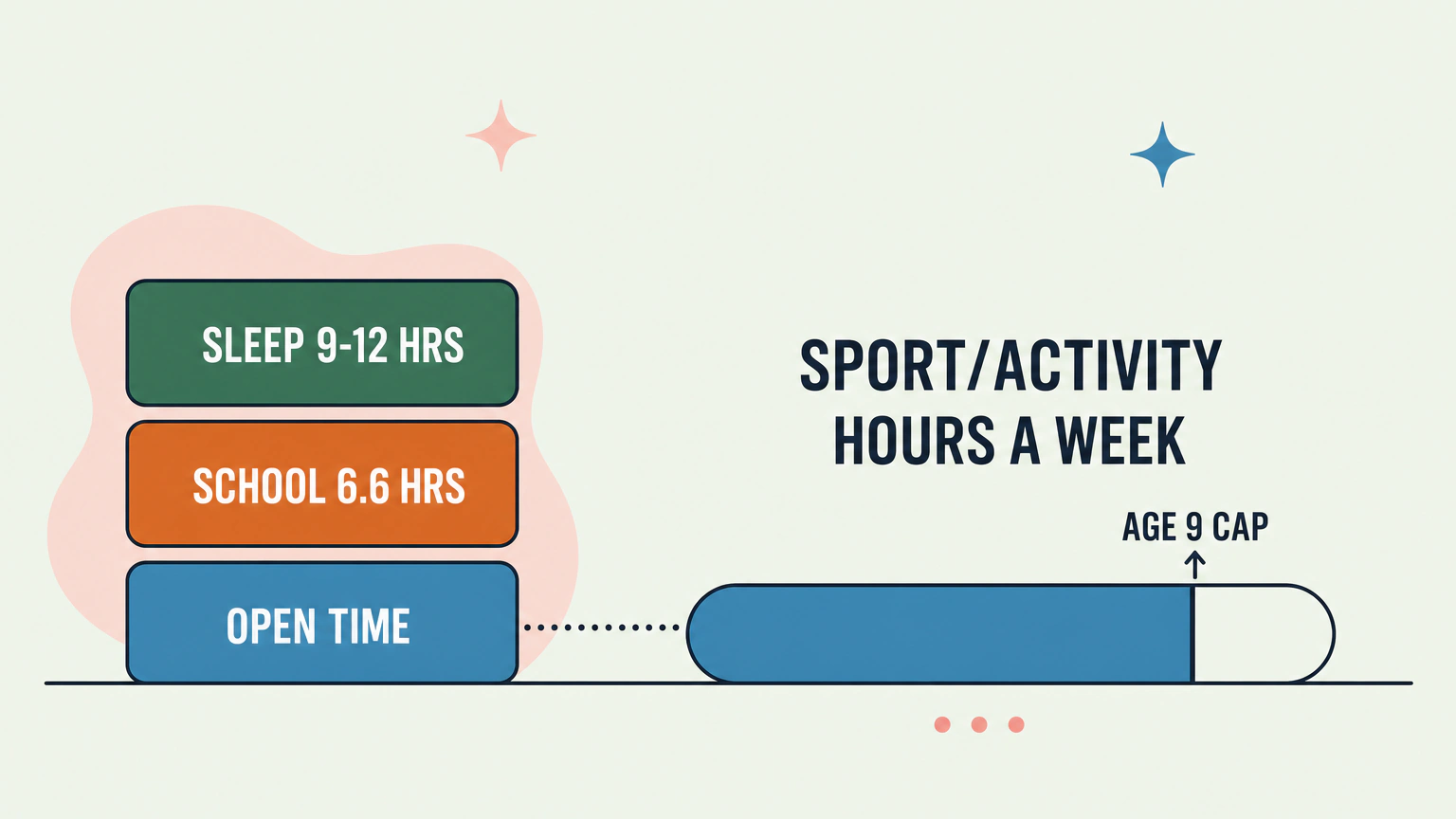
Here's the subtraction, and it's our own arithmetic on those numbers rather than a published finding. Take a 6-to-12-year-old's 9 to 12 hours of sleep. Add an average US public school day of 6.6 hours (National Center for Education Statistics, Schools and Staffing Survey, 2007-08). That leaves roughly 5 to 8 waking hours for homework, dinner, the drive and the activity.
Run the numbers on your own child's week
The check below takes four things you already know: your child's age, the weekly hours in organized sport and physical-activity classes, practices and games, the days with organized training or competition, and how many organized sports run this season. It gives your child's ceiling rather than a national average. It diagnoses nothing, and a child thriving at the limit is not in trouble.
Weekly Activity Load Check
- Young athlete's age9
- Hours a week in organized sport and physical activity7
- Days a week with organized training or competition4
- How many organized sports are running this season1
The age comparison was studied in athletes ages 7 to 18. NATA's statement doesn't name a lower age.
Add organized physical-activity classes, practices and games. Count the activity itself, not the drive.
Count a day with at least one organized sport or physical-activity class, practice, competition or game.
Team and individual organized sports both count. Music, art and tutoring don't.
There's no box for the total number of activities. NATA and the AAP set their limits in hours, organized-training days and sports per season, not in a count.
Inside all three published limits.
7 hours a week against a 9-hour ceiling for a 9-year-old - about 2 hours of headroom.
Weekly hours7 of 9 hours
Inside the limit
Days off3 of 7 days
Meets the two-day minimum
Organized sports this season1
At or below one sport per season
This schedule is inside all three published limits. If your child is tired, sore or dreading practice anyway, the signs matter more than the arithmetic.
Guidelines: National Athletic Trainers' Association official statement (2019) and the AAP Council on Sports Medicine and Fitness (2024). These are population-level guidelines for organized sport and activity, not a diagnosis. A child with pain, persistent fatigue or a change in sleep should see their pediatrician.
The five-minute schedule audit
To do this on paper, run the same check against next week's calendar.
- Add up every organized sport or physical-activity class, practice and game on next week's calendar. Count only the activity itself, not the drive.
- Compare that total to your child's age in years. Over? You have found your number.
- Count the days off from organized training and competition. Fewer than two, and the NATA rest-day recommendation is not being met.
- Count the organized sports running right now. More than one in the same season is above the published recommendation.
- If your child is on more than one team, check whether both have games or practices on the same day.
- Look at bedtime on the two busiest nights. If it has moved later than the sleep range for your child's age, the schedule is being paid for out of sleep.
- Ask your child which one they would keep if they could only keep one. Write the answer down; do not act on it yet.
Warning signs that the load has gone too far
The arithmetic is a starting point, not a verdict. When the calendar says fine and your child doesn't look fine, believe your child.
The four stages of an overuse injury
The AAP describes overuse injuries as developing gradually through four stages. An estimated half of all sports-related injuries in children are overuse injuries.
Red flag: stop-and-check signs of an overuse injury
- Pain in one spot after games or practice: this matches the AAP's stage 1 description.
- Pain during activity that does not yet affect performance: this matches stage 2.
- Pain serious enough to keep your child out of the activity: this matches stage 3.
- Chronic pain at rest, when your child is not moving at all: this matches stage 4.
The timing of the pain and whether it hampers performance distinguish the four stages.
The signs that are not physical
The rest of the list comes from parenting and pediatric-practice writing, not from a published guideline. That's why we've kept it apart. Bedtime slipping on the two busiest nights. Dread before practice. Relief when a session is cancelled. Homework that used to be finished by eight. Family dinners that stopped.
Two of them do appear on the AAP's own list of what makes a child more vulnerable. One is too little sleep to recharge. The other is fear of what happens if they slow down, or worry about being forced off the team.
How to cut back without making it a punishment
A child who hears "you're doing too much" often hears "you failed at this." The way around that is to cut hours without cutting the thing they love.
Cut hours before you cut the activity
Work down this order, because each step costs your child less than the next. Drop the second team before the sport. The travel squad before the rec league. One weekly session before the whole class. A competitive track before quitting the discipline.
Ask whether a program offers a lower-hour tier, even if the option is not shown on its website. At dance studios in your area, compare the published hours for competition and recreational options before choosing.
What to ask before you sign up for the next session
Four questions in August can save you a much harder conversation in December.
Pro tip: four questions before you sign the fall enrollment form
- How many hours a week is this in total, including any conditioning the team requires?
- How many days a week will my child need to be here?
- What are the season's start and end dates?
- If my child steps down to a lower tier partway through, what happens to the fees?
Ask for the answers in writing so you can compare the promised schedule with what the program actually runs.
What to do next
Total this week's organized-sport hours against your child's age tonight. If the number fits, keep everything and stop paying rent on the worry.
If it doesn't fit, make one swap rather than a purge. Trade the highest-hour commitment for a lower-hour one, and let your child have a say in which one stays. Before the next session, look at what a season actually costs before you commit alongside the hours.
Our category pages rank local instructors on their own customers' ratings, and that's rather the point. A directory like ours gains nothing when a family signs up for four things and quits by Thanksgiving.
Please note: We're walking you through published activity guidelines here, not giving medical advice. National bodies write their guidance for whole populations rather than for one child. A child with pain, persistent fatigue, or a change in mood or sleep should see their pediatrician, whatever any calculator says.
Frequently asked questions
How many extracurricular activities is too many?
The NATA and AAP guidance cited here does not cap the number of activities. Its limits are about sport load: no more organized sport and activity hours per week than a young athlete's age in years, at least two days off from organized training and competition, and one organized sport per season.
How many activities should a 5-year-old be in?
The cited sources do not establish a validated hours ceiling or activity count specifically for a 5-year-old. Federal guidance at that age is physical activity through the day, alongside the AASM's 10 to 13 hours of sleep per 24 hours. Let sleep and active play guide the schedule.
How many hours of extracurricular activities per week is too much?
More organized-sport hours a week than a young athlete's age in years is the published threshold: 8 hours for an 8-year-old, 12 for a 12-year-old. A 2015 study enrolled 1,214 athletes ages 7 to 18 and analyzed 1,190, finding roughly double the odds of a serious overuse injury above that line.
How many after-school activities is too much?
The cited guidance does not publish a number of after-school activities. Its sport-load test is the calendar: organized sport and physical-activity hours against age, at least two days off from organized training and competition, and one organized sport in a season. Clearing those checks means the schedule is inside those cited limits, not that every extracurricular schedule is medically cleared.
Are too many extracurricular activities bad for kids?
The guidance focuses on sport volume and specialization while encouraging variety. NATA's first recommendation is to delay specializing in one sport as long as possible; its other recommendations limit weekly hours and year-round single-sport participation and require rest and recovery time.
How much free time should a child have?
No body publishes a free-time figure. The nearest anchor is a ratio from a 2015 study of young athletes. Children with more than twice as many organized-sport hours as free-play hours had higher odds of a serious overuse injury. After sleep and school, a school day leaves roughly 5 to 8 waking hours.
How do you know when your child is too busy?
Run the three-number check first: organized sport and physical-activity hours against age, at least two days off from organized training and competition, and one organized sport a season. Then look at your child. Sleep slipping, dread before practice, relief when a session is cancelled and schoolwork sliding matter more than the arithmetic when the two disagree.