

Pick the instrument whose sound you'd happily hear every day, in the place you actually want to play it: school band, orchestra, or your own music. Then check the two things no personality quiz asks about: at the seven music stores we checked, the middle price to rent a flute, clarinet, trumpet or trombone is $25 a month against $36.99 to $70 for an alto sax, and brass players in a survey of band students needed one to three months, on average, to get back to their old level after braces went on.
Start with the finder, which narrows the list in about thirty seconds. Then come the real rental prices, and what braces and band directors change about the choice.
On this page
- Why a personality quiz can't pick it for you
- Start with where you want to play
- Narrow your list in thirty seconds
- What it costs to rent each instrument
- Braces, teeth and reach
- How band directors actually hand out instruments
- Where you'll practice matters, too
- Still torn? Start here
- Questions parents and adult beginners ask
Why a personality quiz can't pick it for you
You've probably met the quizzes already. Search for a "what instrument should I play" quiz and one popular version asks about your idea of a perfect day, your favorite movie genre and your favorite gemstone, then names your instrument.
The people who hand out instruments for a living sound less sure. A Texas junior high's band staff, writing for other band directors, said instruments "do tend to attract certain personalities. This is not 100% nor has it been scientifically proven." In Iowa, the Linn-Mar school district tells parents something more useful: "The instrument your child is most excited about playing is the instrument that will be practiced the most."
So motivation and fit beat personality. Fit has three parts you can check: where you'll play, what it costs, and what your body brings to it. The first one shrinks the list the most.
Start with where you want to play
The route decides the list. A school band, a school orchestra and your own music each use a different set of instruments. Choose the route first, and eighteen options shrink to somewhere between four and nine.
School band: the instruments you'll choose from
If the question at your house is "what band instrument should I play," here's the menu. Linn-Mar's beginning band offers nine: flute, clarinet, alto saxophone, cornet or trumpet, French horn, trombone, baritone or euphonium, tuba and percussion.
The cornet is a compact cousin of the trumpet, and Linn-Mar prefers it for beginners. The baritone and the euphonium are small cousins of the tuba.
Linn-Mar starts band in fifth grade, so check when your own school does. And know what percussion asks for. At Linn-Mar, percussionists practice both snare drum and mallet parts, need a steady sense of the beat, and should plan on extra practice time every week.
Orchestra: strings that come in small sizes
Orchestra means four instruments: violin, viola, cello and double bass. The good news for a young child: they come in fractional sizes, scaled down for small arms, and stores rent them that way. Hickey's Music Center in New York rents every violin size at one price. Western Reserve Music in Ohio charges $40 a month for a half-size cello, $45 for three-quarter and $50 for full size.
That's why strings can start so early. One Seattle Suzuki program says its students often begin at 3 or 4, with a parent sitting in on the lesson and taking notes. That's one program's norm, not a deadline. When you're ready, look for violin teachers near you.
Your own music: piano, guitar, drums or voice
If your question is "what instrument should I learn as an adult," start here. This route is for singing along, playing alone or jamming with friends, and for the child whose school has no band yet. The choices are piano or keyboard, acoustic or electric guitar, a drum kit, and your voice, the one instrument with nothing to rent.
One fact will save a beginner's fingertips. Guitar World puts a typical electric guitar's strings at .009 to .011 against .011 to .014 on an acoustic, and calls the electric easier on the fingers. If guitar wins, what guitar lessons cost is the next number you'll want.
Adults who'd rather play in a group have a door too. New Horizons bands and orchestras exist to give adults "entry points to music-making," including people "with no musical experience."
For a teacher, start with piano teachers near you, guitar lessons near you, drum lessons near you or singing lessons near you. If none is close, we've looked at whether online lessons work.
Narrow your list in thirty seconds
Here's the quiz we'd rather you took. Pick where you want to play, then say whether braces are on or coming. Each card shows what that instrument rents for at the seven stores, plus one or two things worth knowing before you choose it. Nobody asks about your favorite gemstone.
Find your instrument
The finder didn't load. The table below shows what each instrument costs to rent. Go to Table 1
Start with where you want to play. That decides which instruments are even on the list.
- School band: flute, clarinet, alto saxophone, trumpet or cornet, French horn, trombone, baritone or euphonium, tuba and percussion.
- Orchestra: violin, viola, cello and double bass.
- Your own music: piano or keyboard, acoustic guitar, electric guitar, drum kit and voice.
9 instruments fit. Prices are what seven music stores post for one month's rental.
-
Flute
$21.95 to $35.00 a month at 7 of 7 stores; middle $25.00
One Texas junior high's band staff look for reasonably straight teeth and a student who can get two to four notes from the head joint in a few minutes. That school limits flute numbers; flute is one of its most popular sections.
Flute players in the braces survey took very different amounts of time to readjust. Wax on the brackets was the most common help.
-
Clarinet
$21.95 to $35.00 a month at 7 of 7 stores; middle $25.00
One California studio says beginners usually start on clarinet unless the teacher has okayed saxophone. One Texas band staff checks for an overbite or underbite and whether the cheeks stay flat.
Reed players in the braces survey usually got back to their old level in under a month.
-
Alto saxophone
$36.99 to $70.00 a month at 7 of 7 stores; middle $44.99
Costs more to rent than a clarinet at every one of the seven stores. One Texas band staff checks that a student's hands reach around the body, and that school limits sax numbers; sax is one of its most popular sections.
Reed players in the braces survey usually got back to their old level in under a month.
-
Trumpet or cornet
$21.95 to $35.00 a month at 7 of 7 stores; middle $25.00
The Linn-Mar district prefers cornets over trumpets for beginners. One Texas director asks a student to buzz a note on the mouthpiece with very little coaching.
Brass players in the braces survey took one to three months, on average, to get back to their old level. Don't press the mouthpiece hard.
-
French horn
$44.99 to $95.00 a month at 7 of 7 stores; middle $54.00
Some schools rent horns themselves; Linn-Mar does. When horn numbers run low, one Texas band staff moves over good students who can't obtain the instrument they were first assigned.
Brass players in the braces survey took one to three months, on average, to get back to their old level. Don't press the mouthpiece hard.
-
Trombone
$21.95 to $35.00 a month at 7 of 7 stores; middle $25.00
"Arm length is important for trombone players," as one Texas band staff put it, because of the slide.
Brass players in the braces survey took one to three months, on average, to get back to their old level. Don't press the mouthpiece hard.
-
Baritone or euphonium
$42.00 to $95.00 a month at 7 of 7 stores; middle $50.00
Linn-Mar rents these from the school. A woodwind professor suggests euphonium as a first step for a student not yet strong enough for tuba.
Brass players in the braces survey took one to three months, on average, to get back to their old level. Don't press the mouthpiece hard.
-
Tuba
$75.00 to $150.00 a month at 4 of 7 stores
Linn-Mar rents tubas from the school, and one Texas junior high starts beginners on three-quarter-size tubas. Ask your school before you rent one.
Brass players in the braces survey took one to three months, on average, to get back to their old level. Don't press the mouthpiece hard.
-
Percussion
Bell kit: $16.95 to $35.00 a month at 5 of 7 stores; middle $24.99
At Linn-Mar, percussionists practice both snare and mallet parts, need a steady beat, and should expect extra practice time.
No mouthpiece, so braces don't change how you play it.
Find a teacher near you -
Violin
$18.95 to $35.00 a month at 7 of 7 stores; middle $24.99
Rented in small sizes for children; Hickey's rents every violin size at one price. One Seattle Suzuki program says its students often start at 3 or 4, with a parent at lessons.
No mouthpiece, so braces don't change how you play it.
Find a teacher near you -
Viola
$19.99 to $35.00 a month at 7 of 7 stores; middle $24.99
Also rented in small sizes; Hickey's rents every viola size at one price.
No mouthpiece, so braces don't change how you play it.
Find a teacher near you -
Cello
$36.99 to $50.00 a month at 7 of 7 stores; middle $40.00
Sized to the player: Western Reserve Music charges $40 for a half size, $45 for three-quarter and $50 for full size.
No mouthpiece, so braces don't change how you play it.
-
Double bass
$59.99 to $85.00 a month at 4 of 7 stores
Hickey's rents every size at one price. Only four of the seven stores post a bass price at all.
No mouthpiece, so braces don't change how you play it.
-
Piano or keyboard
None of the seven stores posts a rental price.
A digital piano with headphones is the quiet way to practice at home.
No mouthpiece, so braces don't change how you play it.
Find a teacher near you -
Acoustic guitar
$35.00 a month at the one store of seven that posts it
Acoustic strings are heavier (.011 to .014 on a typical set), so they're harder on new fingertips than electric.
No mouthpiece, so braces don't change how you play it.
Find a teacher near you -
Electric guitar
$50.00 a month at the one store of seven that posts it
Electric strings are lighter (.009 to .011 on a typical set), and Guitar World calls the electric easier on the fingers.
No mouthpiece, so braces don't change how you play it.
Find a teacher near you -
Drum kit
None of the seven stores posts a drum-set rental price.
An electronic kit is quieter in the room, but the kick pedal still thumps through the floor; Roland sells a floor board for exactly that.
No mouthpiece, so braces don't change how you play it.
Find a teacher near you -
Voice
Nothing to rent.
The one instrument you already own. Singing lessons are where to start.
No mouthpiece involved.
Find a teacher near you
Rental prices come from seven stores' own rate cards in Ohio, New York, Michigan, Texas, Arizona and California. Some include tax or damage coverage and some don't, so ask your store what its monthly price covers.
What it costs to rent each instrument
Stores rent school instruments month to month, and at several of the ones we checked, part or all of each payment counts toward buying. That's rent-to-own. We read the posted rate cards of seven places that rent, in six states: five music stores, a nonprofit music school in Brooklyn and a by-appointment studio in Southern California. For the common starters, the prices sit close together.
What seven music stores charge to rent a beginner instrument, per month
| Instrument | Lowest monthly rate posted | Highest monthly rate posted | Middle of the stores | Stores posting a rate |
|---|---|---|---|---|
| Percussion bell kit | $16.95 | $35.00 | $24.99 | 5 of 7 |
| Violin | $18.95 | $35.00 | $24.99 | 7 of 7 |
| Clarinet | $21.95 | $35.00 | $25.00 | 7 of 7 |
| Flute | $21.95 | $35.00 | $25.00 | 7 of 7 |
| Trombone | $21.95 | $35.00 | $25.00 | 7 of 7 |
| Trumpet | $21.95 | $35.00 | $25.00 | 7 of 7 |
| Cello | $36.99 | $50.00 | $40.00 | 7 of 7 |
| Alto saxophone | $36.99 | $70.00 | $44.99 | 7 of 7 |
| French horn | $44.99 | $95.00 | $54.00 | 7 of 7 |
Each figure is the lowest monthly rate the store posts for a standard student instrument. The seven stores: Western Reserve Music (Hudson, Ohio), Hickey's Music Center (Ithaca, New York), Brooklyn Music School, A&G Central Music (Troy, Michigan), The Music Shop (Terrell, Texas), Milano Music Center (Mesa, Arizona) and Cyndi Hall's Music Studio (Southern California). What the price covers differs: A&G's includes maintenance, damage coverage and tax; Milano's includes tax and insurance; Western Reserve's includes a $4 maintenance fee, with damage insurance $4 more; Hickey's damage plan costs extra; Cyndi Hall adds tax. Ask your store what its number includes.
A flute, clarinet, trumpet, trombone, violin or bell kit costs about the same to start. (A bell kit is the beginner's percussion set: a small rack of bells, a practice pad, sticks and mallets.) The jump comes with the saxophone and the big brass.
Why the alto sax costs more at every store we checked
If you came here asking how much it is to rent a saxophone, the answer at these seven is $36.99 to $70 a month for an alto.
No price list points out the gap. At all seven, the alto sax rents for more than the clarinet: about 1.4 to 2.1 times as much, or $12 to $35 more a month. At the middle prices, a year of alto sax comes to $539.88 against $300.00 for a clarinet, a gap of $239.88.
Teachers know it. One California studio says "beginning students usually start on clarinet unless teacher has given permission to play the saxophone." The Texas junior high's sax tester checks that a student's hands can reach "around the body of an alto sax." She also tries to find out "if the cost is feasible for the family."
The French horn is the other jump, at 1.8 to 2.7 times the trumpet price in the same seven. There are three ways around both.
Rent, buy used, or borrow from the school
Renting first makes sense, but rent-to-own terms differ, so read them. Western Reserve Music puts 100% of the base monthly rent toward buying, and a student who switches instruments keeps that credit. The Band Connection in Texas counts 100% of each payment, its maintenance plan aside, and takes 15% off the remaining payments if you buy early. A&G Central Music in Michigan gives band students a 30% purchase discount at any time.
Buying used is the second route. Linn-Mar says used instruments "are perfectly acceptable," and that an old family instrument is often an advantage once a music store has checked it.
Borrowing is the third, and the one families miss. Linn-Mar rents its French horns, baritones and tubas to students itself for a $70 fee. It also lends flutes, clarinets, cornets and trombones to families who qualify for free or reduced-price lunch. Ask your school what it owns and who can borrow it.
Red flag: The bargain instrument nobody will fix. An off-brand instrument from a big-box website can cost less than a year of rent and still be the expensive choice. The Linn-Mar district in Iowa asks parents to stick to its approved brands "due to extreme pitch problems, lack of durability and repair policies of our local music stores concerning generic/off-brand instruments." Used is fine. A family horn from the attic is fine too, once a shop has looked it over.
Braces, teeth and reach
Two body questions come up in almost every family: braces and size. Neither rules an instrument out as often as people fear.
Can you play a wind instrument with braces?
The short answer to "can you play an instrument with braces" is yes, with an adjustment period.
The best evidence we found is small but specific. A Journal of Clinical Orthodontics survey asked 78 band students with braces, at schools in Katy, Texas, and around Oklahoma City, how it went. Only 14% said braces had no effect on their playing.
How long the adjustment lasts depends on the mouthpiece. Reed players, clarinet and saxophone among them, usually got back to their old level in under a month. Brass players took one to three months on average, because a brass mouthpiece presses against both lips. Flute and high-brass players varied widely.
Wax on the brackets topped the list of fixes. The students' most common advice was "They will get used to it." Brass players added a tip: don't press the mouthpiece hard.
The wider research is thin. A 2018 review found only four usable studies on tooth position and wind playing. A 2023 article in a Dutch dental journal says even severe bite problems "should not discourage one from playing a wind instrument."
So if braces are coming, tell the band director early, and expect a slower start on brass, not a closed door. Your orthodontist knows your child's mouth better than any survey does. If braces are due soon, ask before you settle on a brass instrument.
Arm length, hand size and weight
Size matters at the edges. The Texas handout puts it flatly: "Arm length is important for trombone players." The same staff check that an alto sax player's hands reach around the instrument, and they start beginners on three-quarter-size tubas.
Bret Pimentel, a university woodwind teacher, draws the line in the same place. If a student can't manage a tuba's weight, he writes, "perhaps the euphonium would be a better starting point for this year." A student whose fingers can't reach all the keys of a baritone sax can start on tenor or alto.
Strings solve the size problem by coming in sizes.
That leaves the mouthpiece test, where a child makes first sounds on several mouthpieces to see what fits.
Pro tip: Read a mouthpiece test as a tiebreaker. Band directors disagree about these tests. One Texas junior high's staff checks teeth, lips and chin shape, and asks would-be trumpet players to buzz a note with little coaching. Bret Pimentel, who teaches woodwinds at Delta State University, calls that kind of verdict "no better than guesswork" and says motivation is "the make-or-break factor." We'd use a test to catch a real physical mismatch, and otherwise let a strong first choice win.
How band directors actually hand out instruments
Most parents never see this part, so here it is from two programs' own paperwork.
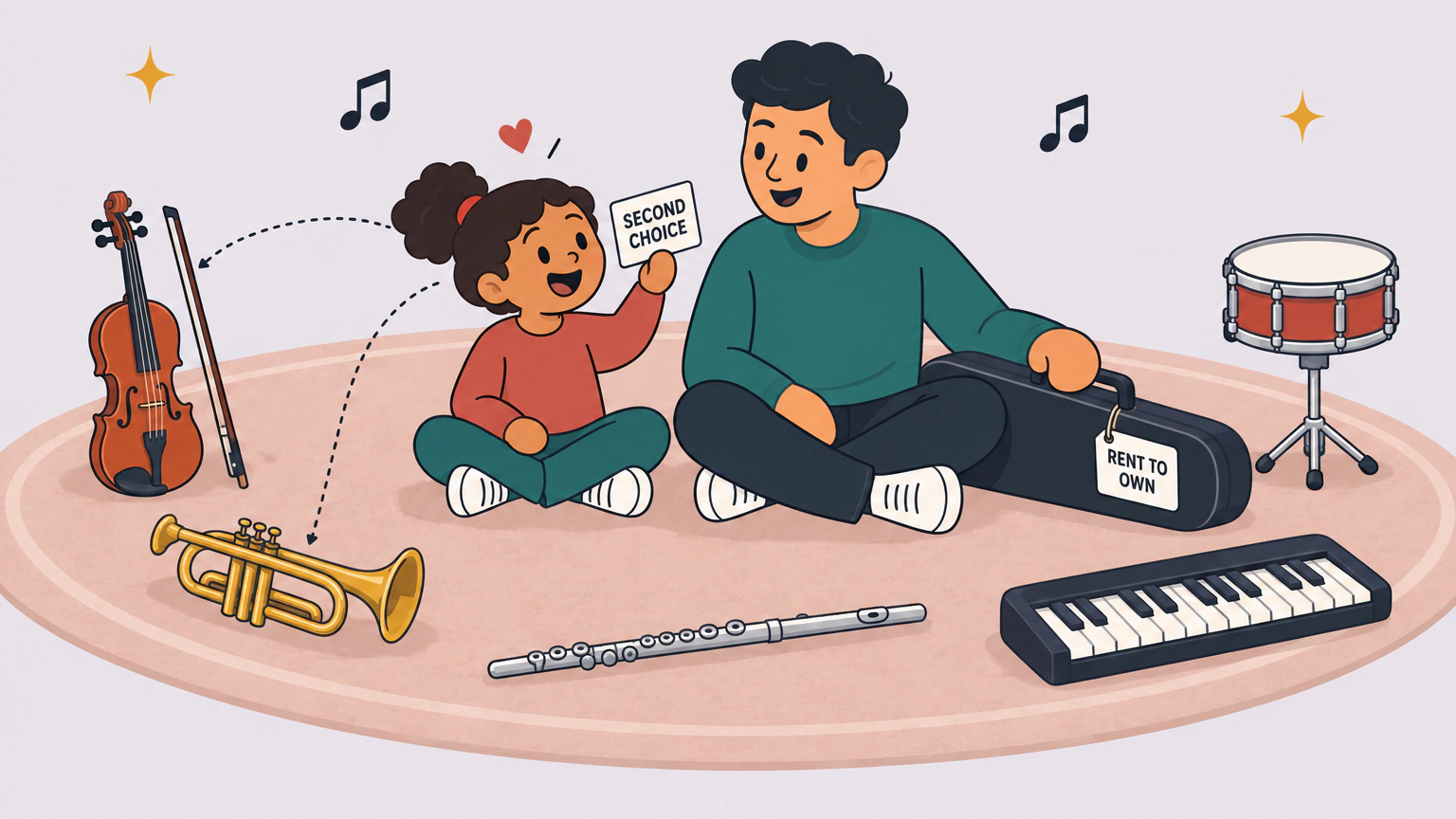
Linn-Mar starts with a demonstration at school in fifth grade. Families then name a first choice and a second, because "there may be a limit to the number of students who can play in each section." A mouthpiece test is offered to the undecided.
The Texas junior high runs a tighter process. Students list their top four choices. Testing starts "with percussion, flutes and saxes since those are the instruments that we tend to limit the numbers and also tend to be the most popular." When horn, baritone or tuba numbers run low, the handout tells directors to relax. There tend to be good students, it explains, "who you can move over when they cannot obtain an instrument on their original assignment." It even lists a question for staff: "Is somebody willing to say 'No' to students/parents about certain instruments?"
For a parent asking "what instrument should my child learn," that means a real second choice matters. A child who'd happily play horn, baritone or tuba has more room than one set on flute or sax. Those are two programs, though, and your director may run things differently. So ask.
Before instrument night, or before you rent anything
- Listen to a recording of every instrument on the school's list together, and have your child name a first and a second choice.
- Ask the band director which sections fill up first and which ones need players.
- Ask whether the school rents or lends the big instruments, such as French horn, baritone and tuba.
- If braces are planned for the next few months, tell the director and the orthodontist before you settle on a brass instrument.
- If your child is torn between two instruments, ask for a mouthpiece test and treat the result as a tiebreaker.
- Get the rental terms in writing: the monthly price, what it covers, how much of each payment goes toward buying, and whether a switch keeps that credit.
- Check the director's list of approved brands before you buy anything online.
Where you'll practice matters, too
Noise is the fit question nobody asks until the first evening at home. A digital piano with headphones is the quiet route to piano. An electronic drum kit is quieter in the room, but the kick pedal still thumps through the floor. Roland, which makes those kits, sells an isolation board for exactly that. In Roland's own tests, the board cut the noise reaching the room below by about three quarters.
An electric guitar is quiet when it's unplugged, and some practice amps take headphones. Wind instruments and acoustic drums have no volume knob. Think about who's on the other side of the wall.
Still torn? Start here
If you're still asking "what instrument should I play," take three steps, in this order.
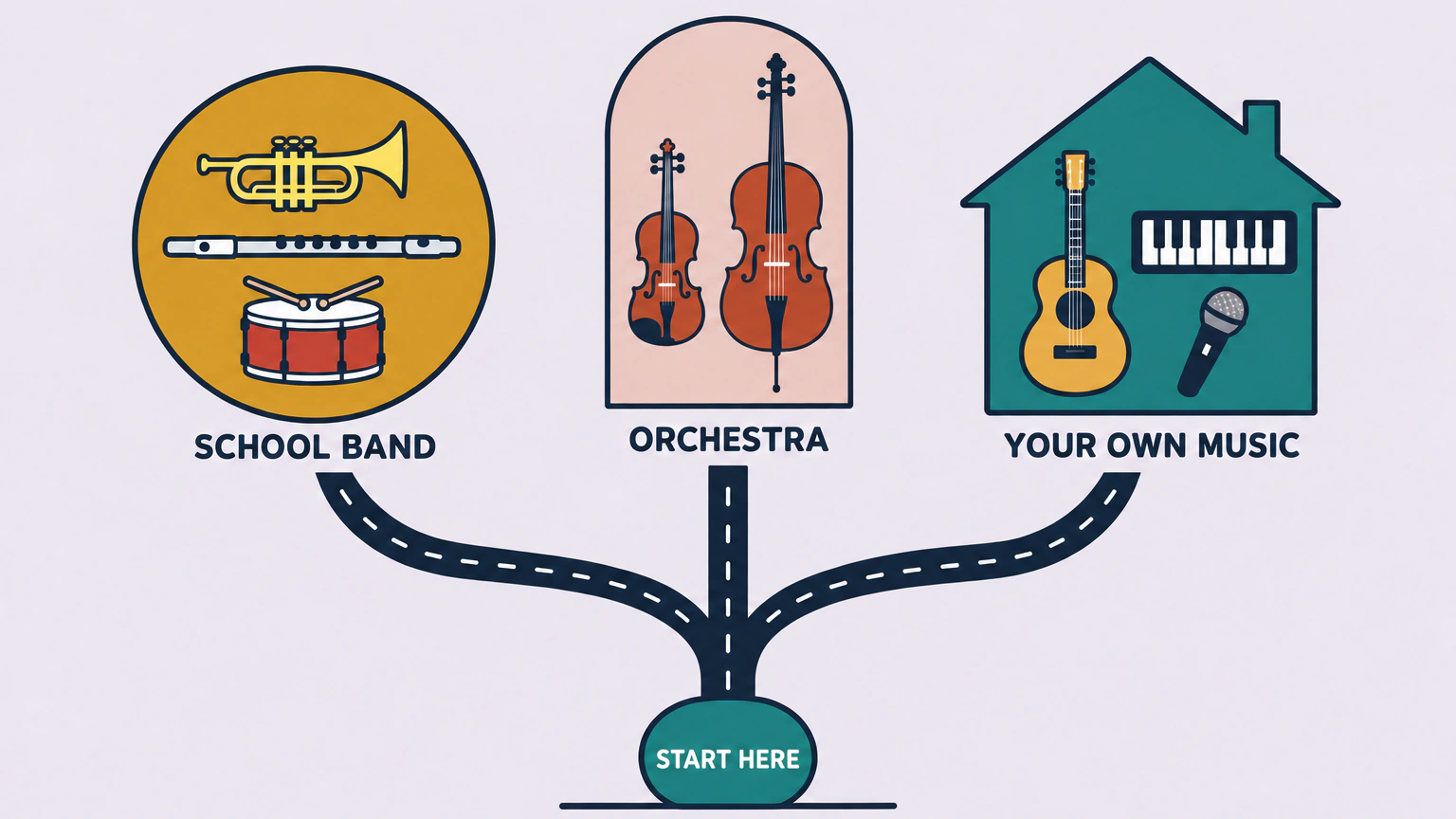
- Choose the route: school band, orchestra or your own music.
- Listen to every instrument on it, then name a first and a second choice.
- Rent for a term before you buy anything.
Then book a first lesson. Our piano teachers, guitar lessons, violin teachers, drum lessons and singing lessons pages are the next click. Adults who want a band can look for a New Horizons group.
Questions parents and adult beginners ask
What's the cheapest band instrument to start on?
It's almost a five-way tie. At the seven stores' middle prices, a flute, clarinet, trumpet or trombone rents for $25.00 a month and a percussion bell kit for $24.99. The alto sax ($44.99), baritone or euphonium ($50.00) and French horn ($54.00) cost more. Some districts, Linn-Mar among them, rent the big brass themselves, so ask first.
Can you play a brass or woodwind instrument with braces?
Yes. In a survey of 78 band students with braces, reed players usually got back to their old level in under a month. Brass players took one to three months on average. Wax on the brackets was the most common help. Only 14% said braces had no effect on their playing, so expect an adjustment.
What instrument should a young child start with?
One that comes in child sizes or needs no fitting. Violins, violas and cellos are rented in small sizes, and nobody has to size a piano. One Seattle Suzuki program says its students often begin at 3 or 4, with a parent at the weekly lesson. Band instruments tend to wait for the school program, which at Linn-Mar starts in fifth grade. We cover timing in what age kids can start lessons.
Is it too late to learn an instrument as an adult?
No. New Horizons Music exists to give adults "entry points to music-making," including people "with no musical experience," and it has programs "across the US, Canada, and internationally." Choose by where you'd play. Singing along at home points to guitar or piano, and a group points to a band instrument or strings. An electric guitar is easier on new fingertips than an acoustic.
Should we rent or buy a band instrument?
Rent first, from a store whose rent-to-own terms you've read. They vary. Western Reserve Music credits 100% of the base rent toward buying. A&G Central Music gives band students a 30% purchase discount at any time, and The Band Connection takes 15% off the remaining payments if you buy early. A good used instrument is fine. An off-brand one from a non-music website is the gamble.
Can you switch instruments after band starts?
Usually, on the store side. Western Reserve Music moves your rental credit to the new instrument at no charge, and A&G Central Music exchanges instruments at any time for free. The harder part is the band. Sections can be capped, so ask the director first. If the instrument just isn't sticking, here's what to do if your child wants to quit.
Are some instruments better for girls or boys?
No. The Texas junior high's handout checks teeth, lips, chin, hand size and arm length, along with grades and a listening test, and it never mentions boys or girls. Woodwind teacher Bret Pimentel goes further. Barring a significant physical or learning problem, he writes, "any student is physically and mentally capable of playing any instrument he or she wishes." Let your child's first choice lead.