

On this page
The short answer
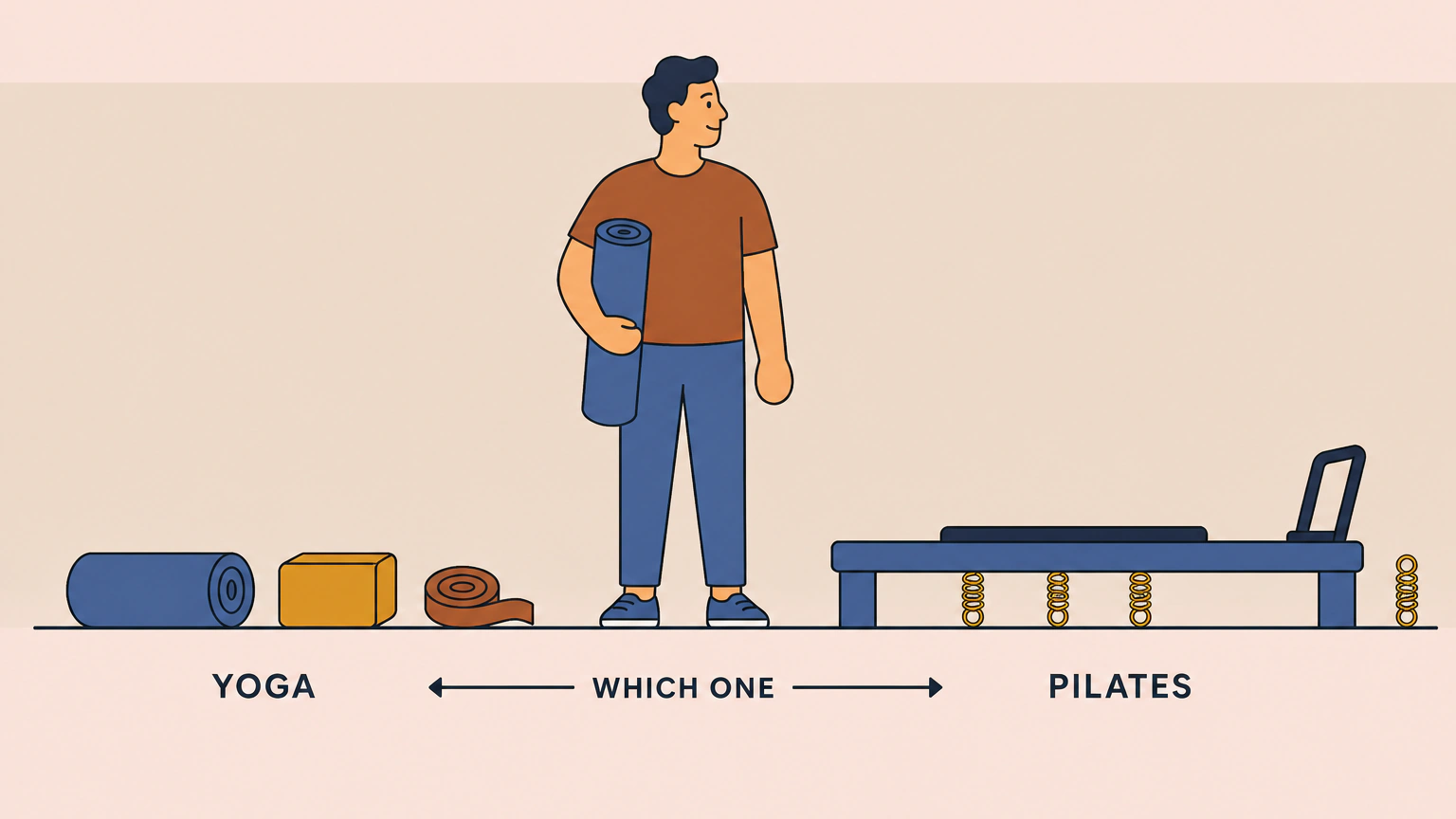
Strip the marketing off and these two have more in common than either camp admits. Both drill breath, control and a slow honest range of motion rather than speed. Both are sold as group classes and as one-to-one sessions.
The difference that shows up on your card statement is equipment. Yoga needs a mat, a room and a teacher. Pilates can need all of that plus a spring-loaded machine for every body in the room, and somebody paid for those machines. That equipment helps explain the price gap and often limits class size.
Four things settle the choice: what each one costs, what the trials found, who's allowed to teach you, and how to sample both without burning a month of fees.
What Pilates and yoga actually cost
Two kinds of number are in play, and they answer different questions. One is the price on a studio's own schedule. It's real, local, and impossible to generalize from: the studio two towns over runs on different rent. The other is what people around the country report paying, which smooths out the noise and tells you whether the quote in front of you is normal. You want both before you hand over a card.
What our own cost profiles show
We publish cost panels on our Pilates and yoga category pages, built from what providers in each category report. Right now the Pilates panel averages $213 and the yoga panel $165, off 666 and 909 cost profiles. That's roughly a third more for Pilates. The minimums are $162 for Pilates and $124 for yoga, while the maximums are $849 and $515.
One caveat: that's our own aggregate of what providers report, not a market survey, and the panel adapts to where you're sitting, so your page may show a slightly different number. For how a studio gets listed, read how we review and list studios.
Not everyone lands where we do. A Philadelphia studio, Pilates by Pamela, priced both practices in its own city and concluded they run "relatively similar" there. In one city, sure. Across our combined 1,575 cost profiles, the averages differ by $48.
Mat and reformer are two different prices under one word
Ask a studio what a Pilates class costs and you'll often get two answers. That isn't a bait and switch. It's two different products sharing one word.
A mat class is what it sounds like: bodyweight work on the floor, and a big room holds plenty of people. A reformer is a low bench with a sliding carriage and adjustable springs, so you push and pull against resistance while lying, sitting or kneeling on it. One person, one machine. A studio with ten reformers sells ten spots in that hour and not an eleventh, however many people want in.
That cap is part of what you're buying, which is what class size actually buys you. Yoga does not hit the same equipment limit, because a yoga room can absorb a few more mats without buying reformers.
Drop in, class pack, or unlimited month
Three common options are drop-ins, class packs and monthly memberships, and the option matters as much as the sticker.
A drop-in buys one class without a longer commitment. It can cost more per class, and it is still the cheapest way to find out you hate it. A class pack is a block of classes bought up front, sometimes with an expiry date worth asking about. An unlimited month can be the best deal per class and the worst bet for someone who hasn't yet proved they'll show up.
Look at what The Studio, an Atlanta Pilates studio, publishes: $15 for a same-day drop-in, $90 for a first month of eight classes, $325 a month standard for unlimited. Now look at the middle number again. It renews at $150 a month for five more months, which is the part people miss when the intro price is the only figure on the poster.
| Figure | Pilates | Yoga | What it tells you, and what it does not |
|---|---|---|---|
| National average across our cost profiles | $213 | $165 | Our own aggregate of what providers report, not a market survey. It adapts to the reader's location, so the number on the page may differ. |
| Typical price range | $182 to $253 | $145 to $268 | The band most quotes fall into. Yoga's band is wider at the top, Pilates' is higher at the bottom. |
| Lowest we see | $162 | $124 | Pilates' minimum is $38 higher in our panel. |
| Highest we see | $849 | $515 | Pilates' maximum is $334 higher in our panel. The panel does not say what the figure includes. |
| Cost profiles behind the figures | 666 | 909 | Sample size. We have more cost profiles behind yoga. |
| One Philadelphia studio's published ranges | Group $40 to $60, private $60 to $100 | Drop in $20 to $40, private $70 to $100 | One studio, one city, its own post. It concluded the two are priced similarly there. |
What the research found, and what it did not
First, the fine print on all of it. Almost every decent trial here enrolled adults with chronic low back pain, measured pain and day-to-day function, and ran a few months. None was built to tell you which class you'd enjoy more, which teacher you'd click with, or which one you'd still be attending in April. The evidence answers a narrow question well, and the narrow question isn't quite yours.
For back pain, both beat doing nothing and neither clearly beats other exercise
Cochrane, the outfit that reviews medical evidence for a living, has looked at each practice on its own.
Its 2017 yoga review found small to moderate gains in back-related function at three and six months against people who did no exercise. Then comes the sentence that matters: "it is uncertain whether there is any difference between yoga and other exercise for back-related function or pain."
Its 2015 Pilates review arrived at the same place from the other side. There's "some evidence for the effectiveness of Pilates for low back pain," it says, but "no conclusive evidence that it is superior to other forms of exercises." And then Cochrane hands over the decision rule itself. The choice, the reviewers wrote, "may be based on the patient's or care provider's preferences, and costs."
Costs. Their word, not ours.
One dissent, worth naming rather than burying. A 2024 review in Disability and Rehabilitation was warmer on Pilates, finding it beat non-specific exercise as well as no exercise at all. That's a real disagreement with the 2015 verdict, and picking whichever version suits us would be cheap.
Strength, flexibility and weight loss: what nobody has measured well
Weight loss has thin evidence under it in the trials above. Those trials measured pain and function, not body composition, so they do not establish either practice as a weight-loss program. A studio selling one that way has run ahead of the evidence.
Core strength and flexibility are firmer ground, if the claims stay plain. Equipment Pilates trains controlled trunk and hip work against spring resistance. Yoga trains range of motion, balance and breath across a wider set of shapes. Each one makes you good at the thing you practice, and that's worth something.
Here's what we'd tell a friend. Adherence is the variable nobody randomizes. Pick the class you'll actually turn up to three times a week in February, when it's dark at five and you're tired. That one choice beats every effect size in the literature.
If your real problem is your back: a 2023 network meta-analysis in Frontiers in Public Health pooled 75 randomized trials of exercise for chronic low back pain. Tai chi, yoga and Pilates all beat conventional rehab for pain relief, and tai chi's effect was the largest of the three. The authors are careful and so are we: the pooled trials were small and uneven, so it ranks approaches in general. It doesn't prescribe one for your back. Still, if the back is the whole reason you're shopping, tai chi classes deserve a look before you sign anything. We're not clinicians. Back pain that's new, severe, or shooting down a leg belongs in front of one before it belongs in a class.
Who is teaching you, and how to check before you pay
We read the ten pages that rank highest on Pilates vs yoga. Seven tell you to find a certified instructor. Across all ten, exactly one names a real credential, once, in passing. That's the advice equivalent of "hire a good one."
So here's what the words on the studio wall actually mean, and where to look them up. Both credential systems give you a public directory to check.
Yoga Alliance records training, it does not test teaching
Yoga Alliance is a registry, not a licensing board. RYT 200 means a teacher completed a registered 200-hour training program. RYT 500 means 500 total hours of registered training, either in one program or a 200-hour course plus 300 hours of advanced training, along with at least 100 teaching hours. E-RYT adds teaching-experience requirements. Yoga Alliance does not require a separate exam for these credentials.
That sounds like a knock, and it isn't quite one. Yoga Alliance publishes a public directory you can search by name and by designation, so you can check a claim on a studio bio. That public directory makes a studio bio easy to check.
Which brings us to Pilates.
Pilates has one accredited exam, and nobody has to take it
The National Pilates Certification Program runs the only Pilates credential accredited by the National Commission for Certifying Agencies. A teacher who holds it puts NCPT after their name. To sit the comprehensive exam, a teacher needs training across the mat and the full apparatus. NPCP says that program "must be minimally 450 hours." NPCP's separate mat certification requires at least 100 hours. Both routes end in a proctored exam, at a test center or under a webcam.
Two things should change how you read a wall of certificates. NPCP now publishes a public directory of current certificants, so search it just as you would Yoga Alliance. And in 2000 a federal judge in New York held both PILATES trademarks generic and ordered them canceled, which is why anyone can advertise a Pilates class today without asking permission. NPCP says it plainly: "As Pilates is an unregulated industry (it is not a licensed profession)."
None of that makes an uncertified teacher a bad teacher. Some studios train their own. It just means the sign isn't evidence. Ask. And here's how to verify any instructor's credentials.
| Credential | Who issues it | What it takes to hold it | How you can check it |
|---|---|---|---|
| RYT 200 or RYT 500 | Yoga Alliance | RYT 200 requires a registered 200-hour program. RYT 500 requires 500 total hours of registered training and at least 100 teaching hours. Yoga Alliance does not require a separate exam. | Search the public teacher directory by name |
| E-RYT 200 or E-RYT 500 | Yoga Alliance | E-RYT 200 normally adds 1,000 teaching hours and two years. E-RYT 500 normally adds 2,000 teaching hours and four years, with a separate experienced-teacher pathway. | Same directory, listed as a separate designation |
| NCPT (Nationally Certified Pilates Teacher) and PMC (Pilates Mat Certified) | National Pilates Certification Program | NCPT requires comprehensive teacher education of at least 450 hours, then a proctored exam. PMC requires mat education of at least 100 hours, then a separate proctored exam. NCCA's directory lists the NCPT program as accredited. | Search NPCP's public certificant directory by name, location or certification type. |
| Certified in Pilates, no issuer named | The training school itself | Whatever that school required. Pilates is not a licensed profession. | Ask which school, how many hours, and whether there was an exam |
How to try both without wasting a month of fees
A fair trial is smaller than people fear and bigger than one class. Try two or three sessions at each practice so your decision is not based on one first impression. If Pilates is in the running, make at least one of those an equipment class. A mat class does not show you how a reformer feels.
Go before you buy anything longer than a single class. Then ask five questions at the front desk.
- Ask whether the price you were quoted is for a mat class or an equipment class, because studios can list those products at different prices.
- Ask what the intro offer renews into and on what date, before you hand over a card.
- Ask what happens to unused classes in a pack, and whether they expire.
- Ask which credential the teacher holds and who issued it, then look it up yourself.
- Ask how many people and how many machines are in the class you are booking, because that ratio affects how much individual attention is possible.
So which one should you start with
We'll take a position, because "it depends on your goals" isn't an answer.
Start with yoga if money is the binding constraint, if the goal is mobility, stress or sleep, or if you want something you can also do at home on a mat you already own. Its average, minimum and maximum are lower in our cost profiles. Both Yoga Alliance and NPCP have public directories you can search.
Start with equipment Pilates if you want a small room and a teacher close enough to see your form. It is also an option if you've been cleared to exercise after an injury and want someone watching. The machine and the smaller head count are part of what the class offers.
If your back is the whole reason you're shopping, consider tai chi as a third option too.
And sometimes the honest answer is neither. If you can't commit to a fixed slot most weeks, a membership is a donation. One or two private sessions with somebody good beat eight classes you skip, so it's worth reading whether a trainer is worth the money before any money moves.
Frequently asked questions
What is the main difference between Pilates and yoga?
Equipment and intent. Yoga links breath to postures and holds, and a mat is all it needs. Pilates drills controlled core and hip strength through set movement patterns, often on spring-loaded machines like the reformer. Both pair controlled movement with breath, which is why they can look alike from the doorway.
Is Pilates or yoga better for back pain?
Neither, on the evidence we have. Cochrane reviewed each practice separately and found both beat doing nothing, while neither clearly beat other forms of exercise. The 2015 Pilates review said the choice may come down to preference and cost. So pick the class you'll attend consistently, and see a clinician first if the pain is new or severe.
Is Pilates harder than yoga?
Different kinds of hard. Pilates is usually harder on the abdominals and hip flexors, and the reformer's springs make small movements demanding fast. Yoga is usually harder on balance, grip and long holds, and a hot vinyasa class gets genuinely aerobic. A first reformer class can be harder to follow, because the machine comes with rules.
Do I need to be flexible to start Pilates?
No. Pilates trains control and strength through the range you already have, not the splits. Teachers can adjust springs, straps and box positions for stiff hips and tight hamstrings. Tell the teacher before class what's tight or sore.
Which one is better for weight loss?
The trials behind both measured pain and function rather than body composition, so they do not establish either practice as a weight-loss program. A vigorous vinyasa or a fast reformer class burns real calories, but weight tracks what you eat and how much you move all week. Choose on enjoyment and cost, and treat any change on the scale as a bonus.
Why does Pilates cost more than yoga?
Machines and head count help explain it. Across our cost profiles Pilates averages $213 against yoga's $165. An equipment class needs one reformer per person, which caps how many spots a studio can sell in an hour. A yoga room fits a few more mats without buying reformers. Mat-only Pilates can price closer to yoga.
Can I do both?
Yes. They emphasize different things, so you can use one for controlled trunk work and the other for range of motion. When budget is tight, one membership plus occasional drop-ins at the other place is one way to combine them.
Find a Pilates or yoga class near you
Shortlist three studios inside a distance you'd genuinely drive in bad weather. Compare the same four things at each: the price of a single class, what the intro offer renews into, the class size, and the teacher's credential. Then go and try them. Our listings for Pilates studios near you and yoga studios in your area are a practical place to start.