

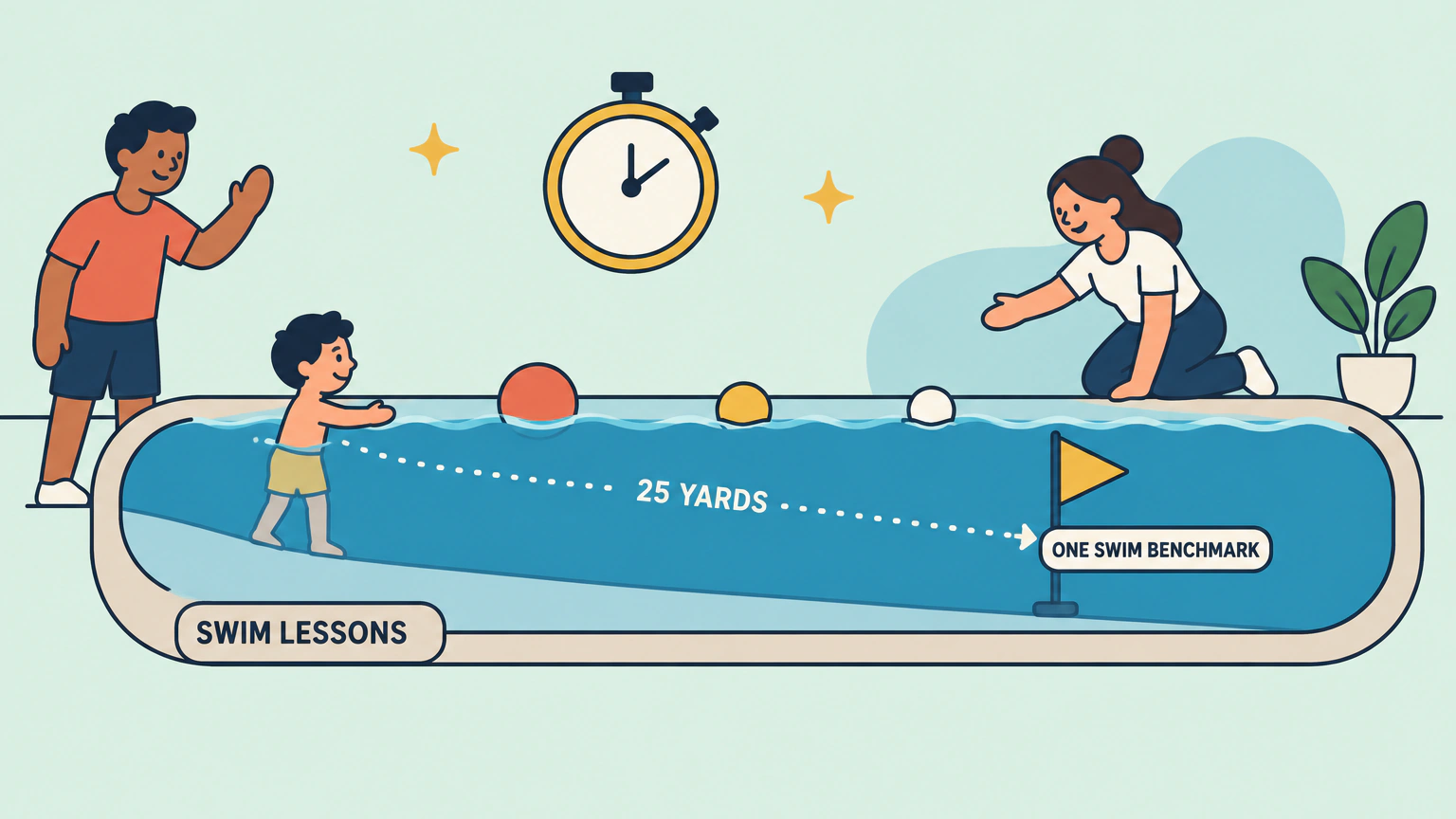
Plan on more lessons than one session gives you. In the Red Cross ladder, and at the YMCA branches we checked, the rung tied to basic water competency sits third of six. A 2025 study put lesson counts side by side. It found that children who got 12 to 18 lessons picked up more of those skills than children who got 4 to 8. Researchers still haven't established how many swim lessons a child needs. The team that came closest said so in their own paper.
On this page
- The short answer, and the question hiding under it
- What can swim actually means, once somebody writes it down
- What the research measured, and what it would not say
- Three things you can change while your child learns
- What a session actually buys you
- How to tell it is working, six lessons in
- What swim lessons do not buy
- Frequently asked questions
The short answer, and the question hiding under it
If you want one checkpoint to plan against, make it ten lessons, but don't treat it as a finish. In a 2018 study of 149 children learning to swim, gains sped up among children who took ten or more lessons.
No page selling lessons will tell you the next part. The question has no answer until somebody says what the child is supposed to do at the end of it. A lesson count without a finish line is just a bill.
If what you really wanted was the starting age, that's a different question, and we've answered it separately: when to start.
What can swim actually means, once somebody writes it down
Three US programs have written the finish line down, and a national coalition publishes the version they share. It's lower than most parents assume and much higher than one session delivers. Get it settled first, because every number that follows hangs off it.
The Red Cross minimum, in five moves
Water Safety USA, the coalition of national water safety groups, publishes the American Red Cross criteria as the starting point for pool swimming. Five moves:
- Step or jump into water over your head and come back to the surface.
- Float or tread water.
- Turn around and orient yourself to safety.
- Swim at least 25 yards to safety, using any stroke you like.
- Get out of the water.
Breath control isn't a sixth move. It runs through all five, which is how Water Safety USA writes it: combine breath control with all swim skills, including moving forward in the water. Twenty-five yards is one length of a 25 yard pool, so a child at this bar can cross it once, unaided, and climb out at the far end.
Now the part swim schools rarely say out loud. Meeting this bar is the beginning of swimming, not the end of worry. A person who has just met the Red Cross criteria, in Water Safety USA's words, "is still a novice, not a good swimmer."
Where that finish line sits in your child's program
We read three program ladders one at a time, plus the cross-organization standard, and they place the same skill in different spots. In the six-level Red Cross Learn-to-Swim program for ages 6 to 12, Level 3 is Stroke Development. The Red Cross says it "will help students achieve water competency." At the two YMCA associations we checked, the 25 yard swim, the one minute tread and the exit all sit in Stage 3, Water Stamina, the last stage of Swim Basics before stroke work starts. Both land on rung three of six.
Portland Parks and Recreation puts it much higher. Three separate 25 yard swims are the entry requirement for Dolphin, level six of a seven level youth ladder. Same distance, nearly the top of the ladder. Which is why the rung number on your child's sheet tells you nothing until you read what that rung requires.
| Program | What it calls the goal | What the child has to do | Where it sits in the ladder |
|---|---|---|---|
| American Red Cross Learn-to-Swim, ages 6 to 12 | Water competency | Control breathing, float or tread, turn, swim 25 yards with any stroke, enter and exit | Level 3 of 6 |
| YMCA Swim Basics (as published by the two associations we checked) | Basic swimming competency | Swim, float, swim 25 yards; jump, push, turn, grab; tread water one minute; exit | Stage 3 of 6 |
| Portland Parks and Recreation, youth ladder | The 25 yard mark | Front crawl with side breathing 25 yards, backstroke 25 yards, elementary backstroke 25 yards | Entry requirement for Dolphin, level 6 of 7 |
| Water Safety USA, the cross-organization view | Water competency | Water safety awareness, basic swim skills and helping others, not just strokes | A standard programs are measured against, not a rung |
What the research measured, and what it would not say
Three studies carry this entire question. Two measured skills in a pool, and the third measured deaths. Together they say something more useful than a range by age, and less comforting.
Four to eight lessons against twelve to eighteen
The 2025 study in Injury Prevention answers the dosage question directly, because it ran the comparison. Young children, ages 1 to 5, in 30 minute formal group lessons at a nationally recognized organization. The first project gave them four to eight lessons. The second gave them 12 to 18.
More lessons did more. Children in the larger dose picked up more components of water competency, and reached more advanced levels of them, than children in the smaller dose. Both groups improved on every component measured.
Across both projects, most children reached unsupported competency only in getting into the water and getting out of it. Everything else, floating on the back, breath control, turning over, was still happening with help at the end of the lessons. That's not a knock on swim schools. It's the timescale of a small child learning a hard physical skill.
And the authors closed by saying the quiet part in print: more research is needed to work out the optimal number of lessons for most children to reach unsupported water competency.
The ten lesson threshold
The 2018 study, also in Injury Prevention, watched 149 children aged 3 to 14 through an eight week group program and counted the skills each one gained. The average was 12.3 skills. Gains accelerated past ten lessons, and the adjusted comparison put children with ten or more lessons 8.2 skills ahead of children with nine or fewer.
One finding matters most to a worried parent. The number of lessons predicted skill acquisition far more strongly than the child's age or gender did. So age alone doesn't tell you a child is behind. Lesson count was the stronger signal in this study.
| Study | What it tested | What it found | What it does not tell you |
|---|---|---|---|
| Injury Prevention, 2025 | 4 to 8 versus 12 to 18 formal group lessons of 30 minutes, children aged 1 to 5 | More lessons produced more competency components and more advanced levels; most children reached unsupported competency only in water entry and exit | The optimal number of lessons, which the authors say is still unknown |
| Injury Prevention, 2018 | An 8-week group program, 149 children aged 3 to 14, with number of lessons as a mediator | Average 12.3 skills acquired; 10 or more lessons produced 8.2 more skills than 9 or fewer; lesson count predicted skill better than age or gender | Whether the same holds outside a single community-recruited sample |
| Archives of Pediatrics and Adolescent Medicine, 2009 | Formal swimming lessons and drowning deaths, case-control, ages 1 to 19 | 88 percent lower drowning risk in ages 1 to 4, adjusted odds ratio 0.12 | A precise effect size; the interval ran from 3 to 99 percent, and the 5 to 19 result was not significant |
The 88 percent figure, read properly
You'll meet this number everywhere, including on Water Safety USA's own page: formal swim lessons cut the risk of childhood drowning death by 88 percent. It comes from a 2009 study that compared children who drowned with matched children who didn't, and it belongs to one age group, children aged 1 to 4.
It also rests on small numbers, which is where the honest version lives. Of 61 children in that age group who drowned, two had taken formal lessons, against 35 of 134 matched controls. From counts that small, the researchers could only narrow the true benefit to somewhere between a 3 percent and a 99 percent reduction. That span is the 95 percent confidence interval, and it shows how imprecise the estimate is. In the 5 to 19 age group, the result pointed the same way but wasn't statistically significant, meaning chance alone could explain it.
The study points toward a benefit, but the size is fuzzy. Lessons are worth buying for a preschooler. The 88 percent is not a promise anyone can make about your child.
Three things you can change while your child learns
Age is the variable every swim school page organizes around, and it's the one thing about your child you can't change. These three you can.
How close together the lessons are
The studies did not isolate lesson spacing from lesson count. We went looking for a trial that pits weekly against twice weekly and couldn't find one, so anybody who quotes you a cadence is quoting a preference.
Programs do put one thing in writing: what a long gap costs. Miss a season and your child may have to repeat a rung they already climbed.
The cheapest thing you can do: Portland Parks and Recreation puts the reason in writing. A swimmer who hasn't had lessons for more than three months "should repeat the last level they took as a refresher." Book the next session before the current one ends and you lower the chance of repeating the same rung.
How many children share one instructor
Water Safety USA publishes a number for this. Most swim schools don't. For young or beginner swimmers with no caregiver in the water, best practice is an instructor to student ratio of "1:4 or fewer," and "no more than 1 instructor to 6 students."
Ask before you enroll. Ask about your child's stage, not about the program in general. Then watch a class and count heads in the water yourself, because the number in the brochure and the number on a Tuesday in October are sometimes different animals. If you're weighing that against the price of going private, we've done that math elsewhere: what class size actually buys you.
Whether anybody gets in the water in between
Programs treat the parent as part of the method for the youngest children. The Red Cross has a parent or guardian in the water for children up to age 3. The Twin Cities YMCA requires a parent in the pool area for every lesson involving a child of 6 or under.
For practice between sessions, the 2025 study points at the obvious job. In the shorter-lesson project, the biggest improvement was in water exit, followed by breath control. Water entry and exit were the first unsupported skills to appear. So at the public pool, spend ten minutes at the wall: get in, come back up, blow bubbles, climb out, again. That's a game, not homework, and it rehearses the skills that move first.
What a session actually buys you
You don't buy lessons. You buy a session, and then somebody else decides what your child does next. Portland is refreshingly blunt about it: "The instructor will tell you which lesson to sign up for next." That mechanic, where you buy time and the instructor hands out the level, also turns up in gymnastics classes.
A lesson isn't a fixed unit either. Portland runs 30 minutes, the Twin Cities Y runs 30, and the Kansas City Y's Water Movement stage runs 35. Compare programs by minutes in the water, not by the word lesson.
Public programs can also cap you. Portland allows one swim lesson per person per session because demand is high, and it offers no private or semi-private lessons at all. So in Portland's city program, buying your way up the ladder faster may not be on the menu.
Then price. Our own cost profiles for swim lessons, 861 of them, put the national average at $134, with a typical range of $103 to $201, a low of $78 and a high of $371. That's what parents get quoted for a booking, and those figures don't carry a time unit, so treat it as the shape of the market rather than a price per lesson. If you're wondering how a provider earns a spot there, here's how we vet the providers we list.
How to tell it is working, six lessons in
Six lessons in, you've spent real money, and your child looks roughly the same in the water as in week one. That can also be what a bad fit looks like. These six checks can help you tell the difference. Five you can do from the deck.
- Ask the instructor which named level your child is in, and what the exit skill for that level is. Otter and Stage 2 mean nothing until you know what gets a child out of them.
- Watch one full class and count how many children share the instructor in the water. Hold that against the 1:4 best practice, and against whatever you were told at sign-up.
- Check whether your child now gets into the pool and out of it without help. Water exit showed the biggest improvement in the shorter-lesson project, so it's an early signal.
- Ask whether your child can float on their back unassisted, and for how many seconds. A number you can ask for again next month beats "doing great."
- Ask what the program does when a child stalls in a level, and whether repeating it costs full price. The answer tells you how the business thinks.
- Find out how long a gap the program treats as a reset, then put the next session in the calendar before this one ends.
If those answers are thin, the instructor's training is the next thing worth a look, and the method transfers straight across from other lesson categories: checking an instructor's credentials.
What swim lessons do not buy
Drowning is the leading cause of death among US children aged 1 to 4. In 2023, 981 US children under age 20 died from drowning, by the American Academy of Pediatrics' count. Those numbers are why the AAP frames prevention the way it does: "Multiple layers of prevention are necessary, because no single method is effective in preventing drowning."
Lessons are one of those layers. The AAP names the others alongside swimming competency: four-sided isolation fencing around the pool with a self-closing, self-latching gate, close and constant supervision, life jackets when boating, and early rescue and CPR. Water Safety USA is just as direct about an entry-level class. Children who complete one "may still not have the basic skills and knowledge for water competency," and they "still need close and direct supervision."
So the honest version of a good outcome is smaller than the one in your head, and it's still worth every dollar. Your child gets safer by degrees, with an adult still watching the water.
We're not a swim school and we can't see your pool. If your child has a condition that affects breathing, seizures or movement, talk to your pediatrician before the first lesson.
Frequently asked questions
How many swim lessons does a toddler need?
Researchers haven't established an optimal number for toddlers. The 2025 study gave one group four to eight lessons and another 12 to 18, and the bigger dose produced more skills. Even so, most children in both groups reached unsupported competency only in getting into the water and getting out. Up to age 3, the Red Cross keeps a parent in the water alongside them anyway.
How often should my child go to swim lessons?
Often enough that a break never turns into a reset. The research counted lessons rather than spacing, so volume is the thing actually measured. Programs price the gaps instead: Portland asks a swimmer who has been away more than three months to repeat their last level. Weekly through a session, with the next one booked before this one ends, keeps you off that treadmill.
How long is one swim lesson?
Thirty minutes at Portland Parks and Recreation and at the Twin Cities YMCA. Thirty-five minutes for the Water Movement stage at the Kansas City YMCA. So a lesson isn't a fixed unit of time, and two programs at a similar price per lesson can be selling different amounts of water time. Ask for the minutes before you compare prices.
Can a child forget how to swim between sessions?
Programs act as though they can. Portland tells parents that a participant who hasn't had lessons for more than three months should repeat the last level they took, as a refresher. That's a policy rather than a lab result, and it may mean repeating a session.
At what age can a child swim without an adult in the water?
The program sets that, not a birthday. The Red Cross has a parent or guardian in the water for children up to age 3, and the Twin Cities YMCA wants a parent in the pool area up to age 6. Even after you get out, a child who has just met the water competency bar is a novice rather than a safe solo swimmer, so keep watching from the deck.
Do swim lessons actually prevent drowning?
The evidence says they help, and it's less precise than the headline. The 2009 case-control study found an 88 percent lower drowning risk among children aged 1 to 4 who had taken formal lessons. The interval ran from 3 to 99 percent, and the 5 to 19 group showed no significant result. The AAP treats lessons as one layer among several, because no single measure prevents drowning.
The next move takes one email. Ask your program which named level your child is in and what the exit skill for that level is. Then ask where water competency sits on their ladder. Now the count means something: you're buying the distance between where your child stands this month and that rung, not a block of Saturdays. If the answers come back vague, or you count eight children and one instructor in the water, go and ask the same two questions at swim lessons near you.