

On this page
- A birdie is one stroke under par on one hole
- Par is the baseline, and it is a range rather than a single number
- The scoring ladder, from condor to triple bogey
- How often golfers actually make a birdie
- Net double bogey, the score name that caps a posted hole
- What actually puts a birdie on your card
- Frequently asked questions
A birdie is one stroke under par on one hole
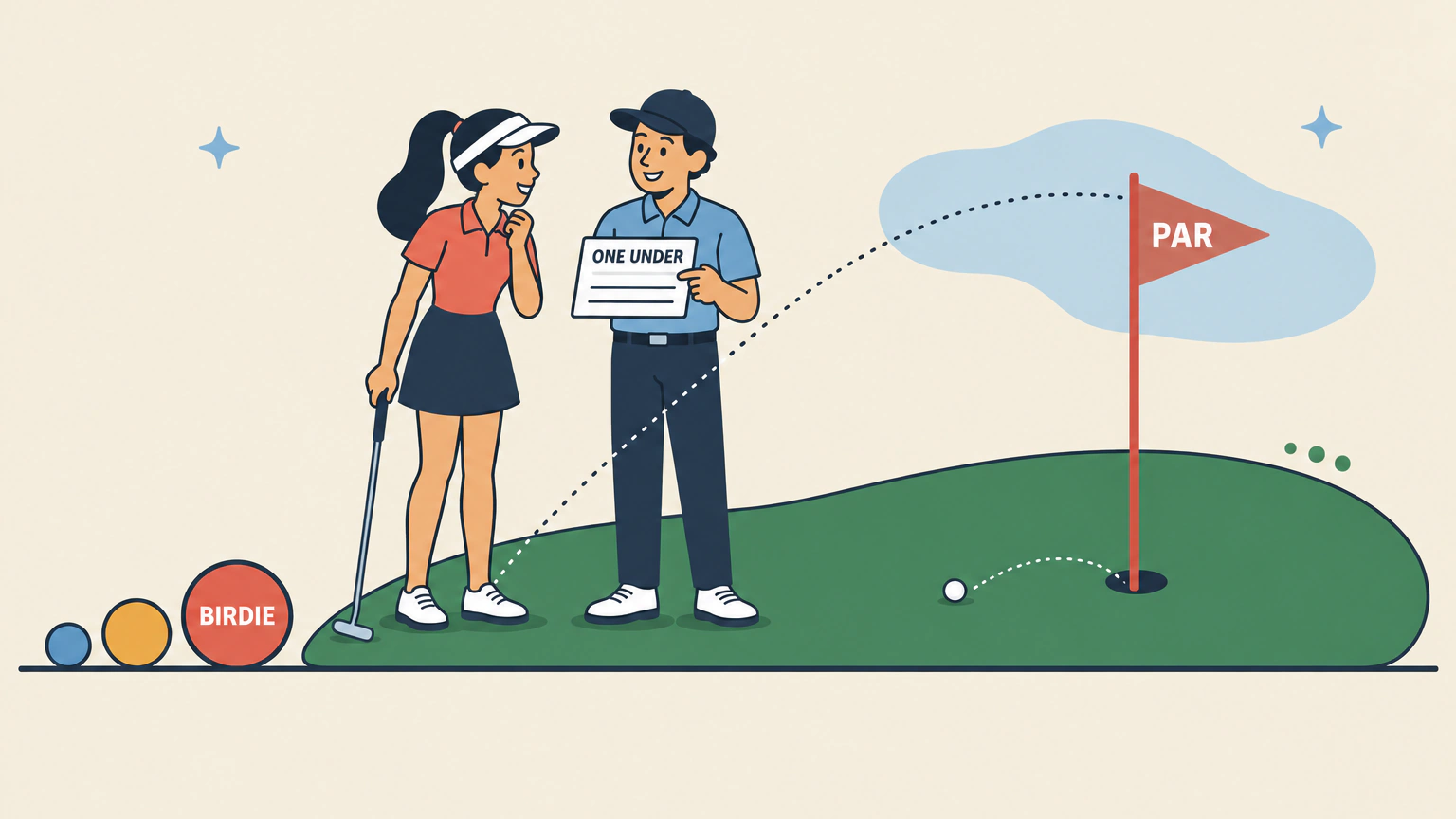
You heard the word on a broadcast or across a golf cart, and you'd rather not ask out loud what a birdie in golf actually is. Fair enough. A birdie is one stroke under par on a single hole: three shots on a par 4, four on a par 5, two on a par 3. It's the most common way a good hole ends. For most amateurs it's also rarer than it sounds: Shot Scope's tracked-round data puts a 15 or 20 handicap at roughly one birdie every three rounds.
A handicap, by the way, is golf's measure of a player's ability. The lower it is, the better the golfer. Now the part most explanations skip. A birdie is a hole score, not a round score. You can birdie the fourth hole, finish twenty over par for the day, and that birdie still counts. Each hole gets judged on its own, against its own par, the number printed beside it on the scorecard. So par is where the arithmetic starts.
What a birdie looks like on a par 3, a par 4 and a par 5
The math is one subtraction. Take the hole's par and subtract one, and that's a birdie. Subtract two and you have an eagle. Subtract three and you have an albatross. So if you're wondering how many strokes under par a birdie is, the answer never changes. It's always exactly one, whatever the hole.
| Hole par | Par | Birdie | Eagle | Albatross |
|---|---|---|---|---|
| Par 3 | 3 strokes | 2 strokes | 1 stroke, a hole in one | not possible |
| Par 4 | 4 strokes | 3 strokes | 2 strokes | 1 stroke, a hole in one |
| Par 5 | 5 strokes | 4 strokes | 3 strokes | 2 strokes |
Par 3s are where it gets strange. Two under par on a par 3 is a single stroke, so an eagle there is a hole in one. Three under would mean finishing in zero strokes, which is why a par 3 has no albatross at all.
Par is the baseline, and it is a range rather than a single number
Every name in golf scoring measures distance from par, so it helps to know what par really promises. The Rules of Handicapping, the joint USGA and R&A rulebook behind every Handicap Index, define it as "The score that a scratch player would generally be expected to achieve on a hole under normal course and weather conditions, allowing for two strokes on the putting green." A scratch player is a very good golfer, one with a Handicap Index of 0.0.
That last clause tells a beginner the most. Par budgets two putts on every green. Everything before the green gets the rest: one shot on a par 3, two on a par 4, three on a par 5. On paper, then, a birdie is a one-putt. The approach does its normal job, and the putter saves the stroke. It isn't a heroic shot from 200 yards, which is good news for anyone who owns a putter and a long hallway.
How a hole gets its par in the first place
Nobody hands par down from on high. Under the Rules of Handicapping, a golf association sets it, or the club itself when the national association allows. They start from Appendix F of the same rules, which recommends a par for each hole by its length. Its figures assume a course less than 2,000 feet above sea level.
| Par | Men | Women |
|---|---|---|
| 3 | Up to 260 yards | Up to 220 yards |
| 4 | 240 to 490 yards | 200 to 420 yards |
| 5 | 450 to 710 yards | 370 to 600 yards |
| 6 | 670 yards and up | 570 yards and up |
These are recommendations, and the bands overlap on purpose. A 250-yard hole for men fits par 3 and par 4. A 470-yarder fits par 4 and par 5, and a 700-yarder fits par 5 and par 6. Where a hole lands inside two bands, the people setting par decide.
Why a 470 yard hole can be a par 4 at one course and a par 5 at another
Appendix F picks exactly that length as its own example: "Where a hole length falls within two par ranges, for example 470 yards (men) or 400 yards (women), the par may be allocated as 4 or 5 depending on the difficulty of the hole." It also lets whoever sets par weigh how the hole plays. Hills count, and so do a hazard that forces you to play short, a wind that usually blows one way, and what the designer had in mind.
So picture two 470-yard holes. One climbs uphill into the usual breeze and gets par 5. There, a 4 is a birdie. The other is flat and open and gets par 4, so the same 4 is just a par. Same length, same score, different name.
That's worth knowing before you compare cards with a friend from another club. Your birdie is measured against a local judgment call, and theirs against a different one. Both cards are honest. They just started from different lines.
The scoring ladder, from condor to triple bogey
| Name | Strokes against par | On a par 5 that means | How common |
|---|---|---|---|
| Condor | 4 under | 1 stroke, a hole in one | a handful ever recorded |
| Albatross, or double eagle | 3 under | 2 strokes | rare enough to make the news |
| Eagle | 2 under | 3 strokes | a good player's highlight |
| Birdie | 1 under | 4 strokes | see the handicap figures below |
| Par | level | 5 strokes | the baseline |
| Bogey | 1 over | 6 strokes | see the handicap figures below |
| Double bogey | 2 over | 7 strokes | see doubles or worse below |
| Triple bogey | 3 over | 8 strokes | included in doubles or worse below |
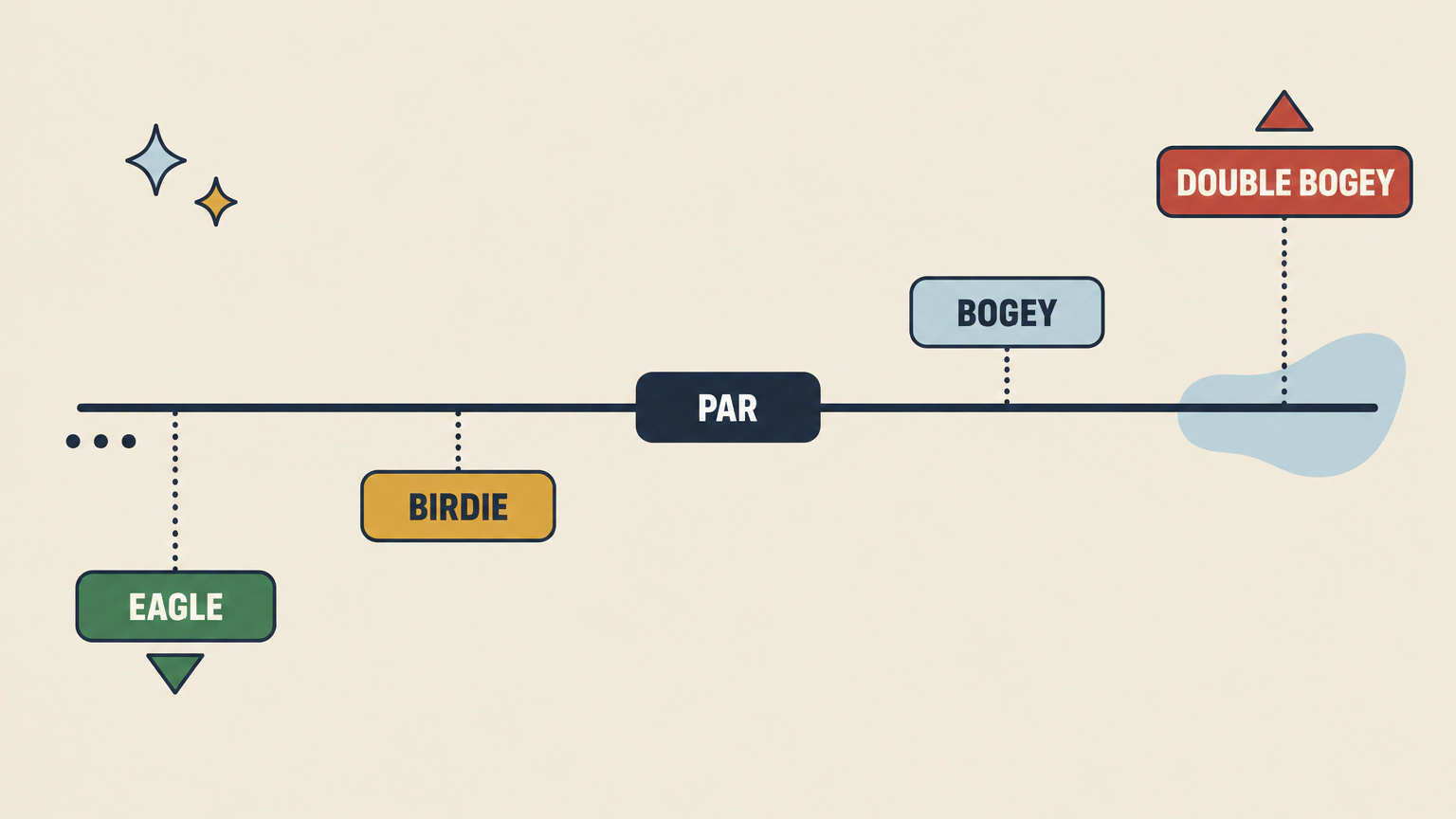
Those are the golf score names in order, best to worst. On an ordinary Saturday you'll hear the middle of the ladder over and over: par, bogey, birdie, and double bogey, which most people shorten to "a double." The names work as verbs, too. You "birdied the fourth" or "bogeyed the seventh." Two of the names mean the same thing. Albatross and double eagle both describe three under par, and in the US you'll hear double eagle more often. The first famous one came from Gene Sarazen, on the 15th hole at Augusta National during the 1935 Masters.
How condor lines up with the end of the Stableford table
A condor is four under par. On a regular course that means a hole in one on a par 5, usually by cutting across a sharp bend in the fairway. Only a handful have ever been recorded, and it's the lowest score against par anyone has made on a single hole.
The standard Stableford table stops in the same place. Stableford is a points format. Instead of adding up strokes, you score points on each hole against a target, which is par unless the committee running the event sets another. Rule 21.1b's table gives 0 points for more than one over the target (or for no score), 1 for one over and 2 for the target itself. After that you earn one more point for each stroke under, up to 6 for four under, and the table has no row below that.
We wouldn't read a grand design into it. It's just a neat fit: a condor and the standard points table both land at four under.
How often golfers actually make a birdie
If you've played a handful of rounds and never made one, relax. That's normal. Shot Scope, the golf GPS and shot-tracking brand, has published birdies per round by handicap from its tracked rounds. Scratch golfers average a little over two a round. A 5 handicap makes a little over one. A 10 handicap averages under one, closer to three every four rounds. At 15 and 20 it's about one every three rounds. Even the pros on TV don't birdie every other hole. Shot Scope puts the 2025 PGA Tour average at just under four a round.
| Handicap | Birdies per round | Bogeys per round | Doubles or worse per round |
|---|---|---|---|
| 0 | 2.34 | 3.87 | 0.27 |
| 5 | 1.26 | 6.12 | 1.44 |
| 10 | 0.72 | 7.2 | 2.88 |
| 15 | 0.36 | 8.1 | 4.68 |
| 20 | 0.36 | 7.38 | 6.66 |
| 25 | 0.18 | 6.12 | 9.18 |
Source: Shot Scope's tracked-round data. The birdie figures come from Shot Scope's own release, and the bogey and doubles columns from the same data as Golf Monthly and Golf Insider each published it.
What those numbers mean for your own scorecard
Now compare the two ends of the card. A 5 handicap makes only about one more birdie a round than a 25 handicap does. Doubles or worse tell a different story. They run from roughly a quarter of one per round at scratch to more than nine at a 25. That's about nine more blow-up holes every round, and no birdie habit makes that up.
Bogeys do something odd, too: they climb until a 15 handicap and then fall. Golf Insider's read of the same data explains it. As golfers cut their doubles, some of those holes become bogeys, so the total rises for a while as players improve. Past a 15 handicap, heading toward scratch, bogeys finally start to shrink as well.
So birdies aren't what separates you from a better player. The other end of the card is.
The rulebook puts names on the two ends of that range. A scratch player is "A player with a Handicap Index of 0.0." A bogey player is "A player with a Handicap Index of approximately 20.0 for men and approximately 24.0 for women."
Distance plays a part too. Shot Scope has scratch players hitting 55 percent of greens in regulation (on the green with two putts left for par), against 24 percent for a 15 handicap. More greens means more birdie chances. A coach works on the swing. If strength or flexibility is what's holding your distance back, a trainer who works with golfers covers the other half. Before you pay for either, it helps to read up on whether paid coaching is worth it.
Net double bogey, the score name that caps a posted hole
Birdie, eagle, albatross and condor aren't among the defined terms of either the Rules of Golf or the Rules of Handicapping. Ask what a double bogey in golf is and you'll hear "two over par," which is right. But double bogey also sits in the rulebook, in a longer form: net double bogey. Here, a score name changes the number used for handicapping.
The cap on what you can post, before and after a Handicap Index
Posting a score means submitting it so it counts toward your Handicap Index. Once you have an index, Rule 3.1b usually caps each hole at net double bogey. The formula is: "Par of the hole + 2 strokes + Any handicap stroke(s) that the player receives on that hole." The exception is a Course Handicap above 54 when you get four or more strokes on the hole. That cap is par plus five. Handicap strokes are the extra shots your handicap gives you. The stroke index, a number assigned to each hole, decides where they fall.
Say you get one stroke on a par 4. Your cap there is 7, so a 9 goes in as a 7. Before you have an index, Rule 3.1a sets a simpler cap of par plus five, so that same par 4 caps at 9.
Rule 3.1b adds a cross-check we like: "A net double bogey is equal to the lowest score on a hole for which the player would achieve zero Stableford points." Line it up with Rule 21.1b and it holds exactly. With no handicap strokes, zero points starts at two over par, which is plain double bogey.
Pro tip: A scorecard doesn't print the word birdie anywhere. It prints the hole par, the stroke index and a box for your own number. Every name on this ladder is just a description of the gap between the two. If you want the gap counted for you, post the round hole by hole and the software applies the right maximum itself.
What actually puts a birdie on your card
None of this needs a new swing. A few habits give you more real chances.
- Pick the hole, not the round. Your realistic birdie hole is usually the shortest par 5 or a par 3 you can reach comfortably. We'd circle it on the card before you tee off.
- Hit the green with a stroke in hand. A green in regulation leaves you two putts for par, so one putt is a birdie. In Shot Scope's numbers, greens hit fall from 55 percent at scratch to 17 percent at a 20 handicap.
- Take the tee that fits your distance. Appendix F recommends keeping a hole's par the same across its tees where that makes sense, and its own example keeps a 410-yard forward tee at par 5 when the hole was designed to play that way. Same par on a shorter hole means one under asks less of you.
- Leave the putt below the hole. An uphill putt lets you hit firmly at the back of the cup. A downhill one has to be nursed, and a miss can run well past.
- Count your two putts as the plan. Par already budgets two strokes on the green. A birdie means saving one of them, not holing a miracle approach.
- Stop feeding the other end of the card. Shot Scope's figures show doubles, not birdies, separate one handicap from the next. Turning one double into a bogey saves exactly the stroke a birdie would.
A birdie ambition with nine doubles a round behind it is a coaching problem, not a putting problem. Browse golf instructors near you, weigh a private lesson or a group clinic, and check the instructor's credential first. Bring a few old scorecards. The doubles on them show a coach where to start.
Frequently asked questions
The words new golfers most often ask about, answered short.
Is a bogey a bird?
No. Bogey is the odd one out, the only name in the set that isn't a bird. It came from a popular British music hall song, "Here Comes the Bogey Man," around 1890, when golfers played against an imaginary "Colonel Bogey." Back then, bogey meant the score a good golfer should make on a hole, roughly what par means now.
What is the difference between a birdie and an eagle in golf?
One stroke. A birdie is one under par and an eagle is two under, so on a par 5 a birdie takes four strokes and an eagle takes three. Eagles happen most often on par 5s, when a long hitter reaches the green early, and on short par 4s. On a par 3, an eagle is a hole in one.
How many birdies does an average golfer make in a round?
Fewer than you'd guess. Shot Scope's tracked rounds put a 15 or 20 handicap at about one birdie every three rounds, and a 10 handicap at a little under one per round. A 5 handicap averages just over one, and a scratch golfer just over two. If you haven't made one yet, you're in good company.
What is a birdie on a par 3?
Two strokes. The classic version is a tee shot onto the green and one putt into the hole. A chip-in after a missed green counts exactly the same. The scorecard only records how many strokes you took, never how pretty they were.
Why is it called a birdie in golf?
The accepted story puts it at the Atlantic City Country Club in New Jersey, when "bird" was slang for something outstanding. A shot finished inches from the hole, someone called it "a bird of a shot," and the one-under score became a birdie. Tellings disagree on the details. The club dates it to December 1903 and credits Abner Smith's approach, while other versions say 1899 and George Crump.
Is a bogey golfer an 18 handicap?
No, though the guess makes sense: a bogey on every hole is 18 over par. The Rules of Handicapping define a bogey player as one with a Handicap Index of approximately 20.0 for men and approximately 24.0 for women, and a scratch player as 0.0. So the rulebook's bogey golfer sits closer to 20 than to 18.