

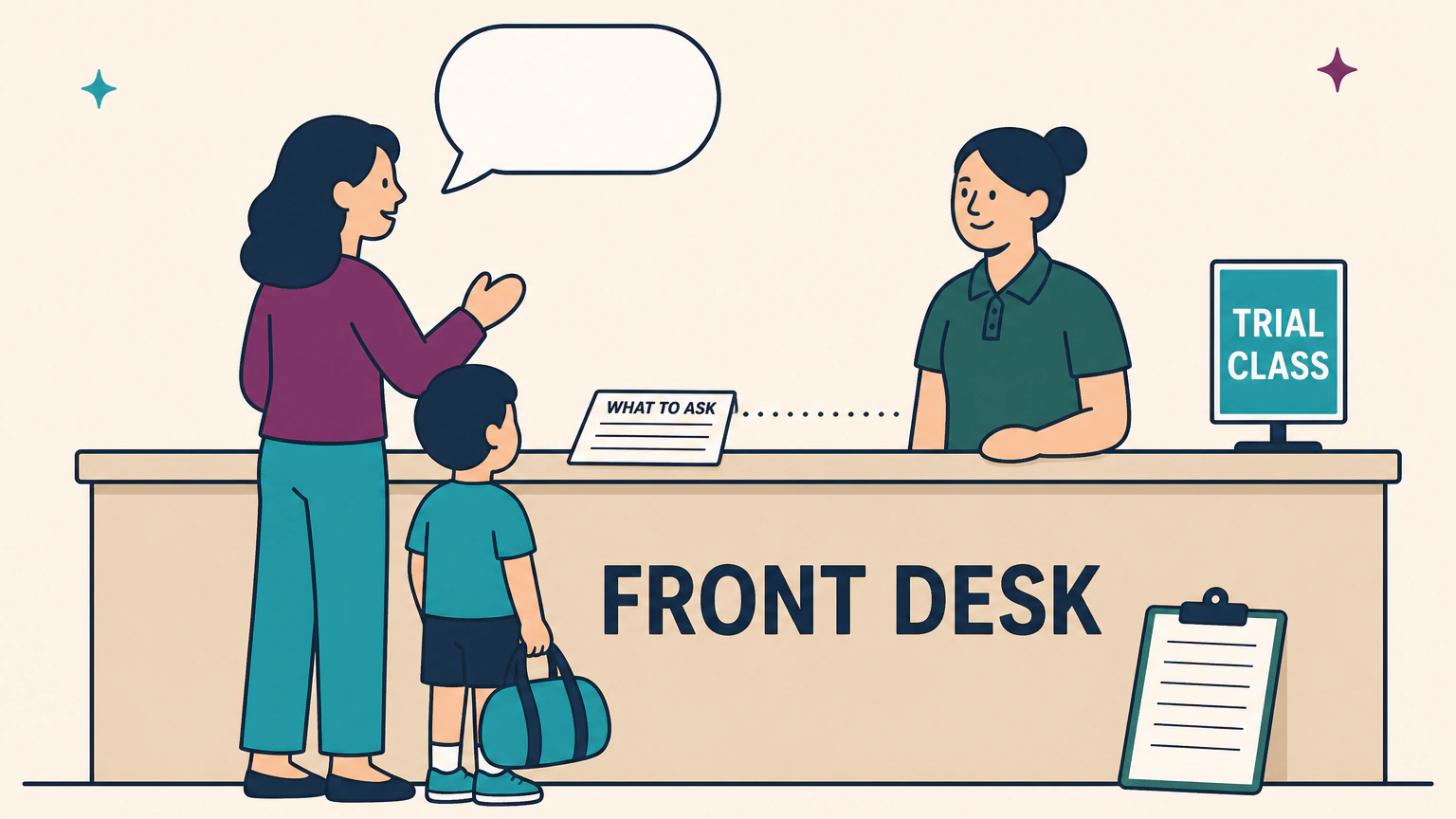
So start with the program, not the activity. A private studio that's open to the public has to make reasonable changes to its rules so your child can take part, and it can't charge you extra for making them. That flips the front-desk conversation around. The line you bring isn't "will you take him." It's "here's what he needs, can you do it."
Those lists aren't wrong, exactly. Swimming, martial arts, music, art: every one of them is a reasonable answer to a different question. None of them decides whether the season works.
On this page
The activity matters less than the program
You've done a version of this before. Soccer lasted five weeks. The swim school called at week three to say it wasn't working out, and nobody could name what "it" was.
Now you're looking at four martial arts schools near you, and every one has a photo of a smiling kid on the mat. Two dojos on the same road can run completely different classes. One drills the same warm-up every week and posts the running order on the wall. The other improvises, and the instructor changes month to month. Same belt system, same price, same friendly website. One will work for your son and the other probably won't, and the discipline on the door tells you nothing about which is which.
What to check before you enroll
Five things are worth checking before you enroll.
A session that runs the same way every week, so week four is recognizable from week one. A group small enough that one adult notices a child slipping. An instructor who has done this before and can describe it in specifics rather than in warmth. An agreed way for your child to leave the room and come back without that counting as failure. And a trial session before money changes hands.
Program fit matters alongside age, and the starting ages programs actually publish can help you compare the two.
A University of Queensland team asked 35 parents of autistic children and 171 parents of neurotypical children what their kids did outside school. The activity categories came back similar, with sports the most reported answer in both groups. Among children still taking part, the autistic group reported fewer activities, less breadth and fewer hours. For activities they had dropped, parents in the autistic group rated program features and social factors as barriers, while parents in the other group rated them as helps. It's one Australian study of 35 families, so it can't settle the question. It does give you a reason to look beyond the activity label and ask how the program runs.
Three ways in, and who each one suits
Here are three ways into a class, with different tradeoffs for your child.
An adaptive class is a group built for disabled participants from the start. Everyone in the room is working with something, and nobody explains. You'll find the same idea listed as adaptive swim lessons, sensory friendly classes, special needs martial arts or autism friendly dance classes, but the label alone doesn't tell you how the class works. Ask about the wait before you build a season around one.
Inclusion means your child joins the regular class with support arranged in advance. How it works depends on the plan and the people carrying it out.
A private lesson removes the crowd, the noise and the line. It also removes the other children, which for many families was the point. What class size actually buys you is worth reading first.
| Format | Who it tends to suit | What to ask | Where you'll find it |
|---|---|---|---|
| Adaptive class (a group built for disabled participants) | A child who needs the whole room to move slower | "How big is the group, and how long is the wait?" | City parks and recreation departments and specialist studios |
| Inclusion in a regular class, with support | A child who can hold a group setting once a plan exists | "Who arranges the support, and when do we meet them?" | Private studios and municipal inclusion teams |
| Private lesson | A child who needs the noise gone, or one skill unstuck | "Can we start private and move into a group later?" | Ask the studio whether it's available |
What a studio has to change for your child
This is a business open to the public, not a favor economy. That distinction does more work than any script you could rehearse.
Federal law already settled most of what you're nervous about asking. The Americans with Disabilities Act treats a private swim school, dojo, dance studio or music school open to the public as a public accommodation, the same way it treats a restaurant. The statute's own list covers "a nursery, elementary, secondary, undergraduate, or postgraduate private school, or other place of education" and "a gymnasium, health spa, bowling alley, golf course, or other place of exercise or recreation."
Nobody at a front desk opens with this. It's still the floor you're standing on.
The rule, in plain words
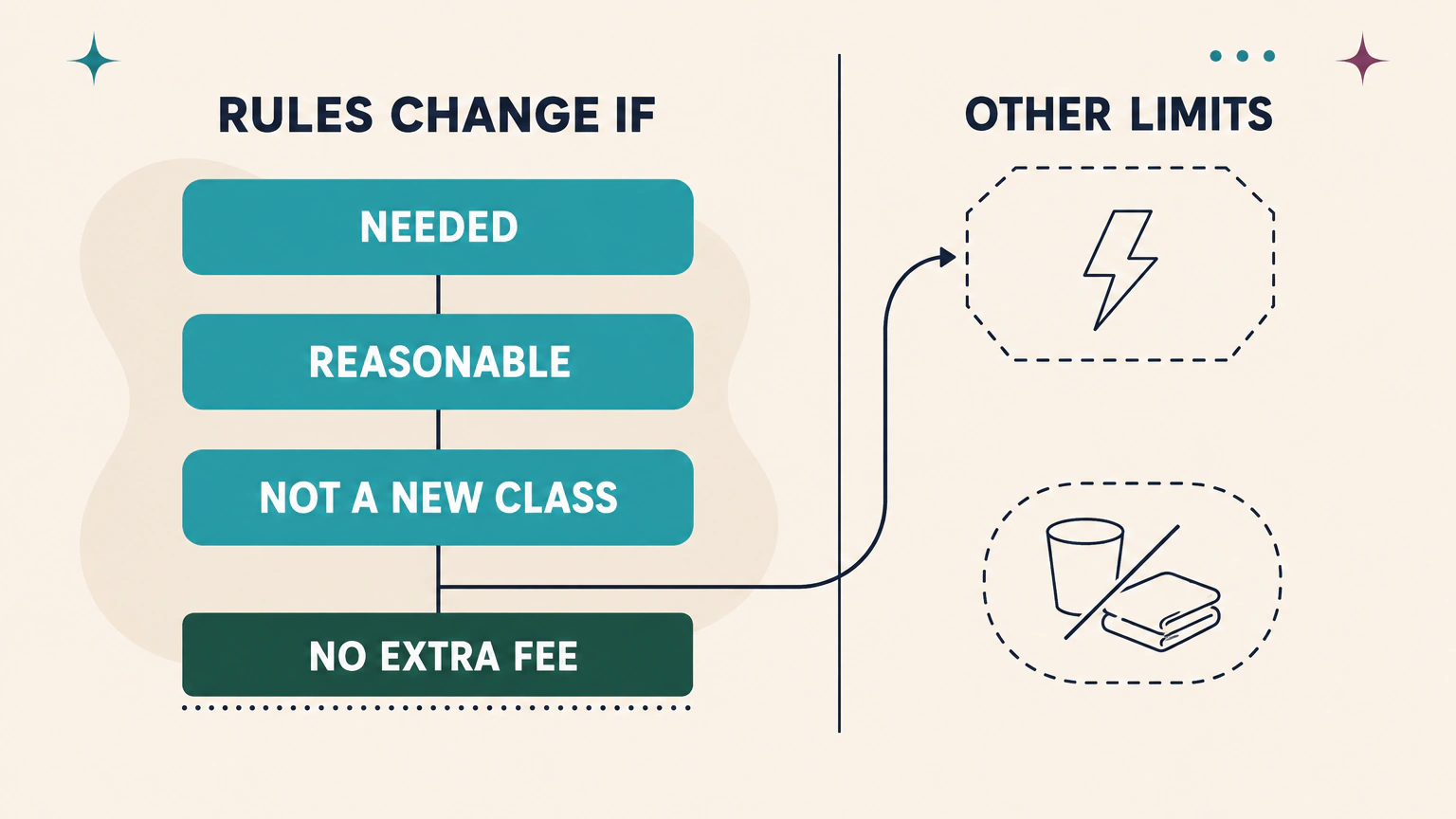
The rule is one sentence long. A public accommodation "shall make reasonable modifications in policies, practices, or procedures" when those changes are needed so a disabled person can use what it offers, unless it can show the change would "fundamentally alter" what it's offering.
Read that as: the studio's rules bend. The class itself doesn't have to.
In a real class, requests may look small and specific. Ear defenders through a loud warm-up. The same instructor every week instead of a rotation. Twenty minutes for the first three sessions instead of forty-five. You on the pool deck for the first month. An exception to the no-food rule for a child who eats on a schedule. A service animal, which gets its own paragraph in the same regulation.
Those are requests to discuss, not promises that every studio has to say yes. The question is whether a needed rule change is reasonable or would fundamentally alter the program.
When a program can say no, and when it is just guessing
A studio can't refuse a child just because of a disability. Fundamental alteration and direct threat can support a refusal, while the personal-services rule limits what the program has to provide.
Fundamental alteration. If the change would turn the thing into a different thing, they don't have to make it. Slowing a competitive team's entire practice is a plausible example. Letting one child sit out a drill isn't.
Direct threat. The Justice Department describes this as "a substantial risk of serious harm to the health and safety of others." The risk must remain after reasonable changes or auxiliary aids are considered, and the finding has to be about your child, not about autism. A safety rule "must be based on actual risks and not on mere speculation, stereotypes, or generalizations about individuals with disabilities."
Personal services. A program doesn't have to supply personal devices such as a wheelchair, or "services of a personal nature including assistance in eating, toileting, or dressing."
There's an honest fourth, worth knowing so you don't waste a fight on it. A full class with a waiting list doesn't have to take your child out of turn.
What they cannot charge you extra for
If the change is one the law requires, they can't bill you for it. That's the sentence to keep.
The regulation says a public accommodation "may not impose a surcharge on a particular individual with a disability or any group of individuals with disabilities to cover the costs of" the measures it's required to provide. The Justice Department's child-care guidance puts it in a line: "If the service is required by the ADA, you cannot impose a surcharge for it. It is only if you go beyond what is required by law that you can charge for those services."
Insurance may come up, and the broader rule is clear. A studio can't use insurance rates as the reason to exclude a disabled child. In its child-care guidance, the department says the extra cost belongs in overhead rather than on one family's bill.
So when a fee appears, ask one thing. Is this change something the law requires, or is it genuinely extra? A program can charge for extra. It can't charge for the floor.
When a religious organization runs the program
One important gap catches families whose class meets in a fellowship hall.
Programs actually run by a religious entity sit outside Title III. A church, mosque or synagogue operating its own children's program is exempt, and the Justice Department states that directly. Renting the room is a different thing. Where a religious organization leases space to a program it doesn't control or operate, Title III applies to that program, though not to the religious organization itself.
So the question isn't where the class meets. It's who controls or operates the program. Ask, because the answer changes what you can expect.
Eight questions to ask before you pay
These are registration questions, not a confrontation. Every one is something a parent of any child might reasonably ask, and a good program answers them without flinching.
Send them by email. Not to build a case, but because a written answer is a specific answer, and in six weeks you'll want to know exactly what was promised.
One thing worth saying plainly about our own listings. How we screen the instructors we list tells you about the business and its standing. It can't tell you whether this instructor suits this child. Only your own questions can.
- Has anyone on staff taught a child with my child's needs before, and can I speak with that instructor? Ask for a name and five minutes, then use how to check an instructor's credentials yourself.
- How many children are in the class, and how many adults are on the floor? Both numbers, not a ratio, and what happens when one adult calls in sick.
- Does the session run the same way every week, and can I see the order of it? A program that can email you the running order already has one.
- What happens if he needs to leave the room, and who goes with him? A pause here is itself an answer. Push once for specifics.
- Can we do a trial session, and does it count against the term fee if we stop? Get the refund rule in the same reply.
- If he needs an extra adult with him, do you provide that, and is there a charge? If there's a charge, ask which side of the surcharge line it sits on.
- What have you changed for another child before, specifically? Warmth isn't experience. A story with a name and an outcome is.
- Who do I contact during the term if something isn't working, and how fast do you answer? One named person, one response time, not an info@ address.
Ask at registration, not at the door
The mistake is completely understandable. You say nothing until day one, then you say it in the lobby, quietly, with your child standing right there listening.
It fails for a practical reason. On day one, the instructor is teaching and staffing is set. Tell them earlier and there's time to plan. Tell them at the door and the choices narrow fast.
Programs that handle this well are built around advance notice. They ask at registration, on the form, in a box you tick.
The lead time nobody tells you about
The two municipal programs we checked publish their process, which shows what advance notice looks like in practice.
San Ramon, California asks families to register at least two weeks in advance and to mark the "Special Accommodations" box on the form. Staff then work the specifics out with you case by case, and a therapeutic recreation staff member drops in on the program to see how it's going.
Bloomington, Minnesota runs the same shape. Register, tick the box saying you may need support, and someone from the inclusion team gets in touch to build an inclusion plan. Every registrant there is entitled to an assessment to work out which support fits.
A private studio may not publish a window. That's an argument for asking early and in writing, not an argument against asking.
What a good answer sounds like, and what a brush-off sounds like
A good answer names three things: a person, a change and a date. "Coach Dani has taught autistic students for years, we'll keep him in her Tuesday group all term, and I'll call you Thursday to walk through the warm-up order." You can act on that, and you can check it in week two.
A brush-off is warm and empty. "We're very inclusive here." "We'll see how he does." Neither tells you what will be different on Tuesday, and warmth without a plan is how week three ends in a phone call.
So use one test. Could you write down what they just promised?
Red flag: three brush-offs, and the move that answers each one.
"We're not really equipped for that." Ask by email which specific change they judged unreasonable, and why. A program that has genuinely considered the request can answer that.
"You'd need to send an aide with him." Ask whether anyone has looked at your child specifically. The Justice Department says a child who needs one-to-one attention can't be excluded for that reason alone when she can be included without altering the program fundamentally. Its child-care guidance also says the ADA generally doesn't require a center to hire extra staff or provide constant one-to-one supervision. Ask what change, rather than what person, would make the class work.
"There'd be an extra charge for the support." Ask which side of the line the fee sits on. Required changes carry no surcharge. What a program adds beyond the law, it may bill for.
What it costs, and where the free help is
You've probably been braced for "specialized" to mean expensive. The ADA keeps required changes off your bill, but the ordinary class price still varies by format and studio.
The price of the ordinary class
Here are the figures on our category cost panels. The panels call the averages national, but they don't state a billing period. They also don't explain the ranges' geography or how the profiles were collected.
| Class type | Published price range | National average | Cost profiles behind it |
|---|---|---|---|
| Swim lessons | $103 to $201 | $134 | 861 |
| Gymnastics | $52 to $94 | $89 | 591 |
| Martial arts | $105 to $158 | $126 | 668 |
| Dance | $368 to $735 | $420 | 667 |
If the studio says a higher quote pays for disability support, ask which required change the extra covers. It's worth seeing what swim schools near you, gymnastics gyms in your area and dance studios near you publish before you pay.
A private lesson is a different class format, so a higher quote isn't automatically a disability surcharge. Ask whether you're choosing the format or the studio says your child must take it.
Start with your city's parks department
Two useful searches are "adaptive recreation" and "inclusion services," each with your city or county name.
Bloomington's inclusion services are provided at no additional cost, and the examples it publishes include schedule flexibility, extra peer and staff support, and staff trained in inclusive practices. San Ramon says reasonable accommodations are provided at no cost and that participants pay the regular program fees, listing disability awareness training, activity modification, behavior support and adaptive equipment.
A city program runs under Title II of the ADA, while a private studio runs under Title III. Bloomington and San Ramon both publish a process for asking for support.
If a program turns your child away
First, this isn't the end of your season. A front-desk refusal may repeat a policy rather than a decision about your child. Second, the next steps don't have to start with a lawyer.
What to do next
Ask for the reason in writing. One line does it: "Could you email me which accommodation you weren't able to make, and why?" A written answer turns a vague no into something specific.
Offer a narrower version. If a full term is too much, ask for four weeks. If the whole class is too much, ask for the first half. A smaller request may be easier to consider, and it can reveal whether the obstacle is scheduling rather than your child.
Go up one level. A front-desk answer may not be the owner's answer, and the owner can reconsider it.
If it's a flat refusal, file. The Justice Department takes ADA complaints against private businesses that serve the public, online at ada.gov.
Then there's the move nobody writes down: the studio two miles away that says yes. Take it. Your child's fall doesn't have to be a test case.
We're explaining a federal rule in plain words here, not giving legal advice. A protection and advocacy agency can help you understand your options, and the National Disability Rights Network lists one in every state and territory.
Questions parents ask
What does an adaptive class actually mean?
Programs use "adaptive" in different ways. Ask what's actually different: group size, session length, staffing, and what training the instructor has.
Can a private studio refuse to take my child?
A private studio can't refuse your child just because of a disability. It may refuse if a needed change would fundamentally alter what it offers, or if your child poses a serious risk to others that reasonable changes or auxiliary aids can't remove. It also doesn't have to provide personal care or take your child ahead of a waiting list. "We're not set up for that" isn't enough.
Can they charge me more for the extra support?
Not for anything the law requires. The regulation forbids a surcharge on a disabled person to cover the cost of required changes, and the Justice Department's guidance says a program may charge only when it goes beyond what the law asks. So ask which side of that line the fee sits on. Higher insurance costs aren't a valid reason to charge you or to exclude your child.
Which activities work best for autistic kids?
No activity wins across the board. Swimming, martial arts, music and dance can all work, but the label doesn't tell you how a particular class runs. Ask about its routine, group size, staffing and exit plan, then choose the program that fits your child.
Are there free swim lessons for a child with autism?
The class itself may not be free. Bloomington provides inclusion services at no additional cost. San Ramon provides reasonable accommodations at no cost while charging the regular program fee. Search "inclusion services" or "adaptive recreation" with your city name, then ask what its swim program charges and what support costs extra.
Do I have to tell the studio about the diagnosis?
Not just to enroll. The ADA bars unnecessary questions about disability, though a program may ask for information it needs to keep an activity safe. Explain what your child needs so the program can plan. The useful disclosure is the specifics: he needs the same instructor, he'll need to step out sometimes, a loud whistle ends the session for him.
Two emails this week, then. One to the studio you like most, with the eight questions pasted straight in. One to your city's parks and recreation department, asking what inclusion support it provides and how far ahead it needs to know. Send the first from the category page for the class you're actually considering, so you're looking at real schedules beside real prices, and give the season to whoever answers with a person, a change and a date.