

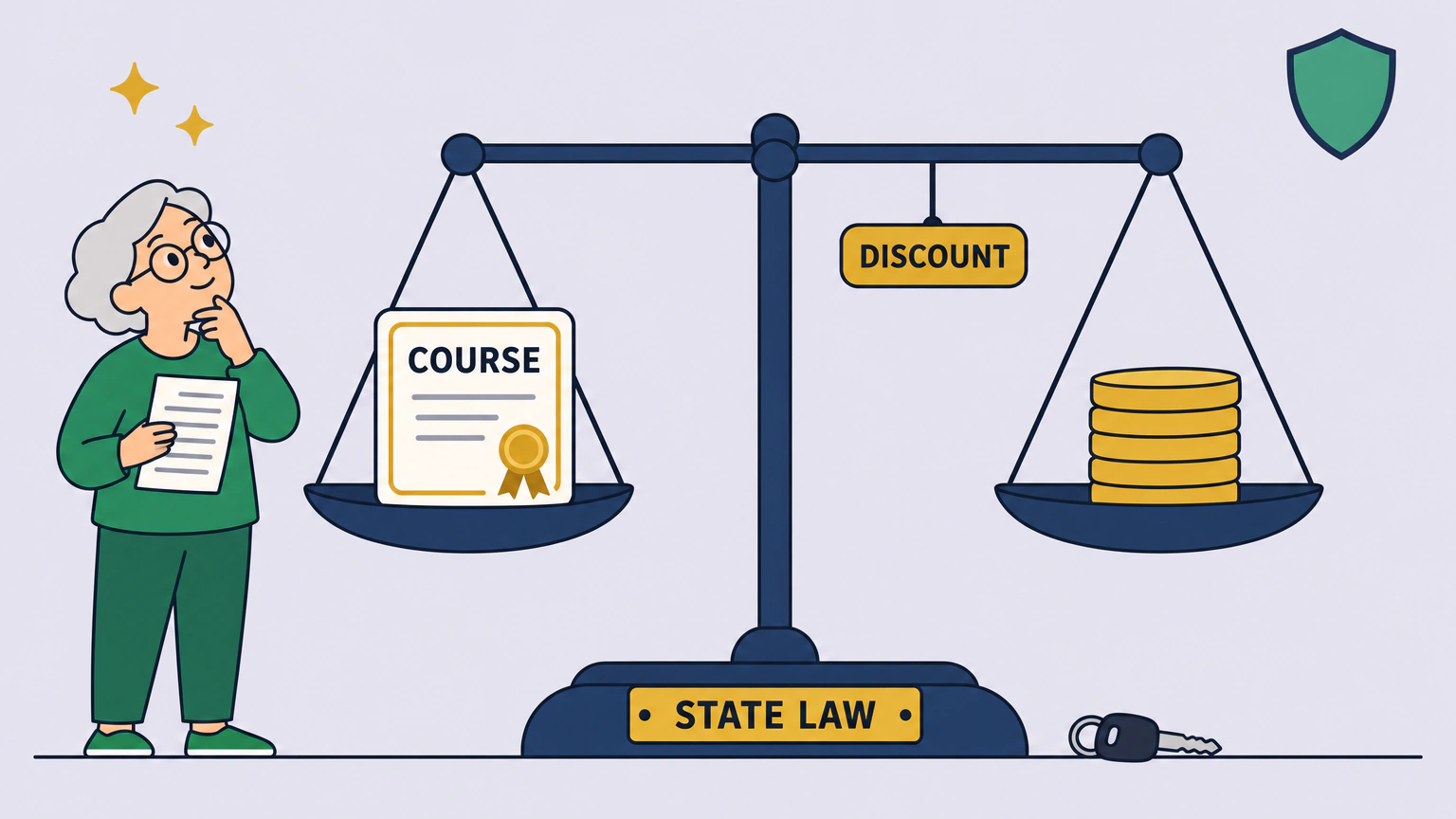
A defensive driving course lowers your car insurance only where state law makes the insurer give the discount or the insurer chooses to, and in most of the 12 states we checked, the law covers only drivers from about age 55. New York, New Jersey and Delaware require it at any age, the discount usually runs three years, and five of these laws don't count a course a court or agency ordered.
Whether it does anything for you comes down to three things, and you can check all three in a few minutes, before you spend a dollar on a course or an afternoon in a classroom.
On this page
Three things decide whether you get the discount
The first is your state's law. Of the 12 states we checked, 11 have a law that makes insurers give or offer the discount. Texas is the odd one out. Its Department of Insurance (TDI) says each company decides for itself.
The second is your age. New York, New Jersey and Delaware cover drivers of any age. Georgia's law looks at every named driver on the policy, young or old. In the other seven states, it works as a mature driver discount that starts at about 55.
The third is why you took the course. Five of these laws won't count a course that a court or agency ordered you to take.
Then there's a fourth thing nobody gets to skip. The discount isn't automatic. Florida, California, Pennsylvania, Illinois, Minnesota and Virginia build proof of completion right into the law. In every state, the practical step is the same: send the completion certificate to your insurer.
Those rules change from one state to the next.
What the law says in 12 states
The table shows who each law covers, what it guarantees, how long the discount lasts, and what happens if someone ordered you to take the course. Every rule comes from the state's own law. Where a number comes from a state agency instead, the table says so.
| State | Who the law covers | What the law guarantees | How long it lasts | If a court or agency ordered the course |
|---|---|---|---|---|
| New York | Any age. The principal operator of each car | An "actuarially appropriate" cut on liability and collision. The state's insurance regulator says it's generally 10% | 3 years | The law shuts out only the alcohol and drug rehabilitation program |
| New Jersey | Any age. The named insured, principal operator, or an occasional operator whose driving history helps set the rate | A cut "justified by the insurer's actuarial experience" on PIP, liability and physical damage | 3 years from the next policy period. Removed at renewal after 4 or more points or a qualifying license suspension | The law doesn't say. NJM, a New Jersey insurer, excludes the MVC's Driver Improvement and Probationary Driver courses |
| Delaware | Any age, if you went voluntarily | A rate cut. The DMV says 10% off part of your premium, or 15% after a refresher taken within 180 days of the end | 3 years | Doesn't count if a court ordered it or the DMV required it |
| Georgia | Every named driver. At 25 and older, a 6-hour course. Under 25, a driver's ed course of 30 classroom hours and 6 driving hours. Everyone needs 3 years without at-fault claims. No traffic offenses for 3 years, or since licensing if that's shorter | At least 10% on liability, medical and collision, which the insurer must offer | 3 years, ending if any named driver commits a traffic offense or has an at-fault claim | Not addressed, but a recent traffic offense already fails the clean-record rule |
| Florida | 55 and older. The principal operator | An "appropriate" cut on liability, PIP and collision. Any discount the insurer uses is presumed appropriate | 3 years. The insurer may drop it after an at-fault crash or a moving violation | Doesn't count |
| California | 55 and older. The principal operator | An "appropriate percentage" off liability insurance only | 3 years. The insurer may drop it after an at-fault crash or a moving violation | Doesn't count if a court ordered it under the traffic school law |
| Pennsylvania | 55 and older, and every named insured on the policy must qualify | At least 5%, on all coverages | 3 years, then retake the course | Doesn't count |
| Illinois | Over age 55 | A cut on liability insurance "as determined by the insurer" | 3 years. A recent conviction or suspension can hold it back | Not addressed |
| Minnesota | 55 and older | At least 10% | Retake the course every 3 years to keep it | Not addressed |
| Virginia | 55 and older, after a classroom course. Under 55, only if the insurer chooses | An "appropriate" cut. An online course counts only if the insurer allows it | 3 years, or 2 years under 55 where offered | Doesn't count |
| Washington | 55 and older | An "appropriate" cut on liability and physical damage, except underinsured motorist coverage | 2 years | Not addressed |
| Texas | No law requires it | Each insurer decides whether to offer one, and how much | Set by the insurer | Set by the insurer |
Words in quotation marks are each state's own law. Where a law says "appropriate," your insurer sets the size, so ask for the number. Delaware's percentages come from its DMV and New York's 10% from its Department of Financial Services. If your state isn't listed, your insurer and your state insurance department can tell you whether a law applies.
The pattern is hard to miss. Seven of the 11 laws start at about 55, three cover drivers of any age, and only Washington's runs two years instead of three.
Where the law names a number, and where your insurer does
Start with the three laws that put a floor in writing. Georgia's says the insurer must offer at least 10% off liability, medical and collision coverage. Minnesota's says at least 10%. Pennsylvania's says at least 5%, and on all coverages.
New York is the state the ads are built on, and its statute never names a number. It asks for an "actuarially appropriate" cut. The famous 10% comes from the Department of Financial Services (DFS), which says the discount "is generally 10%," a figure that traces back to a 1980 circular letter. New York's DMV puts it as 10% off the base rate of your auto and motorcycle premiums, each year for three years. So the cut trims the base rate, not every line of your bill.
Delaware's statute asks only for "a reduction in rates." Its DMV says that means 10% off a portion of your premium, or 15% after an on-time refresher.
Everywhere else, the law says "appropriate" and leaves the size to the insurer. New Jersey's cut must be "justified by the insurer's actuarial experience." Its insurance rules add that the cut "should be a minimum of five percent," then let an insurer justify a different figure. Florida goes further: any discount the insurer uses "is presumed to be appropriate." California's law reaches liability insurance only. So does Illinois's, with the size "as determined by the insurer." Virginia's is simply "appropriate." Washington's covers liability and physical damage, but not underinsured motorist coverage.
Which leaves you one job. Ask your insurer what the discount comes to on your own policy, in dollars.
Texas, and every state not in the table
Texas has no law that forces the discount. Its Department of Insurance says so plainly in its auto insurance guide: "Each company decides what discounts to offer and the amount of the discount." A finished defensive driving or driver education course is on its list of things that might earn you one. In Texas, the course is worth exactly what your insurer says it's worth.
Live in a state that isn't in the table? Don't guess from a neighbor's rules. Ask your insurer whether it gives the discount, and under which state rule. Then ask your state insurance department whether a law requires one.
We're not your insurance agent, and your insurer's own filed rules set the final number. Get that number in writing before you pay for a course.
Who on the policy has to take the course
This is the rule the course ads almost never mention, and it matters most when two people share a policy. New York ties the discount to the principal operator, meaning the person who drives the car most. DFS says it then applies to every car that person mainly drives, not just one. Florida and California also attach it to the principal operator, who has to be 55 or older. New Jersey covers the named insured and the principal operator. Its rules also cover an occasional operator whose driving history helps set the policy's rate.
Pennsylvania is where couples trip. Its 5% floor applies only when every named insured on the policy is 55 or older and has taken the course. Say you're 58 and your spouse is 52, and you're both named insureds on one policy. The law doesn't reach you. Nothing in it stops your insurer from offering its own discount, though, so ask anyway. (Pennsylvania also lets an insurer drop the state discount if it shows the insurance commissioner it already gives a duplicate driver improvement discount.)
Georgia needs every named driver to qualify. For a family, that means the parents each take a course of at least six hours. A teen driver under 25 needs a driver's ed course of 30 classroom hours and 6 driving hours. Everyone needs three years without at-fault claims. The traffic-offense rule covers three years, or the time since getting licensed if that's shorter.
Delaware splits the difference. When not everyone in the group on the policy took the course, the law cuts the discount in proportion.
When the course won't earn you a discount
Even in a state with a strong law, three situations can break the deal.
The court or the DMV sent you
Florida, California, Pennsylvania, Virginia and Delaware all shut out a course that a court or agency ordered. In California, that means a judge sent you under the state's traffic school law. Virginia also has a shorter, optional discount for drivers under 55 who finish a driver improvement clinic, and it excludes anyone the court or the DMV sent there.
New York is the contrast. Its law excludes only the alcohol and drug rehabilitation program. So a course you choose on your own after a speeding ticket can earn both the insurance cut and the DMV's point reduction. In New York that course is called PIRP, short for the Point and Insurance Reduction Program.
New Jersey's statute says nothing either way. NJM, a New Jersey insurer, says its discount doesn't apply to the Motor Vehicle Commission's Driver Improvement and Probationary Driver courses. Texas leaves it to the insurer. Ask before you use one course for both a ticket and a discount.
You took it online where the law wants a classroom
Virginia makes the discount mandatory only after a classroom course. An insurer may honor the online version, but it doesn't have to.
New York's law bars a discount for self-study courses, with one exception: courses approved under a pilot program for online and other technology. Current law ends that pilot on April 1, 2028. Online PIRP courses count today, so check again if you're renewing after that date.
Illinois allows an eLearning course, and Washington takes internet, video and other approved formats. California sets course length instead. The first mature driver course runs at least 400 minutes, and the renewal course at least 240.
A ticket or a crash during the discount years
The discount can end early. Florida and California let the insurer drop it after an at-fault crash or a moving violation, and California's list also covers alcohol and drug traffic offenses. Pennsylvania's adds a DUI conviction or ARD, the state's diversion program for some first offenders. New Jersey removes it at renewal after four or more points or a license suspension for a covered driving offense.
Georgia's discount hangs on the whole household. It ends if any named driver commits a traffic offense or has an at-fault claim. So one teen's speeding can cost everyone on the policy their discount.
Illinois works a little differently. A principal driver convicted under the state's motor vehicle laws can't get the discount until they've gone a full year without a crash or a moving violation. Anyone whose license was suspended or revoked in the past 36 months is shut out too.
Is the course worth the money?
Start with what the course costs. The online courses we priced ran from about $22 to $39, before any state fee. IMPROV sells New York's online PIRP course at $21.95 on sale, plus an $8 fee it labels a DMV fee. AARP's Smart Driver online course shows $27 for members and $30 for everyone else on its price page, and AARP says pricing varies by state. Aceable's Texas course sells at $29, or $39 for the audio version.
The one-line math: Multiply the annual premium the discount applies to by the discount rate, then by the years it lasts. On $1,000 of covered premium, 5% for three years is $150, and 10% for three years is $300. In Washington, where the discount lasts two years, 10% comes to $200.
Here's our verdict. Where your state's law sets a floor, or your insurer quotes you a real number, take the course. Even 5% on $1,000 of covered annual premium is $50 a year, which is more than any course we priced costs. We'd take that deal every time. Where neither is true, get the number before you pay anyone.
There's a side benefit in two states. New York's DMV subtracts up to 4 points when calculating a suspension for violations in the 18 months before you finish. You can use that once every 18 months. Georgia's Department of Driver Services lets you reduce up to 7 points once every five years.
How to make sure the discount shows up on your bill
A discount you never claim is worth nothing. Work through these seven steps before you pay for anything.
Before you pay for a course:
- Ask your insurer whether it gives the discount, what it comes to in dollars, and which coverages it reduces. Get the answer in writing if you can.
- Check that your state's licensing agency approves the course for the insurance discount, not only for points or a ticket.
- Match your age and your policy to your state's rule. In Pennsylvania every named insured must be 55 or older, and in Georgia every named driver has to qualify.
- Take the course on your own. In five of the states we checked, a course a court or agency ordered doesn't earn the discount.
- Send the completion certificate to your insurer and ask the date the discount starts. In New Jersey it starts with the next policy period.
- Note when the discount ends and retake the course before then. Delaware raises the cut to 15% for a refresher taken within 180 days of the end.
- Drive carefully through the discount years. An at-fault crash or a moving violation can end it early in Florida, California and Pennsylvania.
Once your insurer has given you a number worth chasing, find a driving school near you that teaches an approved defensive driving or mature driver course. If you're in New York, Florida or Georgia, start with schools and instructors across New York, schools and instructors in Florida or schools and instructors in Georgia. And if you came here as a parent thinking about Georgia's under-25 rule, check what a teen driver's ed course costs and whether your state requires driver's ed.
Questions people ask about the defensive driving discount
Do insurance companies have to give a defensive driving discount?
Only where state law says so. Of the 12 states we checked, 11 have a law requiring insurers to give or offer one, and seven of those cover only older drivers, starting around 55. New York, New Jersey and Delaware require it at any age. Georgia's covers every named driver who meets its course and clean-record rules. In Texas, the insurance department says each company decides.
How much does defensive driving lower insurance?
It depends on your state and your insurer. Georgia and Minnesota set the floor at 10%, and Pennsylvania at 5%. New York's regulator says its discount, on liability and collision, is generally 10%. Delaware's DMV says 10% off part of your premium. Elsewhere the law usually just says "appropriate," which leaves the size to your insurer, so ask for the dollar figure before you pay.
How long does the defensive driving discount last?
Three years under 10 of the 11 state laws, and two years in Washington. Several states make you retake the course to keep it going: Pennsylvania, California and Minnesota say every three years, and New York's DMV says every 36 months. Delaware raises the cut to 15% if you take a refresher within 180 days of the end. Texas leaves the term to each insurer.
Does defensive driving lower insurance after a speeding ticket?
Usually not when a court or agency ordered the course. Florida, California, Pennsylvania, Virginia and Delaware all exclude ordered courses. Georgia requires no traffic offenses over the past three years, or since licensing if that's shorter. A recent traffic offense rules out its required discount. New York's law excludes only its alcohol and drug program, so a course you choose after a ticket can still count.
Can I take a defensive driving course online for the insurance discount?
In many states, yes, but check first. Illinois and Washington allow online or other remote courses. New York counts online courses through a pilot program that current law ends on April 1, 2028. Virginia requires insurers to give the discount only after a classroom course, and it leaves online courses to the insurer.
Is there an insurance discount for drivers ed?
Sometimes, and it's usually the insurer's call. New York's regulator calls the driver education discount voluntary, unlike the mandatory defensive driving one. Georgia is the exception we found. There, drivers under 25 can get at least 10% after a course of 30 classroom hours and 6 driving hours, as long as every named driver qualifies and has a clean record.