

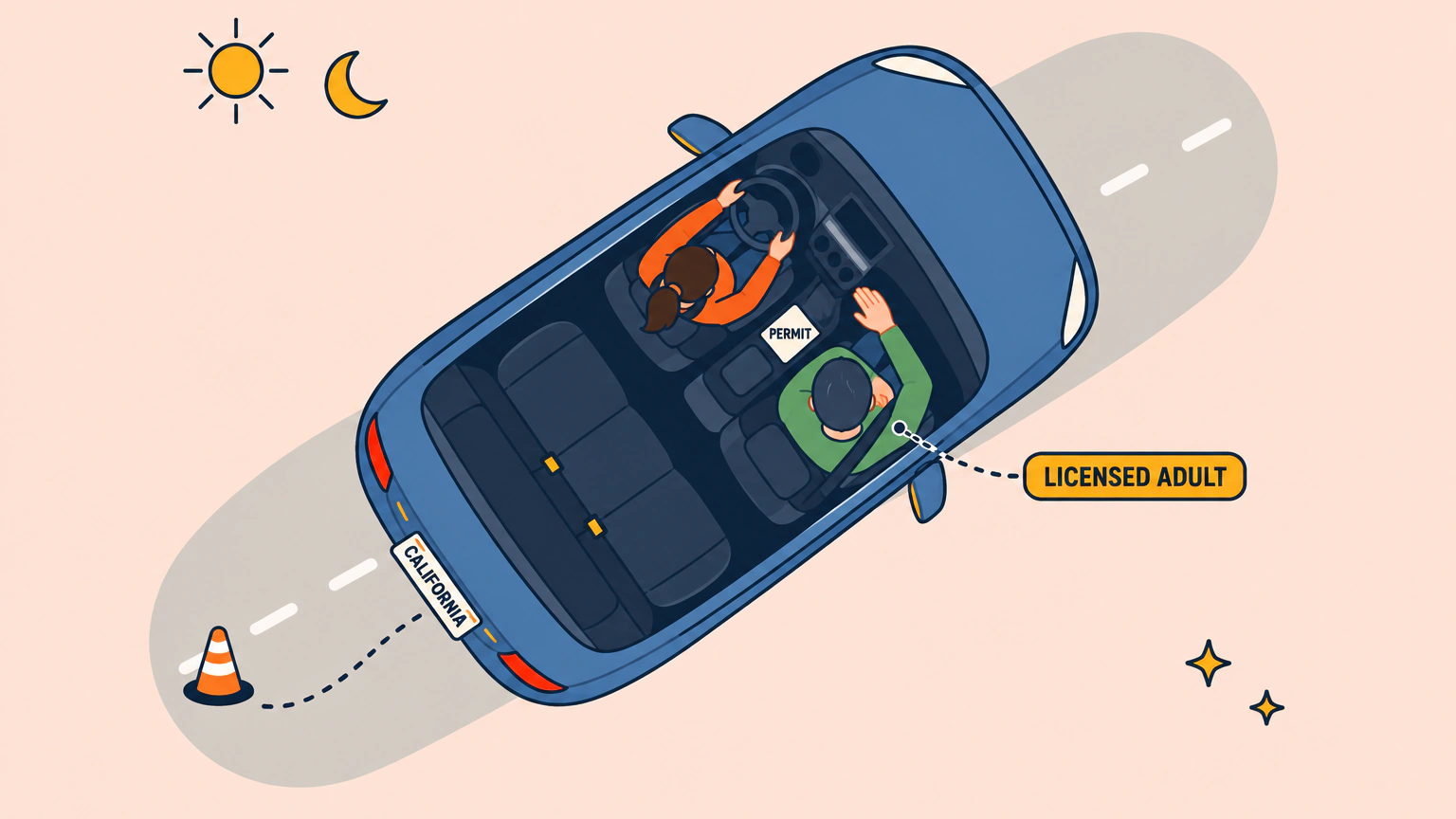
In California your teen can get a learner's permit at 15½ once driver's ed is done, but it isn't valid until a licensed driving instructor signs it after the first hour of behind-the-wheel training. From then on every drive needs a California-licensed parent, guardian or spouse, a California-licensed driver 25 or older, or an instructor in the passenger seat. The earliest license comes at 16 and at least six months after the permit. For the first 12 months (or until 18, if that comes first) your teen can't drive between 11 p.m. and 5 a.m. or carry passengers under 20 without a qualifying adult.
The rest is paperwork and calendar math. For the math, we built a date tool: give it your teen's birthday and it hands back the actual dates.
On this page
- The California permit path, step by step
- How to get a learner's permit in California
- Why the permit isn't valid the day you get it
- Work out your teen's own dates
- Who can ride with a permit driver
- From permit to provisional license
- The first year: late nights, passengers and signed notes
- Starting at 17½, or at 18 and older
- What parents sign up for
- California driver's permit questions
The California permit path, step by step
Teens on California's driver's ed route take the same four steps in the same order, and those who skip it take a slower side road. Here's each one, with the earliest it can happen and what has to come first.
| Step | Earliest | What has to happen first |
|---|---|---|
| Learner's permit | 15½ | Driver's ed finished (or an integrated course started), a parent's signature, the vision and knowledge tests |
| First practice drive | The first lesson | At least one hour with a licensed driving instructor, who signs the permit |
| Provisional license | 16, and 6 months after the permit | 50 practice hours (10 at night), 6 hours with an instructor, a passed drive test |
| Night and passenger limits lift | 12 months after the license, or the 18th birthday if sooner | Nothing more: the calendar does it |
| Without driver's ed | Permit at 17½, license at 18 | No driver's ed certificate, and no first-year limits once licensed |
From California Vehicle Code sections 12509 and 12814.6 and the DMV's teen pages and fact sheets.
So how old do you have to be to drive in California? 15½ with a qualifying adult beside you, and 16 at the earliest on your own, on a provisional license (the restricted license California gives drivers under 18).
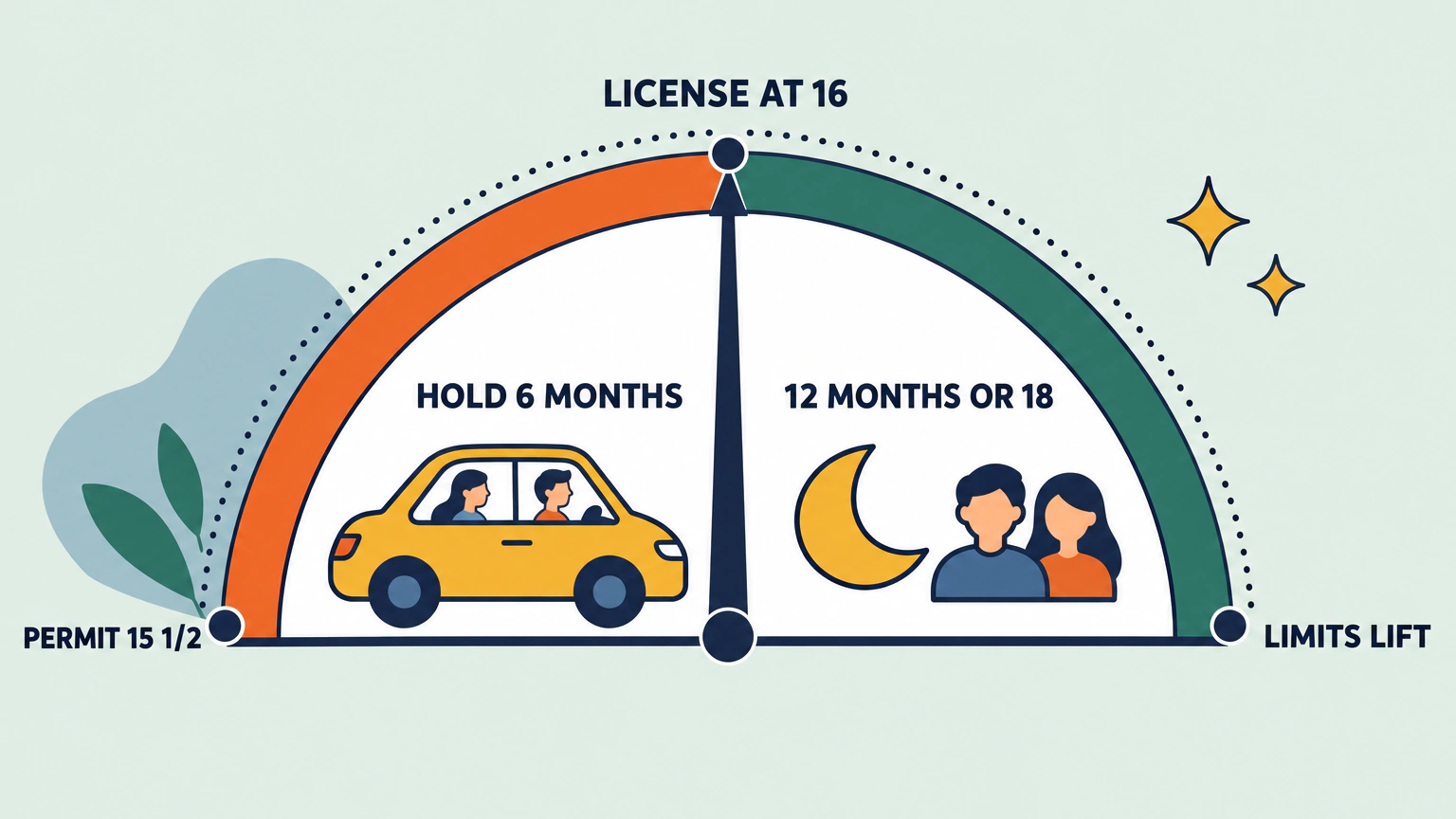
Two clocks decide the rest. The first is six months on the permit before the drive test. The second is 12 months on the license before the night and passenger limits lift. One date can overrule both, and that's the 18th birthday. At 18 the six-month wait stops applying and any first-year limits end.
How to get a learner's permit in California
The application now starts online and ends with an in-person visit to a DMV office. The law calls the result an instruction permit, the DMV calls it a learner's permit too, and they're the same thing.
What to have ready before the DMV visit
Your teen has to be at least 15½ and under 18, with driver's ed finished. The DMV's driver-training page puts it as classroom first, then permit. An enrollment certificate from an integrated course, which mixes classroom and driving, works too.
The application happens in your teen's own MyDMV account, and you approve it from yours. If you share custody, both parents sign. That signature makes you financially responsible for your teen.
A small trap: the handbook lists two proofs of residency for everyone, while the DMV's document list asks for two only on a REAL ID. Bring two and you're covered either way.
What to bring to the permit appointment:
- The online application, started in your teen's MyDMV account and approved from yours. Both parents sign if you share custody.
- The driver's ed certificate of completion, or the enrollment certificate for an integrated course.
- Your teen's proof of identity and Social Security number.
- Proof of California residency, two documents if you want a REAL ID card.
- A parent or guardian, in person.
- The $46 application fee.
- An appointment early enough to start the knowledge test before 4:30 p.m.
What happens at the appointment
A parent or guardian has to be there. You'll pay the $46 application fee from the DMV's fee schedule, and it's non-refundable. Your teen then takes a vision test, sits for a photo and gives a fingerprint.
After that comes the knowledge test, which the DMV also calls the written test. It's multiple choice, the questions come from the California Driver's Handbook, and passing takes 80 percent. Testing has to start before 4:30 p.m., so a late afternoon slot is a gamble.
Your teen gets three tries per application. A minor who fails waits seven days, not counting the day of the test. The DMV's Teen Driver Roadmap says 8 days, which is the same wait counted with the test day in, so go by the handbook's wording. The application and fee stay valid for 12 months.
If your teen is dreading the handbook, skip the cover-to-cover read. Take the DMV's practice tests first to find the gaps, reread only those sections, then test again. And read every answer choice before picking one.
Why the permit isn't valid the day you get it
Your teen walks out of the DMV holding a permit, and it's tempting to hand over the keys for the drive home. Please don't. The DMV's driver-training page is specific: "Your instruction permit will be valid after being signed by your professional driving instructor, once you have completed at least one hour of behind-the-wheel training."
Even signed, a permit never allows driving alone, "not even to a DMV office to take the driving test," as the DMV's provisional licensing fact sheet puts it.
Driver training means six hours with the instructor, no more than two hours a day. Time in the car watching another student drive doesn't count.
Pro tip: Book the first driving lesson before the permit appointment. The permit only works once that lesson is done, and your teen needs 50 practice hours behind it before the drive test. Every week between the DMV visit and the first lesson is a week of practice your teen can't log.
One more date belongs on your calendar. The application lasts 12 months from the day you apply. If it expires before your teen has held the permit for six months, you reapply at a DMV office, and the DMV credits the permit time already held. Hang on to the expired permit, because your teen brings both permits to the drive test to prove that time.
Work out your teen's own dates
Give the calculator your teen's date of birth and the route they're taking, plus the permit date and license date if you have them. It hands back the earliest permit day, the earliest drive test, the day the night and passenger limits end and the day the phone ban ends, and it tells you which rule set each date.
A permit taken at exactly 15½ hits the six-month mark on the 16th birthday. A later permit pushes the date back, and one taken after 17½ runs into the 18th birthday instead. If a date lands on a day the month doesn't have, it moves to the first of the next month, so no date shown is too early. The DMV makes the final call at the counter.
When can your teen drive alone?
Put in your teen's birthday, and the permit and license dates if you have them. We'll work out the rest from California's rules.
We use it to find 15½, 16, 17½ and 18.
The date printed on the permit. Leave it blank if your teen doesn't have one yet.
The day your teen passed the drive test. Leave it blank to see the earliest possible date.
Earliest day your teen can drive alone: December 2, 2026
That's six months after the permit was issued.
- Permit issued: June 2, 2026
- Earliest drive test: December 2, 2026
- If licensed on December 2, 2026: No driving 11 p.m. to 5 a.m., and no passengers under 20 without a qualifying adult, until December 2, 2027 (12 months after the license)
- No phone use while driving, hands-free included, until November 20, 2028.
For a drive test before age 18, your teen needs 50 practice hours with a qualifying adult, including 10 at night. They also need 6 hours with a licensed driving instructor. The permit isn't valid until that instructor signs it after the first hour of behind-the-wheel training. The application is good for 12 months after you apply. If it runs out before the drive test, you reapply, and the DMV credits the time your teen already held the permit.
If a date would land on a day the month doesn't have, like six months after August 31, we show the first day of the next month, so no date here is too early. The DMV makes the final call at the counter.
Most teens run on two clocks. The permit comes at 15½ at the earliest, and your teen has to hold it at least six months before getting a license, which can't come before 16. Then the night and passenger limits last 12 months from the license, or end sooner if the 18th birthday comes first.
Who can ride with a permit driver
The rules turn on who's sitting in the passenger seat, and they change at each stage.
The supervising driver rule
A permit driver under 18 needs one of three people alongside: a California-licensed driver 25 or older, a California-licensed parent, guardian or spouse of any age, or a licensed driving instructor. Whoever it is, their own driving privilege can't be on probation.
The DMV's handbook boils this down to "25 for minors," which leaves out the waiver for parents. Go with the Vehicle Code. A 24-year-old parent qualifies, and a 24-year-old big brother doesn't.
The supervisor also has to carry a valid license and sit close enough to take control of the car. So no supervising from the back seat, however much calmer that might feel.
Who can sit in the passenger seat:
| Your teen's stage | Who counts as the supervising driver | Where the rule is |
|---|---|---|
| Permit, under 18 | A California-licensed driver 25 or older, a California-licensed parent, guardian or spouse of any age, or a licensed or certified driving instructor, as long as their license isn't on probation | Vehicle Code 12814.6(a)(1) |
| Permit, 18 or older | Any California-licensed driver 18 or older whose license isn't on probation | Vehicle Code 12509(d) |
| First 12 months on a provisional license, after 11 p.m. or with a passenger under 20 | A licensed parent or guardian, a licensed driver 25 or older, or a licensed or certified driving instructor | Vehicle Code 12814.6(b)(1) |
A spouse counts for permit practice but isn't on the list for the first-year limits.
Freeways, night driving and phones on a permit
Freeways are allowed with the supervisor. The permit rules limit who rides along, not which roads your teen takes. The DMV's optional Supervised Driving Log files freeway driving and night driving under Level IV, its last level, and says each level should be mastered before the next. The drive test can include a freeway stretch too, so get there before test day.
Night driving is fine as well. The 11 p.m. limit belongs to the provisional license, not the permit, and 10 of the 50 practice hours have to be in darkness. Vehicle Code 280 counts that from half an hour after sunset to half an hour before sunrise, plus any time you can't clearly see a person or car 1,000 feet away. Check for a city curfew before a late session, though, because the DMV warns that "Local laws may further restrict or prohibit driving during specified hours."
Phones are the firm no. Vehicle Code 23124 bars anyone under 18 from using a phone or other wireless device while driving, even hands-free. The one exception is an emergency, such as a call to the police or a doctor.
From permit to provisional license
Three things have to line up before the drive test: your teen's age, time on the permit, and hours behind the wheel.
The 50 practice hours and the 6 lesson hours
California wants 50 supervised hours on top of the six instructor hours, with at least 10 of the 50 in darkness. Spread over six months, 50 hours comes to about two hours a week. That's easy if you start in month one and a slog if you start in month five.
When the hours are done, a parent, spouse, guardian or instructor certifies them by signing the permit. The DMV's Supervised Driving Log is optional, and it sorts skills into four levels, from starting and stopping up to freeway and night driving. We'd use it anyway, because signing for 50 hours is easier when they're written down.
The six instructor hours run no more than two a day, so plan on at least three lesson days. Our guide to how long drivers ed takes shows how the 30-hour course and the lessons fit a calendar.
The drive test, and what happens if your teen fails
Once your teen is 16, has held the permit six months and has finished those hours, the test is open. You'll need an appointment, because the DMV doesn't give drive tests without one.
On the day, bring the permit, the driver training certificate, proof of insurance and registration, and another California-licensed driver (25 or older for a minor), since your teen can't drive there alone. The car has to pass the DMV's pre-drive safety check of things like the brake lights, horn, mirrors and tires, or the test gets rescheduled.
The test itself runs about 20 minutes. A minor who fails waits 14 days, not counting the test day, and the Roadmap's 15 days is that same wait counted the other way. The retest fee is $9 on the DMV's fee schedule and the Roadmap, while its Driver's Licenses page still says $7. Plan on $9, because the fee schedule is the DMV's actual price list. Your teen gets three attempts per application.
A pass brings a temporary license good for 60 days, and the card follows by mail.
The first year: late nights, passengers and signed notes
A car full of friends on a weekend night is a classic risky trip for a new driver, and California's provisional license restrictions are aimed squarely at it.
What the first-year limits cover, and when they end
For the first 12 months on a provisional license, your teen can't drive between 11 p.m. and 5 a.m. They also can't carry passengers under 20. Either one is fine if a licensed parent or guardian, a licensed driver 25 or older, or a licensed or certified driving instructor rides along. "Passengers under 20" means all of them, little brothers included. Until 18 there's also no driving for pay.
The limits end 12 months after the license's original issue date, which the law requires on the face of the card, or on the 18th birthday if that comes first. The DMV's retired FAQ on these rules put it as "one year from that date or until your 18th birthday, whichever comes first." So a teen licensed at 17½ gets six months of limits, not 12.
Nobody has to do anything to end them, and your teen doesn't need a new card. The phone ban is separate and runs until 18 regardless.
The signed-note exceptions, and what they don't cover
California allows five exceptions, and four of them need a signed note your teen keeps with them:
- Medical: a physician's note with the diagnosis and the expected recovery date.
- School or a school activity: a note from the principal, the dean or a staff member they choose, with an end date.
- Work: a note from the employer, confirming the job and its end date.
- Family necessity: a note from you, the parent or guardian, with the reason and an end date. The handbook adds that it should name the family member.
- Emancipated minor (a teen legally independent of their parents): no note needed.
The first four work only "when reasonable transportation facilities are inadequate" and your teen's driving is truly necessary. That's the statute's way of saying there's no other sensible way to get there. If a ride from you or a bus would do the job, don't count on the note.
Even then, the exceptions allow just two things: driving between 11 p.m. and 5 a.m., or carrying an immediate family member.
Red flag: A note won't cover giving friends a ride. The exceptions let a provisional driver drive late, or carry an immediate family member, when there's no reasonable way to get there otherwise. Friends under 20 still need a qualifying adult in the car. As the DMV once put it in its FAQ on these rules, "The law does not provide for emergencies."
What breaking the rules costs
An officer can't pull a teen over just to check the limits, or just to check for hands-free phone use. They need another reason for the stop. Points are the DMV's running count on a driving record: most moving violations count as one, and so does a crash the DMV holds your teen responsible for. Reckless driving or a DUI counts as two.
| What happened | What it costs | Where the rule is |
|---|---|---|
| Driving 11 p.m. to 5 a.m., or with a passenger under 20, in the first 12 months | First time: 8 to 16 hours of community service or a fine of up to $35. After that: 16 to 24 hours or up to $50 | Vehicle Code 12814.6(e) |
| Two or more violation points within 12 months | 30 days of driving only with a licensed parent, guardian, spouse or other licensed driver 25 or older | Vehicle Code 12814.6(g)(2) |
| Three or more violation points within 12 months | A 6-month suspension and 1 year of probation | Vehicle Code 12814.6(g)(3) |
| Using a phone while driving under 18, even hands-free | A $20 base fine the first time, $50 after that | Vehicle Code 23124 |
A first-year-limit violation adds no point to the record. A restriction, suspension or probation runs its full term even past the 18th birthday.
We're explaining California's rules, not giving legal advice. If a ticket or a suspension is on the table, talk to a traffic lawyer.
Starting at 17½, or at 18 and older
Not every teen takes the course. From 17½ a teen can get a permit without the driver's ed and training certificates. The trade-off is the calendar, because the drive test waits until 18. A license issued at 18 isn't provisional, so it carries no first-year limits. If you're moving or comparing notes with family elsewhere, we've also laid out what other states require.
California's permit rules over 18 are shorter. The supervising driver can be any California-licensed driver 18 or older whose privilege isn't on probation. There's no six-month wait and no 50-hour requirement. The DMV's words are that an adult "may obtain an instruction permit until you are ready to take your driving test," so the test comes whenever the driver's ready.
Two bills tried to change that. SB 473 in 2023 and AB 2385 in 2024 would have stretched a shorter version of the teen rules to 18-, 19- and 20-year-olds, with a 60-day permit hold and six months of limits. Both died in committee, so the rules still stop at 18.
What parents sign up for
Your signature on that application is a bigger deal than it looks. Parents who sign, the DMV says, "will accept financial responsibility for that minor." Call your insurer before the license arrives, not after.
You also keep a lever. A parent or guardian can cancel a teen's license with a DMV form, the Request for Cancellation or Surrender of a Driver License or ID Card.
The DMV's Parent-Teen Driving Contract is an optional way to set house rules first. It covers where your teen is going, who's in the car and who pays for gas, insurance and fines. You'll find it and the Supervised Driving Log on the Teen Driver Roadmap page.
The DMV's share of the bill is small: $46 for the application, plus $9 for each retest if you need one. The driver's ed course and six lessons are priced by the school, and we've broken down what driving school costs in its own guide.
Your next step is that first lesson. Check a school on the DMV's Occupational License Lookup first, because "The school must be licensed and bonded by the DMV." Then compare licensed driving schools near you. We have pages for driving schools in Los Angeles, driving schools in San Diego and driving schools in San Jose, plus lessons and schools across California for everywhere else.
California driver's permit questions
Can you drive alone with a permit in California?
No, at any age. Under 18, a permit driver needs a California-licensed parent, guardian or spouse, a California driver 25 or older, or a licensed instructor beside them on every drive, even the drive to the DMV for the driving test. An adult on a permit needs a California-licensed driver 18 or older.
Can you drive on the freeway with a permit in California?
Yes, with your supervising driver in the passenger seat. The permit rules limit who rides along, not which roads you take. The DMV's optional practice log lists freeway driving as a Level IV skill to master before the test, so save it until the basics feel easy.
Can you drive at night with a permit in California?
Yes, with a qualifying supervisor. The 11 p.m. to 5 a.m. limit applies to the provisional license, not the permit. For a license before 18, night practice is required anyway: 10 of the 50 practice hours have to be driven in darkness, which starts half an hour after sunset. A local curfew can still apply.
Who can drive with someone who has a permit in California?
A teen under 18 can drive with a California-licensed driver 25 or older, a California-licensed parent, guardian or spouse of any age, or a licensed driving instructor, as long as that person's license isn't on probation. They have to sit where they can take control of the car. Once the permit driver is 18 or older, any California-licensed driver 18 or older whose license isn't on probation can supervise.
Can a teen with a provisional license drive their siblings in California?
Not on their own in the first 12 months if the sibling is under 20, unless a licensed parent or guardian, a licensed driver 25 or older, or an instructor rides along. One exception is family necessity. With no other reasonable way to get there, your teen can carry an immediate family member if they have your signed note giving the reason, the family member and an end date.
How long is a California learner's permit good for?
Plan on 12 months. The DMV says the application and fee stay valid 12 months after you apply, and it calls permits "good for up to one year from the application date." The Vehicle Code allows up to 24 months, so check the date printed on the permit. If time runs out before the six-month wait ends, reapply, and the DMV credits the time already held.
What happens if you fail the permit test in California?
Your teen can try again. Each application allows three tries at the knowledge test, and a minor waits seven days, not counting the day of the failed test, before the next one. Passing takes 80 percent. After a third failure the application is no longer valid, so you start a new one.
Can you get a permit at 17½ without driver's ed?
Yes. From 17½ a California teen can get a permit without the driver's ed and driver training certificates. The catch is timing, because the drive test waits until the 18th birthday. A license issued at 18 skips the provisional stage, so there are no first-year night or passenger limits, but the phone ban for drivers under 18 applies while your teen practices.