
How many students before this class stops losing money?
Two numbers from your own figures: the students who cover what you pay out, and the students who also pay you for your hours. Free, no sign-up, nothing leaves your browser.
What one student pays
Enter what you actually collect, net of any sales tax you pass on.
How many sessions in the run
What the room costs you
What each student costs you
How many seats the room holds
Who teaches it, and what your time is worth
How this class is sold
What this class is called
The room, in detail
Other costs this class carries
Overhead you want this class to carry
Other costs per student
Card processing
Seats that do not pay full price
How the instructor is paid
Your own hours on this class
The decision you are about to make
A realistic full room
Compare three versions of this class
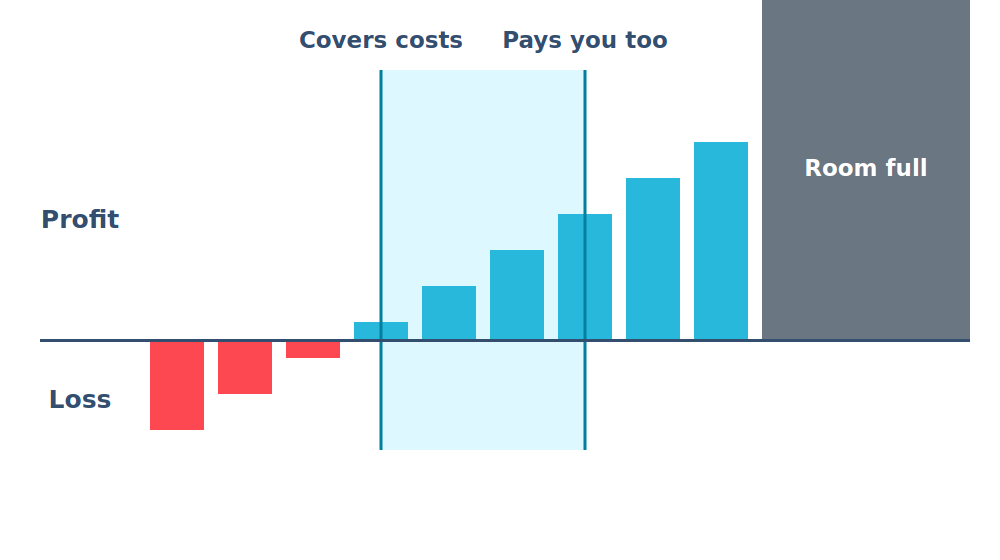
With JavaScript off this page cannot do the arithmetic, so here is the worked example already filled in above: a six session pottery course at $195 a student, a $540 room and $28 of materials a head needs 4 paying students to cover what you pay out, and 7 before it also pays you $40 an hour for your 12 hours in the room.
This one works in this roomThe 3 students between the cash floor and your-time floor move the result by $501.00.
$167.00 is what one more paying student leaves behind.
12 seats in the room. 0 already spoken for. 12 left to sell.
Your 12.0 hours on this class, priced at $40.00 an hour.
- Loss
- Profit
- Past this line the room is full.
Counts are rounded up to whole students. Three point two students is four. Every figure here is arithmetic on numbers you typed. No averages, no benchmarks, no suggested prices. A planning estimate from your own figures, not an accounting statement, and no determination about tax, payroll or employment status.
Reduced-price seats keep the amount you typed. Raising the list price does not raise theirs.
Copy the link and the whole class comes back exactly as you left it.
What this class costs before anyone enrolls
And what comes off each seat
Profit and loss at every enrollment
| Paying students | Seats filled | Profit or loss | With your hours paid |
|---|---|---|---|
| 0 | 0 | -$540 | -$1,020 |
| 1 | 1 | -$373 | -$853 |
| 2 | 2 | -$206 | -$686 |
| 3 | 3 | -$39 | -$519 |
| 4covers what you pay out | 4 | $128 | -$352 |
| 5 | 5 | $295 | -$185 |
| 6 | 6 | $462 | -$18 |
| 7also pays your hours | 7 | $629 | $149 |
| 8 | 8 | $796 | $316 |
| 9 | 9 | $963 | $483 |
| 10 | 10 | $1,130 | $650 |
| 11 | 11 | $1,297 | $817 |
| 12 | 12 | $1,464 | $984 |
Past this line the room is full.
Run it, reprice it, move it, or cancel
Tell us how many are signed up and what you have already committed, and this becomes a decision instead of a forecast.
This assumes you refund everyone in full if you cancel.
This compares one class against itself. It knows nothing about what else that room and that evening could have been used for.
What the free and discounted seats cost
Each line is measured on its own, with the other left as it is. Dollar effects use the original cash-floor headcount. Because counts round up to whole students, the two lines will not always add up to the total.
Your three versions, side by side
| Call this version | paying students to cover what you pay out | paying students to cover that and pay you for your hours | Profit or loss |
|---|
Everything you entered
This is a planning estimate built from figures you typed, not an accounting statement, and it makes no determination about tax, payroll or anyone's employment status. Take the numbers to your accountant before you commit the room.
https://distinguishedteaching.com/tools/class-profitability-calculator/
How the two numbers are worked out
Start with what the class costs you before a single person signs up. The room for the whole run, whatever you spent on flyers, the equipment you rented, the share of insurance you decided this class should carry. If someone else is teaching it, their pay goes here too. The exception is an instructor you pay per head. That's a different animal, and we'll come back to it.
Then the money that only happens because one more person enrolls. Clay, handouts, a take-home kit, the card fee on their payment. That comes off their price before anything else does.
What is left after ordinary per-seat costs is the seat's contribution before any greater-of instructor pay. With a flat, per-head or revenue-share arrangement, divide the first number by that contribution and round up, because two thirds of a student is not a student. With greater-of pay, we calculate each pay branch and keep only an answer that actually belongs to that branch. Either way, the result is your first floor: the number of paying people who cover what leaves your bank account.
Now the second one. You told us your hourly rate and how long the sessions run, so we know what your own hours on this class are worth. Add that to the costs and divide again. That's the number of people who cover the class and pay you for standing in the room.
A spreadsheet that stops at the first floor can make a class look fine on paper while quietly leaving the owner's time unpaid.
Three things move the answer more than they seem to. A free trial seat pays nothing, eats materials and takes a chair, so it can push the number up. A discounted seat can leave less behind than the sticker discount suggests, because the costs attached to that seat don't shrink when the price does. And an instructor paid per head isn't a fixed cost at all: every seat you fill pays them again, which flattens what each seat leaves behind.
Nothing here is an average, a comparison or a suggestion. We don't keep a rate table, and we never will. Every figure above is arithmetic on numbers you typed.
The day you have to decide
There's a date on this decision. The day the room deposit stops being refundable, the day the instructor has to be told, the day enrollment closes. On that date the number you started with is the wrong one to use.
By then, some of what this class costs is already gone: the deposit is paid and the flyers are printed. Canceling won't bring that money back. It just means you spent it on nothing. The only costs your decision can still change are the ones you haven't committed yet.
So the question stops being "does this class break even" and becomes "which of these two costs me less". Cancel, and you lose everything already committed and take in nothing. Run it half full, and you lose whatever the gap is between what the seats bring in and what the class still costs you.
Sometimes running a class that loses money is the cheaper of the two. Don't take that as permission to teach at a loss, or as a strategy. The arithmetic covers one specific evening, when part of the money is already spent.
It has two limits. This compares one class against itself. It knows nothing about what else that room and that evening could have been used for, and if the answer is "a class that would have filled", this is the wrong comparison to make. And a class that only clears its avoidable costs isn't one to run again next session at the same price.
Tick the costs you've already committed and the calculator will show you both losses side by side, with the enrollment where running stops being the worse of the two.
Questions studio owners ask about class break-even
How many students does a class need to run?
However many it takes to cover what the class costs you, which is a different number for every class and usually a smaller one than people fear. A six-session pottery course with a $540 room and $28 of clay a head needs four paying students at $195 to stop losing money. The same class needs seven before it also pays the person teaching it.
How do I work out my break-even number of students?
Take everything the class costs whether one person shows up or the room is full. Unless the instructor is paid the greater of flat or per-head, divide that cost by what one paid seat leaves after its own costs - price minus materials, the card fee and any per-head instructor pay - then round up. With greater-of pay, calculate each branch separately. The rounding matters: three point two students means four.
Should I count my own teaching time as a cost?
Yes, and we default to yes because the damage runs one way. Treat your Saturday as free and you'll build a class that looks profitable and pays you less than you'd earn covering somebody else's. Price your hours, see the second number, then decide. If you'd rather take whatever is left over as your pay, the calculator will show you what that works out to an hour.
What percentage of the room should I plan to fill?
That's your call, not ours, and the calculator asks for the number you believe rather than proposing one. What it will tell you is whether your break-even sits above the seat cap. If it does, no amount of marketing fixes the class: the price, the room, or the length of the run has to change. Capacity here is a limit to divide by. It's never a target to push up.
Should I cancel a class with low enrollment?
Depends entirely on what you've already spent. If the room is paid for and the ads have run, canceling loses you all of it and brings in nothing, while running half full at least recovers something. Tick the committed costs and the calculator puts both losses side by side. Sometimes the answer is cancel. It turns entirely on how much of the money has already gone.
What does a free trial seat actually cost me?
The materials it eats, plus the chair it occupies, plus any per-head pay your instructor earns for the person sitting in it. In a pottery course that can be real money. In a yoga class where the teacher is on a revenue share and there are no materials, a free trial costs nothing in cash. It costs you a seat. The calculator prints both halves.
Can I lower the number of students I need?
Three levers, and they're the three the calculator prices. Raise what each seat leaves behind, by raising the price or trimming what each student costs you. Cut the fixed side, usually the room or the length of the run. Or change how the instructor is paid, because a per-head deal and a flat fee behave completely differently at low enrollment.
Why doesn't this tell me what to charge?
Because that's a different question with a different answer. This page starts from a class you've already priced and asks whether it runs. If you're still deciding the number of dollars in the first place, a rate calculator is the tool for that, not this one. Any price this page prints is what your own costs require, never what the market pays.
Does this include tax?
No. Everything here is pre-tax, in your own dollars. Whether instruction, materials or a take-home kit is taxable is a state-by-state question with no national answer, so enter your price net of any sales tax you collect and remit. Payroll is the same story: the burden field takes your number and the calculator asserts no rate.
Why a class can look full and still lose money
A class can feel busy and still lose money. The number in the room is only one part of the calculation.
Three things do that. The first is the room, which doesn't care how many people turn up. Book it for eight Saturdays and you owe eight Saturdays' worth, whether the number in the room is four or fourteen. The room itself does not change with headcount. What each extra seat adds after its own costs depends on how the instructor is paid.
The second is the seat that pays less than the sticker. A comped place for a friend of the studio. A sibling rate. A free trial that turns into three free trials because the front desk is kind. Each one still uses clay, still uses a chair, and may still earn the instructor a per-head fee. When a seat has its own costs, a 20% discount cuts more than 20% out of what that seat leaves behind, because the costs stapled to the seat don't shrink alongside the price.
The third is the owner's own hour. Leave it out, and one person is working unpaid. Somebody teaching their own Tuesday-night class for nothing has built a business that runs on their unpaid time. That can be a deliberate choice in a first season. It should be a choice, though, not something you find out in March.
There's a fourth thing, and it only shows up at the deadline. By the time you know how many people signed up, part of what the class costs is already spent. The deposit is gone whether you teach or not. From that point the decision isn't "is this class profitable" but "which of these two costs me less", and the answer flips depending on how much of the money has already left. A class worth canceling in June is sometimes worth running in September, on identical numbers, purely because the room is already paid for.
You won't need an industry yardstick or anyone else's averages for any of this. Bring your room, your price, your seat cap and an honest count of the people actually signed up.
Terms used on this page
- Fixed cost for this class
- money you owe whether one student or a full room enrolls.
- Variable cost per student
- money that only happens because one more person enrolls.
- Contribution per seat
- what one paid seat leaves after ordinary per-seat costs, before any greater-of instructor pay.
- Break-even
- the smallest whole number of paying students at which the class stops losing money.
- The cash floor
- the students who cover the money leaving your bank account.
- The your-time floor
- the students who cover that and pay you for your hours.
- Seat cap
- the limit the room, your insurer or your ratio already sets. We divide by it and never propose it.
- Seats for sale
- the cap, less the comped and reduced-price seats already spoken for.
- Comped seat
- a free place. It pays nothing, uses materials and takes a chair.
- Reduced-price seat
- a sibling rate, an early bird, a staff place. It pays less than list.
- Committed cost
- money you cannot get back if you cancel today.
- Avoidable cost
- money you have not spent yet and would not spend if you canceled.
More for instructors with us
-
Your category with us
Parents and adult beginners find classes like yours on our category pages, city by city.
Yoga studios with us, Pilates studios, Dance classes, Pottery and ceramics classes, Martial arts classes, Swim lessons, Personal trainers and gyms, or All categories.
-
Your own listing
This is the other half of what we do. We send US instructors free leads, charge nothing to access matched clients, take no referral fee, and the client pays you directly.
-
Related tools on this site
Two more for the same desk, built the same way. You don't sign up for either one, and neither sends what you type anywhere.
A cancellation policy with no holes in it
Reply before they book someone else
Not committing a room tonight, just reading? We also publish Learning and activity guides.